AI Agents Push Legacy Payment Rails to the Brink, Fueling Shift to Stablecoins: Visa-Artemis Report
Legacy payment networks struggle with high-frequency machine transactions, paving the way for onchain stablecoin alternatives.
The legacy financial system was built for humans. When a human buys a coffee, they tap a card, triggering a multi-party settlement process involving issuing banks, acquiring banks, card networks, and payment processors. This system handles low-frequency, high-value transactions relatively well. But what happens when an autonomous artificial intelligence agent needs to purchase API access, query a database, or buy a fraction of a compute hour every few seconds?
According to a joint report released Wednesday by payments giant Visa and investment thesis platform Artemis, the incumbent global card payments infrastructure is facing a major structural bottleneck. Legacy networks are fundamentally struggling to process high-frequency micropayments initiated by autonomous software agents.
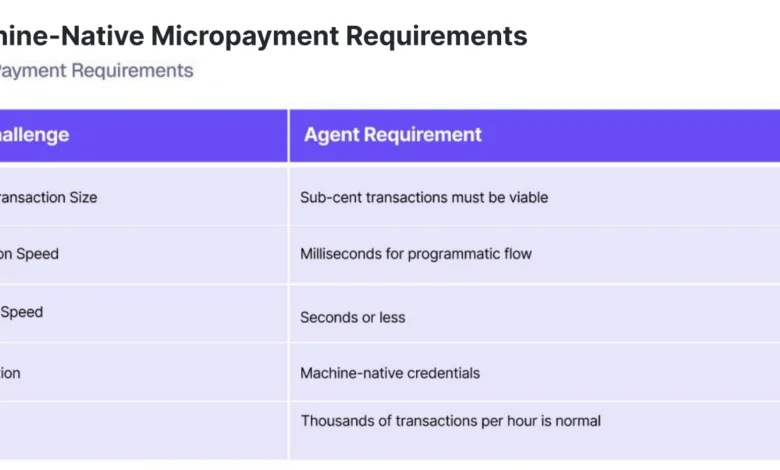
The report highlights that traditional cards, designed for human-scale commerce, are ill-suited for the demands of “agentic micropayments.” For autonomous commerce to become commercially viable, AI agents require a transactional infrastructure characterized by near-zero fees and near-instant settlement—features that traditional card networks simply cannot provide in their current state.
This infrastructure gap has become an urgent challenge because AI capabilities are advancing at an exponential rate. According to the Visa and Artemis report, AI agents crossed a key capability threshold in mid-2025. This milestone enabled them to autonomously discover unfamiliar APIs, evaluate prices, and decide on autonomous payments without human intervention.
When an AI agent can independently negotiate terms and execute transactions, the volume of payments changes from a linear flow to an exponential one. Instead of a human making five to ten transactions a day, a single AI agent might execute thousands of micro-transactions per hour. Under traditional card payments infrastructure, the standard interchange fees and processing costs—often structured as a flat fee plus a percentage—would completely wipe out the economic viability of a transaction worth fractions of a cent.
To bypass the limitations of legacy payment rails, developers are increasingly turning to blockchain networks, where transaction fees on Layer-2 scaling solutions cost fractions of a cent and settle in seconds. This shift could trigger massive growth in the digital asset space. Earlier this week, Australian crypto exchange Swyftx projected that AI-enabled microbusinesses could drive an additional $262 billion in stablecoin volume by 2033. This projection is based on an assumed adoption rate of about 33% for AI-native payments settled in stablecoins.
Stablecoins offer a native digital currency layer for the internet, allowing machines to hold balances, sign transactions cryptographically, and settle value globally without needing a traditional bank account. This makes them the ideal medium for machine-native micropayments.
We are already seeing early signs of real-world adoption for these machine-native payment frameworks. One notable example highlighted in the report is the x402 payment protocol, an open standard developed by Coinbase. The x402 payment protocol has processed $15 million in adjusted volume across over 109 million adjusted transactions since it was launched in May 2025. The protocol experienced a dramatic surge in October 2025, when its monthly transaction count rose from 40,000 to 3.8 million, leading to 38 million transactions processed in October alone. This rapid acceleration underscores the pent-up demand for lightweight, programmatic payment rails.
However, the transition to an AI-driven economy does not necessarily mean the complete demise of traditional card networks. Instead, industry leaders are looking for ways to bridge the gap between legacy fiat systems and onchain environments. The Visa and Artemis report suggests that a single machine-payments framework could support both stablecoin and traditional card transactions, creating a path into agentic payment flows for card networks.
A prime example of this cross-compatible infrastructure is the Machine Payment Protocol (MPP) developed by Stripe-backed fintech firm Tempo. The Machine Payment Protocol now spans both onchain crypto payments and fiat payments via shared payment tokens. To facilitate this integration, Visa has introduced its Card Specification SDK, which is designed to extend the protocol into card-based agent commerce, allowing traditional card credentials to be utilized within autonomous machine-to-machine environments.
The convergence of AI and Web3 payments has triggered a development race among major financial players. In March, both Visa’s crypto division and Tempo launched dedicated AI payment tools. Visa’s solution is designed to allow AI agents to make same-day payments, addressing the multi-day settlement delays that plague traditional banking. Meanwhile, Tempo debuted its Machine Payment Protocol in the same month, focusing on making it easier for AI actors to send and receive money seamlessly across both crypto and fiat rails.
As AI agents continue to assume more complex operational roles—from managing cloud infrastructure to executing automated trading strategies—the demand for specialized payment rails will only intensify. Whether through pure onchain stablecoin transactions or hybrid frameworks that link legacy cards to smart contracts, the financial plumbing of the internet is being rebuilt to accommodate a new class of economic actors: machines.