Bitcoin Consensus Under Fire: Saylor and Back Lead Charge Against BIP-110
Industry leaders warn that a proposed 'spam' filter could undermine Bitcoin's fundamental protocol stability.
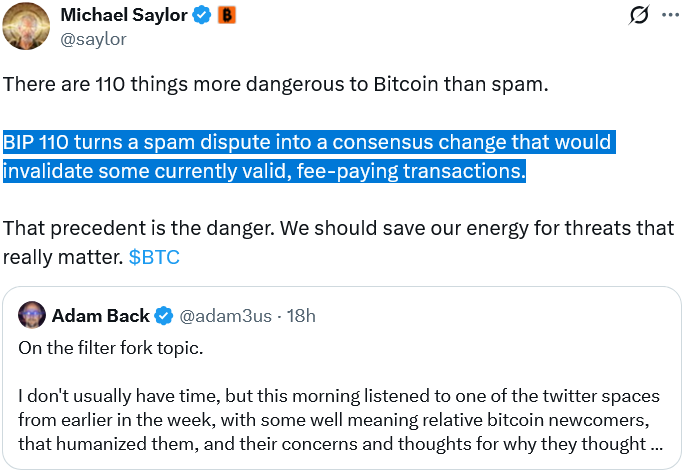
Michael Saylor and Blockstream CEO Adam Back have emerged as the primary institutional voices opposing BIP-110, a controversial proposal designed to purge non-monetary data from the Bitcoin blockchain. The proposal, which seeks to implement a temporary fork to restrict Ordinals and other “arbitrary” data, is being framed by its critics not as a solution to network congestion, but as a fundamental threat to the network’s stability and permissionless nature.
Saylor, the executive chairman of MicroStrategy, warned on Saturday that the proposal could inadvertently invalidate legitimate, fee-paying transactions. “There are 110 things more dangerous to Bitcoin than spam,” Saylor stated via X, arguing that BIP-110 risks transforming a dispute over network usage into a dangerous consensus change.
The proposal, introduced by pseudonymous developer Dathon Ohm and supported by Ocean protocol founder Luke Dashjr, aims to preserve Bitcoin’s primary function as a peer-to-peer electronic cash system. Proponents argue that the “bloat” caused by Ordinals inscriptions represents a “serious threat” that requires an immediate, albeit temporary, one-year fix.
However, Adam Back dismissed the initiative as a “quest to police other people,” asserting that such restrictions are incompatible with the decentralized consensus models that define the Bitcoin protocol. Back emphasized that the ability to use the network without seeking permission or facing censorship is central to the asset’s value proposition.
The debate echoes the “Blocksize Wars” of 2015–2017, a seminal period in Bitcoin history where the community split over how to scale the network. Unlike that era’s high-stakes drama, BIP-110 currently lacks significant momentum. Activation requires support from 55% of Bitcoin nodes over a specific period; during the most recent window between blocks 955,584 and 957,599, support languished at just 1% according to network data.
The push for a fork also arrives as the very activity it seeks to curb is in steep decline. Daily Ordinals inscriptions have plummeted from a peak of over 400,000 in August 2023 to fewer than 10,000 per day over the last month.