OpenAI’s $230 Codex Micro Keyboard Triggers Secondary Market Craze and Voice Computing Test
The limited-edition peripheral designed with Work Louder sold out in hours and serves as a testing ground for voice controls.

When OpenAI released its first physical product on July 15, tech enthusiasts expecting a futuristic consumer device were instead met with a $230 custom key pad. Yet, the Codex Micro—a 12-key peripheral designed specifically for software developers—sold out completely within 12 hours, sparking an immediate secondary market speculative rush.
In the days following the launch, resale prices spiked dramatically. On July 16, a single unit changed hands for $1,250 on secondary channels, with subsequent listings pushing asking prices as high as $1,850. While secondary market values have since normalized to around $450, buyers across the United States, France, Ireland, and the Netherlands continue to trade the device at nearly double its original retail price on secondary auction platforms.
Developed in collaboration with boutique peripheral firm Work Louder, the square device features a multi-color LED ring, an interactive dial, a joystick, and neon illumination. The hardware serves as a physical extension for OpenAI’s Codex programming assistant—a direct competitor to Anthropic’s Claude Code. Developers can manipulate the dial to adjust how much computational effort the AI applies to a task, use the joystick to run automated debugging and code refactoring, and monitor execution states through color-coded LED lights that switch between red, orange, green, and blue.
The project grew out of an effort to revitalize OpenAI’s internal merchandise line, Supply Co. Initially established as an internal store for employees, Supply Co opened briefly to the public in December 2025 for the company’s tenth anniversary. After social media users mocked early apparel offerings like hoodies and tote bags, OpenAI reached out to Work Louder co-founder Mike Di Genova late that month to create a high-utility product tailored to developers.
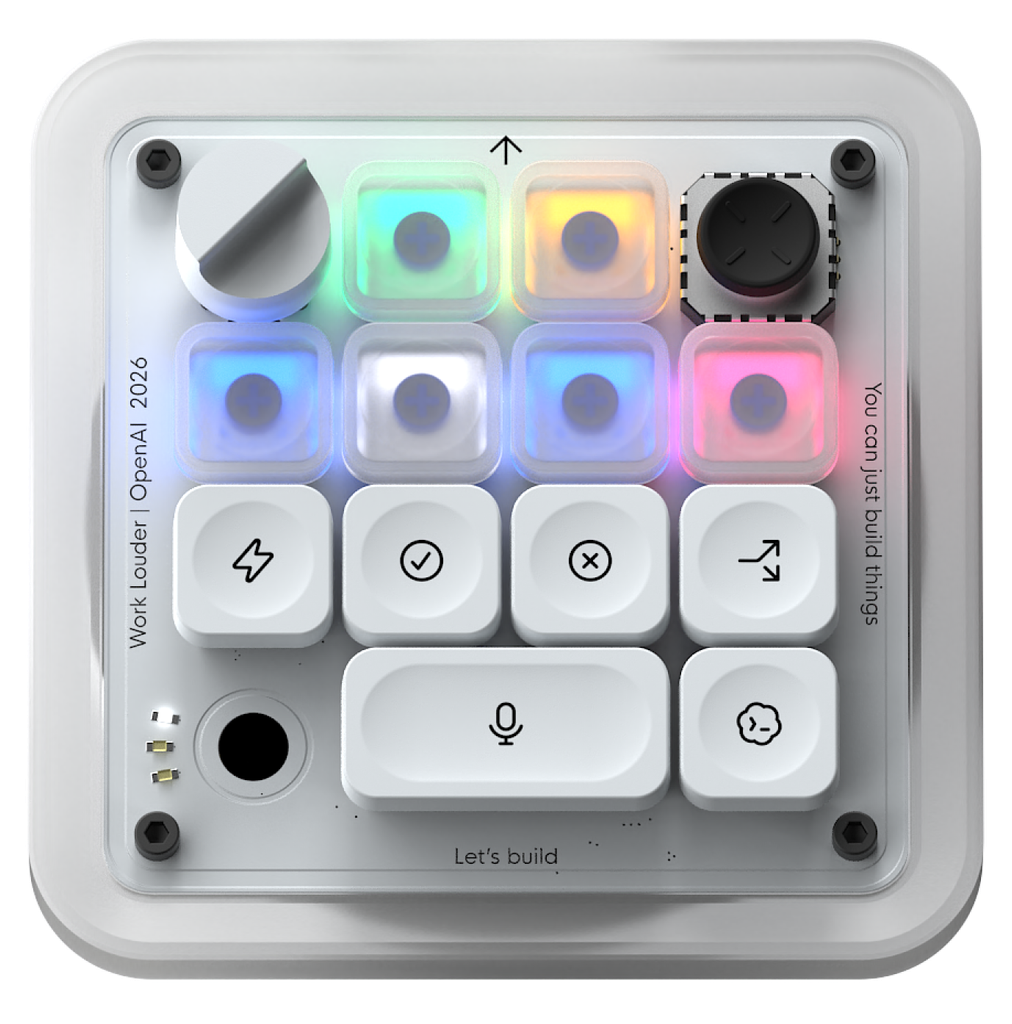
Despite the commercial demand, the device faced skepticism within technical forums. Several programmers noted that programmable macropads with physical knobs are available for as little as $18, while open-source software scripts can replicate similar AI status integrations on standard hardware. OpenAI has confirmed it has no plans to restock the branded unit, though Work Louder continues to offer an unbranded, black variant with identical software functionality.
Beyond its novelty, the Codex Micro serves an internal diagnostic purpose for OpenAI. The keyboard includes a dedicated physical microphone button designed to trigger direct voice input for coding prompts—a feature mirrored digitally in the recently launched ChatGPT Work desktop application. Company executives view voice interaction as a crucial shift in computing paradigms. OpenAI co-founder and president Greg Brockman has argued that voice interfaces represent the logical evolution of user input, predicting that conventional mouse clicks and manual typing will eventually be viewed as a temporary historical phase.
While the keyboard remains distinct from OpenAI’s forthcoming consumer AI hardware project being built alongside former Apple chief designer Jony Ive, telemetry and user feedback gathered from active Codex Micro units are being tracked in real time through a joint Slack channel between OpenAI and Work Louder. Di Genova framed the dynamic as evidence of an inverted software industry landscape, where physical hardware has become essential for AI firms attempting to differentiate their digital offerings.