TUSAŞ Advances ANKA 3 UAV to Final Test Phase
CEO says Turkish Air Force may order over 50 units starting 2026
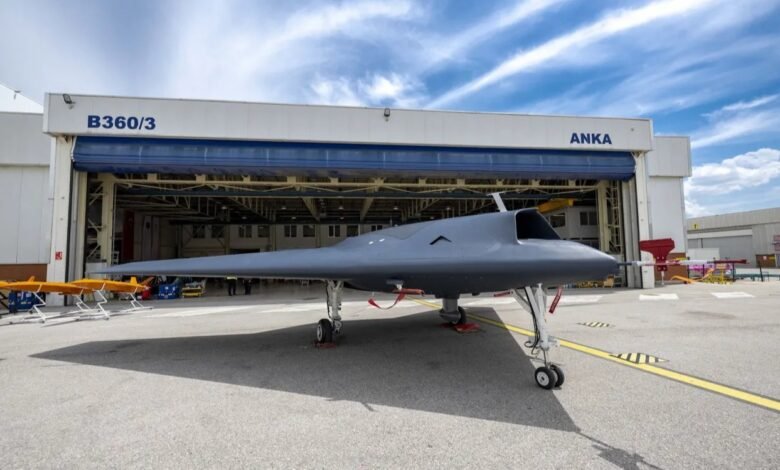
Turkey’s latest combat drone is no longer being treated inside the program as a test aircraft.
After a new round of flight trials, Turkish Aerospace Industries has cleared its ANKA 3 unmanned aircraft for what company officials describe as advanced system validation — a stage usually reached when a platform’s basic design is considered settled.
The aircraft differs sharply from earlier ANKA variants. It uses a jet engine and a flying-wing layout, a combination intended to reduce detection rather than extend endurance. That choice reflects how Turkish planners now view the role of unmanned aircraft in higher-risk airspace.
Flight activity has picked up quietly. By the end of last year, the ANKA 3 had logged more than 40 sorties, several of them focused on autopilot behavior rather than performance limits. Engineers involved in the work say the emphasis has shifted toward system reliability, not experimentation.
A formal design freeze was approved earlier this year, ending major airframe changes. Two revised prototypes are now scheduled for assembly, a step that allows production planning to move forward without constant configuration updates.
Military planners expect the Turkish Air Force to begin procurement discussions in 2026, with internal estimates pointing to an initial batch of over 50 aircraft. No contract has been signed, but programs at this stage typically begin parallel work on training concepts, spares management, and long-term support structures.
The ANKA 3 is designed to operate around 40,000 feet for roughly ten hours and carry up to 1.6 tonnes of payload. Internal bays are intended for strike missions where detection matters, while external pylons remain available for less constrained operations.
The aircraft is expected to fly with Aselsan’s MURAD 100-A radar, enabling targeting and electronic-warfare functions. Its current engine is believed to be sourced from Ukraine, while Turkish manufacturer TEI continues development of a domestic alternative.
Inside TUSAŞ, the language around the program has changed. Engineers now refer to the ANKA 3 as a system approaching service use rather than a prototype. Production is being planned along a standardized assembly line, a choice meant to limit costs as the aircraft moves toward fleet introduction.