
EA Sports FC 27 Rebuilds Clubs Around a 100-Player Social World
The Grounds, Masteries, and Amps reshape EA Sports FC 27 Clubs
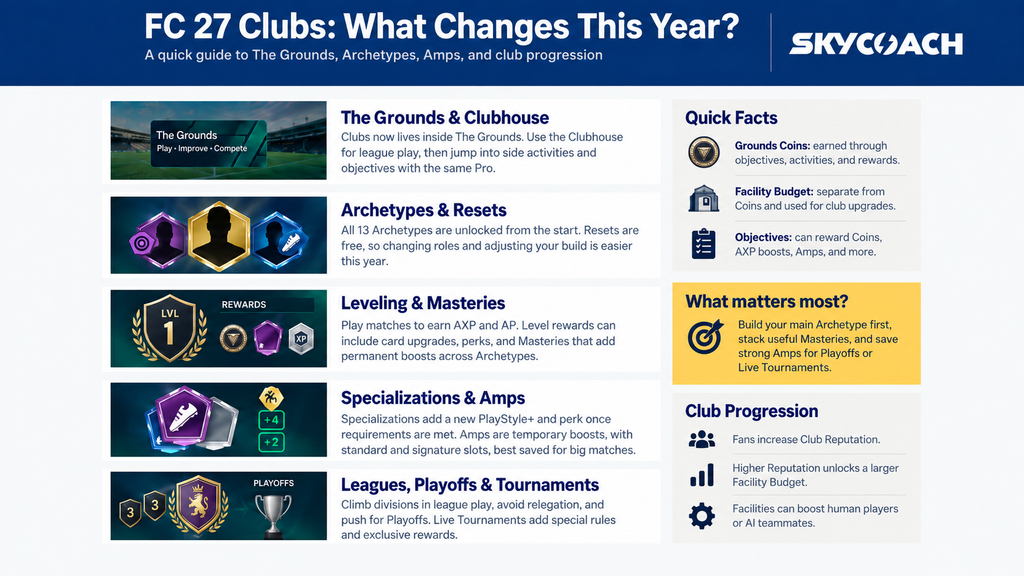
EA Sports FC 27 introduces a major redesign of Clubs, placing the traditional 11v11 online team experience inside The Grounds, a persistent, real-time social world capable of hosting up to 100 players in each instance. The change is among the mode’s largest since the franchise moved away from the FIFA name in 2023.

The new ecosystem will be exclusive to current-generation hardware: PlayStation 5, Xbox Series X|S, PC, and Nintendo Switch 2. PlayStation 4, Xbox One, and the original Nintendo Switch will not support The Grounds, the expanded Clubs feature set, or its interconnected gameplay modes.


Cross-play remains available between PlayStation 5, Xbox Series X|S, and PC. Players on those platforms can share lobbies, compete in unified league structures, and occupy the same The Grounds instances. Nintendo Switch 2 users will instead play within a dedicated cross-play pool separate from Xbox, PlayStation, and PC clusters.
The platform split follows EA’s effort to use modern hardware capabilities. Pro Clubs first appeared in FIFA 10 after an initial 10v10 trial in FIFA 09, using static lobbies and matchmaking menus. EA Sports FC 24 changed the name to Clubs and added cross-platform play between equivalent console generations.
Inside The Grounds, traditional menu screens give way to physical locations across four districts: Central Terrace, Montclair, Zeiza, and Parkside. Each district draws on a different regional football culture and includes street courts, practice pitches, and public gathering areas.

Players navigate the world in third person as their customized Virtual Pro avatar. The Clubhouse functions as the headquarters for competitive squads, with League fixtures, Playoff ladders, squad management tools, and facility upgrades available there. Traditional Drop-In matchmaking for unranked and pickup games takes place at the 11v11 Stadium.
Rush Stadium is dedicated to small-sided football, including Ranked Rush and specialized Rush Tournaments. Rush was originally introduced to the franchise in EA Sports FC 25. Street Courts and Open Pitches support casual activities that range from 1v1 skill duels to informal team Kickabouts.
Four NPC Mentors are positioned around the map. Alex Hunter, the fictional protagonist of EA Sports’ The Journey story mode from FIFA 17 through FIFA 19, handles core player development and attribute progression. Kylian Mbappé focuses on small-sided street football, ball skills, and creative playmaking, while Chloe Kelly oversees casual Kickabout activities and open-world street challenges. Paulo Dybala is linked to organized Club fixtures, stadium events, and tournament play.
The competitive structure still uses a division ladder. Squads begin in lower divisions, earn points, and pursue promotion toward the Elite Division, while teams that fail to meet minimum seasonal point thresholds continue to face relegation penalties.
Clubs Playoffs take place at the end of each league season. A team’s division determines its entry bracket, and final percentile standings produce Champion, Runner-Up, Competitive, Mid-Table, Also-ran, or Participant rewards. Better finishes provide more Fans, Grounds Coins, stadium trophies, and organizational cosmetics.

Alongside the main League queue, Clubs Live Tournaments offer limited-time formats with rotating rules and distinctive rewards. A tournament might award two points for goals from outside the penalty area or increase header success rates, requiring teams to adapt their Archetype loadouts and Amp configurations to the event’s mechanics.
Player creation removes the former progression gates. All 13 player classes are available as soon as a character is created, rather than requiring in-game currency or lengthy skill-tree requirements to unlock advanced Archetypes.

Respeccing also becomes free. Players can change individual stat distributions or rebuild an entire character without consumables or virtual currency, directly from match lobbies in the Clubhouse, Rush lobbies, or The Grounds hub.
An Archetype now determines a character’s physical framework separately from tactical role and pitch position. A Virtual Pro could use the defensive physical framework of the Boss Archetype at Left Center-Back while being assigned the Ball-Playing Defender role in team strategy menus.
The 13 base Archetypes are divided among five positional groups: Goalkeeper includes Shot Stopper and Sweeper Keeper; Defender includes Progressor, Boss, and Marauder; Defensive/Central Midfielder includes Disruptor and Recycler; Midfielder/Creator includes Maestro, Creator, and Spark; and Forward includes Magician, Finisher, and Target.
Virtual Pro progression uses Archetype Experience Points, or AXP, earned from matches, world events, and completed training tasks. Progress along an active Archetype’s linear track awards Attribute Points, playstyle card upgrades, Signature Perks, and Mastery thresholds.

AXP can be accelerated with AXP Consumables or targeted Instant AXP rewards from organized Club Tournaments. Some consumables work across multiple build groups, allowing players to improve undeveloped Archetypes without playing fixtures in those positions.
Masteries add a cross-specialization progression layer. Reaching level milestones on an individual class grants permanent attribute increases across all Archetypes, so developing a secondary build can benefit a player’s primary one. Leveling Finisher, for example, unlocks universal Composure and Finishing bonuses that remain active even after switching to a midfield or defensive Archetype.

The Mastery pool receives two primary stats from each Archetype: Shot Stopper provides GK Positioning and GK Reflexes; Sweeper Keeper provides GK Handling and GK Diving; Progressor provides Long Passing and Standing Tackle; Boss provides Aggression and Strength; Marauder provides Sliding Tackle and Sprint Speed; Disruptor provides Stamina and Interceptions; Recycler provides Defensive Awareness and Short Passing; Maestro provides Reactions and Ball Control; Creator provides Free Kick Accuracy and Vision; Spark provides Crossing and Dribbling; Magician provides Curve and Acceleration; Finisher provides Composure and Finishing; and Target provides Balance and Jumping.
Temporary performance boosts come through the Amp system. An active Archetype can carry three Amps at once: two Standard Amp slots and one Signature Amp slot.

Amps expire after a set number of competitive appearances in Stadium matches or open-world Rush fixtures. Tier 1 Standard Amps provide baseline numerical attribute increases, while Tier 2 Standard Amps deliver larger numerical boosts. Tier 3 Signature Amps add elevated attribute stats, specialized PlayStyles, and active Perks. Tier 4 Signature Amps offer the maximum attribute bonuses, signature PlayStyle+ enhancements, and elite Perks.
Additional Amps can be obtained through seasonal progress tracks, live in-game events, dynamic Objectives, and the internal in-game store.
The Grounds uses its own economy. Grounds Coins come from open-world tasks, daily and weekly objectives, and competitive Playoff placements, and can be spent on Amps, avatar cosmetics, and consumable progression boosts in the Clubs hub. FC Coins remain primarily part of the EA Sports FC Ultimate Team ecosystem, where they support Transfer Market transactions and squad pack purchases.
Club development uses a third resource, the Club Facility Budget. This non-currency allocation is given to Club Managers for temporary or permanent operational upgrades.

The overall Club grows by gaining Fans, increasing Club Reputation, and managing Facilities. Player Facilities improve attribute stats and PlayStyles for human-controlled teammates, while AI Facilities raise the attributes and defensive or offensive abilities of CPU-controlled squad members during fixtures.
Facility upgrades are funded only through the Club Facility Budget, which expands as a Club builds its Fan base and increases its Reputation level. Managers can freely reallocate those funds: a standard Running Track that supplies +2 Sprint Speed and +3 Stamina can be unequipped so the budget can be assigned to technical or defensive cards without losing points.
Club Objectives add further organizational resources through Weekly, Seasonal, and Elite tiers. Their rewards include Grounds Coins, specialized Amps, and operational consumables, with both solo hub activities and team fixtures contributing to the Club’s development pipeline.