Central Banks Ditch New York Fed for London Gold Vaults
Sovereign institutions are routing bullion to the Bank of England to guarantee liquidity rather than simply shipping it home.

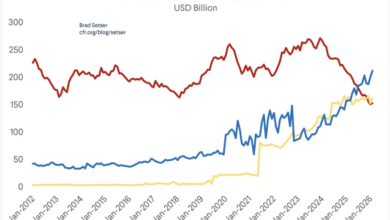
France emptied its gold vaults at the Federal Reserve Bank of New York between July 2025 and January 2026. Weeks later, De Nederlandsche Bank (DNB) pulled more than 78 tons out of the same facility, rerouting it to London alongside seven tons previously held in Canada.
The withdrawals mark a structural shift in how sovereign institutions manage bullion. Rather than rushing reserves back to domestic soil, central banks are funneling holdings into the Bank of England, prioritizing immediate access to the world’s deepest physical trading market over simple repatriation.
DNB governor Olaf Sleijpen framed the transfer around “increasing geopolitical unrest” and “crisis preparedness.” He noted that while the bank expects never to liquidate the metal under duress, storing it in London guarantees liquidity if that calculation changes. The U.S. dollar’s decoupling from the gold standard in the early 1970s triggered the first long decline in foreign deposits at the New York Fed, which once held peak volumes during and after World War II. Current stockpiles sit at roughly half that high-water mark.


Krishan Gopaul, a senior analyst at the World Gold Council, wrote last month that these transfers represent a distinct operational phase. “Heightened geopolitical uncertainty has increased attention on jurisdiction, access during a crisis and exposure to overseas financial infrastructure,” Gopaul said. He noted that recent moves by France and DNB prove the strategy no longer defaults to domestic storage alone. Institutions are now optimizing across custody risk, physical accessibility, and market liquidity simultaneously.
European governments have pushed their monetary authorities to accelerate the exit from U.S. vaults. Lawmakers in Germany and Italy — holders of the second- and third-largest national reserves globally — recently demanded further repatriations, citing President Donald Trump’s hostility toward Europe, including his threats to seize Greenland.
Germany’s central bank rejected those demands. Officials argued that Washington would damage its own standing in global financial markets by threatening foreign deposits. That assurance carries less weight than it did a decade ago. Germany transferred 930 tons from London to Frankfurt in 2000 and moved another 674 tons from New York and Paris to Frankfurt between 2013 and 2017, according to the World Gold Council. The Netherlands shifted 122.5 tons from New York to Amsterdam in 2014. Austria brought 90 tons home from London between 2015 and 2018.
Outside Europe, Venezuela repatriated 160 tons between 2011 and 2012. India has accelerated its own relocation pace since 2023.
Gopaul cautioned that moving metal does not signal an intent to sell. Some central banks are increasing domestic storage while others spread assets across multiple overseas locations, treating diversification of custody as the primary objective. Security alone is no longer enough, he said. Gold must be tradable and distributed across jurisdictions that remain dependable under stress.