Bill Would Ban Federal Candidates From Betting on Own Races
The legislation establishes civil fines up to three times the net gain and grants trading platforms legal immunity for blocking suspect accounts.
Federal candidates and their immediate families would be prohibited from profiting off prediction market contracts tied to their own elections under legislation introduced Monday in the U.S. House.
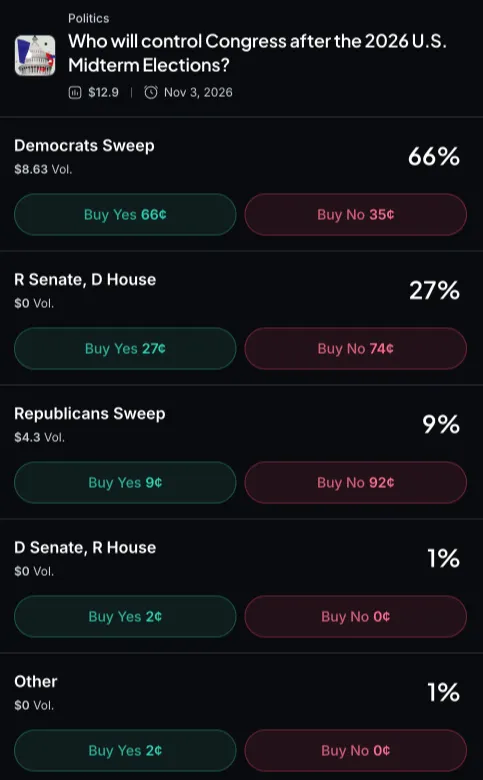
The No Betting on Your Own Race Act, sponsored by Representative Don Davis (D-NC), targets a growing vulnerability at the intersection of campaign finance and unregulated derivatives trading. As platforms like Kalshi and Polymarket have surged in popularity during recent election cycles — with Polymarket processing billions of dollars in volume around the 2024 presidential race — the incentive for political insiders to wager on outcomes they can directly influence has intensified.
Davis framed the proposal using a sports analogy. “We don’t want our athletes to bet on their games,” he wrote on social media, noting that candidates across party lines have already engaged in the practice.

The bill amends federal election law to establish civil penalties of $10,000 per violation or three times the net financial gain, whichever is higher. Unlike existing insider trading statutes enforced by the Securities and Exchange Commission, which focus on corporate securities, this legislation addresses event contracts regulated primarily by the Commodity Futures Trading Commission. The CFTC oversees these markets as swaps, creating a jurisdictional gap that leaves candidate-specific wagers largely governed by platform terms of service rather than statutory prohibitions.
The prohibition extends well beyond a candidate clicking a buy button. It covers spouses, dependent children, authorized campaign committees, and any beneficial interest held under alternative titles. Indirect exposure is also criminalized, including funding another person’s position with knowledge of its purpose or inducing someone else to execute a trade. Covered contracts include those settling on outright victories, vote shares, margins of victory, placement among competitors, and whether an individual remains in a race at all.
To enforce these restrictions, the legislation shifts significant compliance burdens onto the exchanges while simultaneously shielding them from liability. Platforms acting in good faith to restrict, suspend, or close accounts — or to cancel, void, or unwind positions — would receive legal immunity. They could report suspected violations directly to the CFTC, the Department of Justice, or the Federal Election Commission without notifying the account holder.
This safe harbor provision addresses a core challenge for prediction markets: verifying user identities against constantly changing candidate rosters. To solve this, the bill mandates that the FEC publish a free, machine-readable database of every federal candidate, updated at least weekly. The list would include names, commission identifiers, offices sought, and entry and exit dates. State election boards and the FEC would also be required to notify individuals of the trading ban when they file candidacy paperwork.
A divestment window provides a narrow exception. If a trader holds a position that suddenly becomes a restricted contract because the underlying subject declares a candidacy, the individual would not face penalties during the minimum unwinding period permitted by the hosting platform.
Exchanges have attempted to manage the issue internally. Kalshi fined multiple congressional candidates earlier this year for betting on their own races and subsequently suspended offending accounts. However, self-regulation has proven insufficient as the market expands.
The CFTC has begun scrutinizing the manipulation risks inherent in these contracts. Agency staff recently warned exchanges that event contracts settling on the conduct of specific, named individuals should be presumed vulnerable to manipulation. In a separate but related enforcement action, the commission is investigating former Representative Adam Kinzinger over trades linked to his own presidential pardon.
While the Davis bill focuses strictly on candidates trading on themselves, broader legislative efforts have repeatedly targeted the entire prediction market sector. The CFTC previously blocked Kalshi from offering contracts on congressional control ahead of the 2022 midterms, though a federal judge later overturned that prohibition, fueling the current explosion in political event trading.
The definition of a political event contract within the new bill encompasses caucuses, nominations, control of Congress, and any other governmental event the CFTC designates by rule. The ban applies to conduct occurring from the date of enactment.