

AI Is Closing the Corporate Door on Young Professionals
Young workers face a shrinking path into white-collar careers
A quiet fracture is spreading through the U.S. labor market. The broader American economy continues to post resilient job growth, yet elite corporate sectors are sharply reducing hiring, putting the youngest generation of professionals at risk of losing access to entry-level careers.
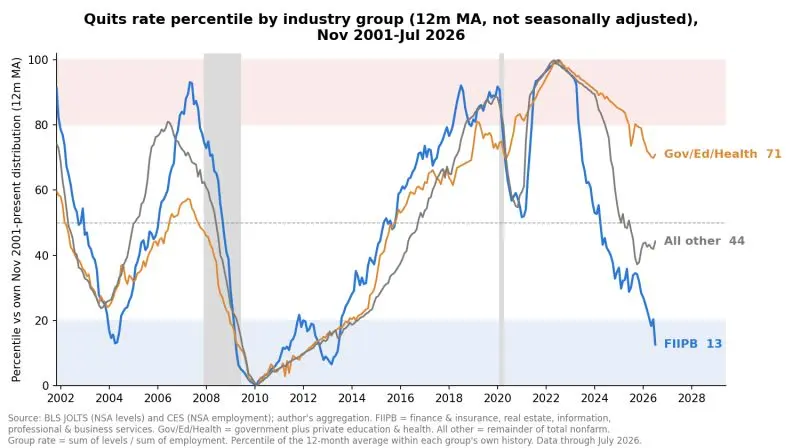
The contraction is concentrated in finance, insurance, information, and professional and business services, collectively known by economists as the FIIPB industries. Total employment in the FIIPB sector peaked in early 2023 and has declined since then. “People quit when they have somewhere to go, and in a sector that’s shedding jobs there’s nowhere to go,” said Gad Levanon, chief economist at the Burning Glass Institute.
Levanon measured each industry’s voluntary quits rate against its own 25-year historical average rather than comparing raw figures across sectors. His analysis identified three labor-market tiers that have diverged sharply since 2022. In FIIPB industries, the quits rate has fallen to 1.8%, down 28% from the 2019 level of 2.5%, the lowest voluntary turnover rate since 2013 and the bottom 13th percentile of the sector’s quarter-century historical range.


The rest of the private economy is at the 44th percentile of its historical norm, while government, education, and health care stand at the 71st percentile. “Job hugging is real, but it’s mostly happening in one part of the economy,” Levanon noted.
The Job Openings and Labor Turnover Survey, published monthly by the Bureau of Labor Statistics, recorded a 188,000 decline in professional and business services hiring in July alone, even as job openings across the country remained stable. Companies have increasingly relied on artificial intelligence for tasks once assigned to junior staff.
This shift follows the Federal Reserve’s March 2022 decision to begin its most aggressive monetary-tightening campaign in four decades. The central bank raised its benchmark interest rate from near-zero to a 23-year high of 5.25% to 5.50% by July 2023, ending the “Zero Interest Rate Policy” era. Corporate America moved from pandemic-era growth-at-all-costs hiring toward strict cost containment.
Although the initial shock from the rate increases has normalized, the professional-sector hiring freeze has widened. Levanon describes the development not as a temporary cyclical downturn but as a structural “decline in the labor intensity of white-collar work.” Output in these industries continues to grow while the human labor needed to produce it shrinks, as companies automate codifiable, routine, and formalizable tasks.
Two competing views have emerged over what AI means for work. Citrini Research’s “ghost GDP” thesis treats AI primarily as a labor substitute: routine cognitive work is automated, hiring dries up, and the fastest-moving firms increase profitability by shrinking payrolls. Behavioral economist Alex Imas’s “relational work” thesis instead treats AI as a complement to human labor, increasing the premium on tacit, contextual, and non-codifiable judgment.
Imas’s framework also warns that firms using AI strictly to replace headcount may misprice and degrade their own workforces. That concern is especially relevant to workers aged 22 to 25. A Stanford Digital Economy Lab working paper examined high-frequency payroll data from ADP, which processes payrolls for more than 25 million U.S. employees.
Economists Erik Brynjolfsson, Bharat Chandar, and Ruyu Chen found no evidence of mass layoffs across the economy. They did find that hiring for 22-to-25-year-olds in occupations heavily exposed to AI is 19% below the level it would have reached if it had kept pace with less-exposed occupations. Experienced workers in those same fields showed no comparable decline.
Gen Z, defined here as people born between 1997 and 2012, has responded by changing its career strategy. A Bank of America Institute report published on September 9 found that Gen Z’s job-switching rate had surpassed every other generation for the first time since 2021. Younger workers who do change jobs are also receiving the largest salary increases of any age group.
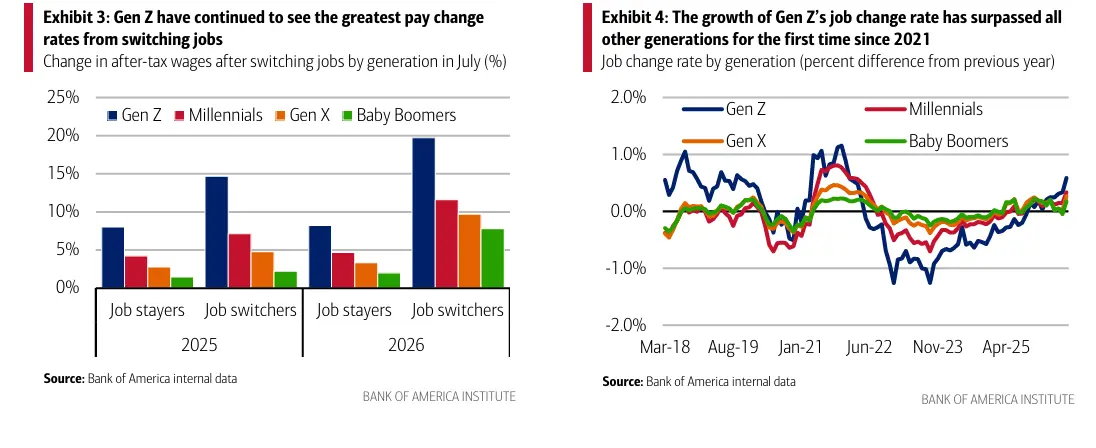
Read alongside the Stanford findings, the Bank of America data indicates that young professionals are being pushed out of traditional corporate hiring pipelines and scrambling laterally into less-exposed sectors to find work.
The loss of entry-level positions raises a separate question about how future professionals will build expertise. The issue is closely connected to “Polanyi’s Paradox,” formulated in 1966 by Hungarian-British polymath Michael Polanyi and summarized by the phrase, “We can know more than we can tell.” It describes tacit knowledge: contextual, intuitive expertise accumulated through experience and observation that is difficult to write down, codify, or program into software.
George Mason University economist Tyler Cowen, who writes the blog Marginal Revolution, has long examined the distinction. Generative AI can replicate and automate codifiable “intelligence,” Cowen notes, but cannot duplicate tacit, contextual expertise. If the entry-level “apprenticeship” jobs used by young professionals to acquire that knowledge disappear through automation, the pipeline for future experts could break down.
A three-month randomized controlled trial involving 133 practicing patent attorneys provided evidence related to that concern. The working paper was co-authored by MIT labor economist David Autor, known for landmark research on technological change and trade shocks in local labor markets. Participants were given access to generative AI tools.
The productivity and quality gains were concentrated entirely among senior attorneys. Junior attorneys recorded no average performance gains. The authors concluded that foundational manual expertise is a strict prerequisite for extracting lasting value from AI-assisted professional practices: junior professionals must first master the basics manually before they can use AI effectively.
Institutional resistance has grown alongside these changes, including AI bans in high schools and universities and anxiety among intellectual and creative professionals. Because FIIPB industries and white-collar professionals produce most of the country’s business analysis and media commentary, the panic over AI automation has been especially visible.
Cowen has encouraged professionals to view the transition through the classical economic distinction made by 19th-century French economist Frédéric Bastiat between “the seen and the unseen.” Bastiat argued that technological and economic changes create immediate, visible disruptions—the “seen”—while also producing massive, long-term, indirect benefits that are not immediately obvious—the “unseen.”
Responding to warnings from prominent mathematicians, including UCLA Fields Medalist Terence Tao, that AI is advancing rapidly into higher-level abstract mathematics, Cowen said the visible effect on his own status as an economist and writer is real. He also said the unseen benefits to scientific progress will likely be immense.
“I realize AIs someday will end up as better column and blog writers than I am,” Cowen admitted.
Asked whether professional and media opposition to AI is driven by self-interest, Cowen said the reaction is more complicated than simple cynicism. “I think the backlash is both sincere and self-interested, the two motives are working together,” he said, comparing it with corporate protectionists who sincerely believe tariffs are public goods rather than instruments for securing private profits.
“People just do not want the world to change so much,” Cowen said.









