

Brazilian Banks Processed $98 Billion in Crypto While Holding None
Brazil’s banks are capturing crypto and stablecoin flows while leaving asset risk with clients

Brazil crypto market 2025
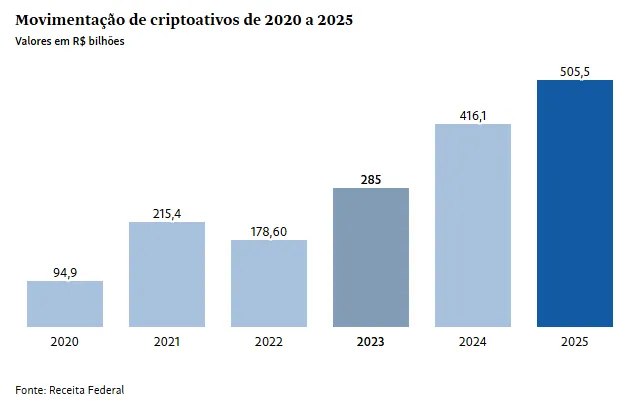
Brazilian banks are facilitating a record crypto market through their customer apps while holding no virtual assets of their own. Central Bank filings dated March 2026 and reviewed by Folha de S.Paulo show zero proprietary crypto holdings across the country’s banks. At the same time, Brazilians moved R$505.5 billion ($98.7 billion) through crypto in 2025, according to Receita Federal data, more than five times the R$94.9 billion recorded in 2020.
Under Central Bank filings, proprietary crypto holdings at Itaú, Bradesco, Santander, Banco do Brasil and Nubank stand at exactly zero.

Basel III rules help explain the position. The Basel Committee on Banking Supervision’s framework caps Group 2 unbacked cryptoassets, including Bitcoin and Ethereum, at 2% of a global bank’s Tier 1 capital. Those holdings also receive a 1,250% risk weighting. The framework makes direct balance-sheet ownership expensive for traditional commercial banks.
Receita Federal crypto transactions
Nearly 98 percent of the 2025 total came from companies. Corporate crypto transactions reached R$497 billion ($97 billion), or 98.3% of the volume tracked by Receita Federal. Brazilian businesses use dollar-pegged tokens such as USDT and USDC for cross-border settlement, where transfers can clear faster and at lower cost than traditional TED or SWIFT wires exposed to Financial Operations Tax, or IOF, and bank foreign-exchange spreads.
In November 2025, Resolution 521 classified the purchase or exchange of a dollar-pegged token as a foreign exchange operation. Stablecoins entered the same reporting framework used for sending money abroad. The rule places corporate dollar liquidity, settlement flows and crypto transactions within the Central Bank’s oversight.
[Resolution 521 stablecoin FX]
Brazil’s Legal Framework for Virtual Assets, passed in 2022, gave the Central Bank authority over the sector. Three resolutions published in November 2025 require firms that let customers trade, hold or send crypto to obtain a license, maintain minimum capital and segregate client accounts. The compliance deadline is October 30, 2026.
About 120 crypto firms operate in Brazil, most still without a license. After the grace period, unlicensed virtual asset service providers face sanctions or shutdown. Their customers and capital are being pushed toward regulated banking apps, where the institutions have already built custody, brokerage and foreign-exchange infrastructure.
Carlos Akira Sato, co-founder of consultancy Syscapital, said Brazilian banks are generally conservative when entering new markets. Clearer rules made them more secure in launching products, he told Folha. The same rules also raise compliance and capital costs that smaller crypto-native competitors may not be able to absorb.
Since 2025, Brazil’s largest lenders have systematically expanded their digital asset menus. At Nubank, client menus span 28 tokens; across the aisle at Itaú, the catalog covers 15 assets, including Bitcoin, Ethereum and the dollar-pegged stablecoin USDC.

Banco do Brasil’s service, introduced in January for direct purchases of Bitcoin and Ethereum, has processed more than R$11 million ($2.1 million), according to the state-owned bank. The figure places a traditional public lender inside the same client-facing market without putting those assets on its own books.
The distinction is between brokerage and ownership. Sato said proprietary exposure exists when a bank buys crypto with its own money and takes on the associated price, liquidity and credit risk. Custody and processing on behalf of clients do not create the same exposure.
Not a single real was risked.
Safra Dólar stablecoin
For clients seeking dollar exposure without opening an account abroad, Banco Safra is building a route that keeps the relationship inside the bank. In September 2025, the high-net-worth-focused lender issued Safra Dólar, its own dollar-pegged stablecoin, and retained full custody in-house.
The structure lets the bank handle client dollar exposure and settlement directly while avoiding a speculative position in Bitcoin or other unbacked cryptoassets. It also reflects a wider shift in which banks are building stablecoin rails instead of leaving cross-border flows to crypto-native firms.
At the October 30 VASP licensing deadline, that control becomes a competitive advantage. Traditional banks that have already cleared the compliance requirements can continue adding assets, custody services and stablecoin settlement while unlicensed exchanges face the possibility of sanctions or shutdown.

Sato’s distinction leaves the banks positioned as brokers and custodians rather than owners. Their clients take the market risk, while the banks collect fees from access, custody and foreign-exchange flows and keep virtual assets off their balance sheets.