U.S. Targets Iranian Crypto Exchange Routing Hormuz Fees to IRGC
Treasury moves against the exchange, executives and infrastructure behind Iran’s maritime crypto extortion scheme

WASHINGTON — The United States has blacklisted BitBank, an Iranian cryptocurrency exchange that the U.S. Department of the Treasury’s Office of Foreign Assets Control (OFAC) says was used to funnel hundreds of millions of dollars in maritime transit fees directly to the Islamic Revolutionary Guard Corps (IRGC).
Since June, the Hormuz Safe Marine Services Authority has used BitBank to process Bitcoin payments collected from commercial vessels. The authority was sanctioned by the U.S. in July after effectively forcing shipping firms to pay for safe passage through the Strait of Hormuz, the world’s most critical maritime oil transit choke point.
Between June and July alone, the Treasury Department estimates that the scheme routed hundreds of millions of dollars’ worth of Bitcoin to the IRGC, a designated Foreign Terrorist Organization that spearheads Iran’s external military and intelligence operations. BitBank served as the primary clearinghouse for digital currency extorted from international shipping vessels navigating the strategic waterway.


The sanctions also target the technological infrastructure behind the platform. Pishtaz Simorgh Electronic Trade Company, the software firm responsible for developing and maintaining BitBank, was designated by OFAC. Pishtaz Simorgh operates as a subsidiary of the Dot One Value Creation Group, an entity already blacklisted by the United States.
Three high-ranking executives affiliated with Dot One were added to the OFAC sanctions list: Hossein Ali Zaker Hossein, Mohammad Mahdi Zaker Hossein, and Seyed Adel Heidari. The Treasury identifies Hossein Ali Zaker Hossein as a central figure in Babak Zanjani’s extensive sanctions-evasion operations, ranging from covert oil exports to brokering digital asset transactions that ultimately funded the IRGC.
Zanjani, a notorious Iranian billionaire financier, has spent over a decade navigating the shadowy intersection of state-backed oil smuggling, sanctions evasion, and financial crime. OFAC blacklisted him in January.
During the Mahmoud Ahmadinejad presidency, Zanjani rose to prominence by orchestrating complex networks to sell Iranian oil despite international embargoes. His operations collapsed in 2013, when Iranian authorities arrested him and accused him of embezzling $2.7 billion from the National Iranian Oil Company. He was sentenced to death in 2016.
Zanjani’s capital sentence was commuted in 2024. He resurfaced last year as a key operator backing new commercial and financial ventures linked to the Iranian regime. According to the Treasury, he has leveraged his public profile to promote BitBank on his social media accounts since at least 2024, signaling his reintegration into Tehran’s economic apparatus.
All five entities and individuals were designated under Executive Order 13902. Initially issued to target key sectors of the Iranian economy, the U.S. administration expanded the order in August to explicitly cover actors operating within Iran’s digital asset sector.
“Efforts to finance the Iranian regime using cryptocurrencies are not beyond OFAC’s reach,” Treasury Secretary Scott Bessent said in a statement. “If you support the Iranian regime, the Department of the Treasury will sanction you.”
The legal authority has become the Treasury’s primary mechanism for dismantling the network of crypto exchanges and intermediaries laundering sovereign funds for Tehran. The sanctions freeze assets belonging to the designated individuals and entities subject to U.S. jurisdiction and prohibit American citizens and companies from transacting with them.
Foreign financial institutions and entities that continue to engage with the blacklisted parties risk secondary sanctions, which would effectively sever their access to the U.S. financial system. The action represents a key escalation under “Operation Economic Outcast,” a comprehensive economic and naval pressure campaign initiated by Secretary Bessent on August 24.
Dubbed “Economic D-Day,” the multilateral initiative is designed to isolate Iran’s financial system and cut off its remaining revenue streams, with coordinated support from the European Union, the United Kingdom, and regional Gulf partners.
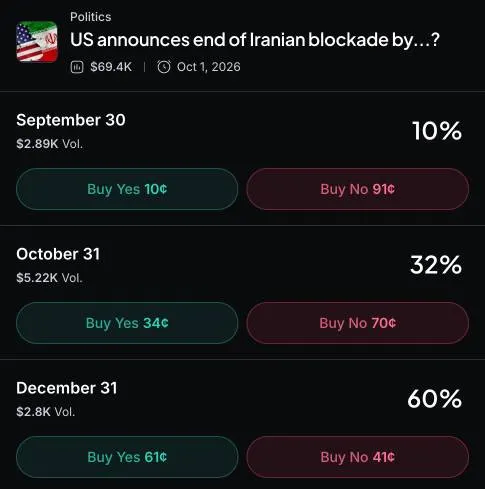
The pressure campaign comes amid an ongoing U.S. naval blockade of Iranian shipping, a policy that market observers expect to persist for the foreseeable future. According to data from Myriad, a decentralized prediction market, the implied probability that Washington will lift the naval blockade of Iran by September 30 has plunged to just 10 percent, down 30 percentage points. Looking further ahead, traders give a December 31 deadline only a 60 percent chance of materializing.