
China Has Too Much Green Power—and AI Is Absorbing the Excess
China turns to AI as renewable generation outpaces electricity demand
MACAU — China’s power sector is confronting an unprecedented surplus of renewable electricity even as geopolitical instability and disruptions along key maritime corridors like the Strait of Hormuz force energy-importing nations across Asia to scramble for oil and liquefied natural gas.
In July, installed solar capacity officially surpassed coal as China’s largest power source by nameplate capability. Daniel Liu, vice president of solar module manufacturer Jinko Solar, noted at the Fortune Leaders Forum in Macau on Sept. 8 that renewable energy expansion effectively satisfied all of China’s electricity demand growth over the past year.
According to projections from the International Energy Agency, China is set to account for 60% of all global renewable energy capacity installed through 2030. Large-scale wind and solar installations in China’s western desert regions, along with ultra-high voltage direct-current transmission lines connecting them to eastern urban centers, have outpaced immediate demand in several regional markets.


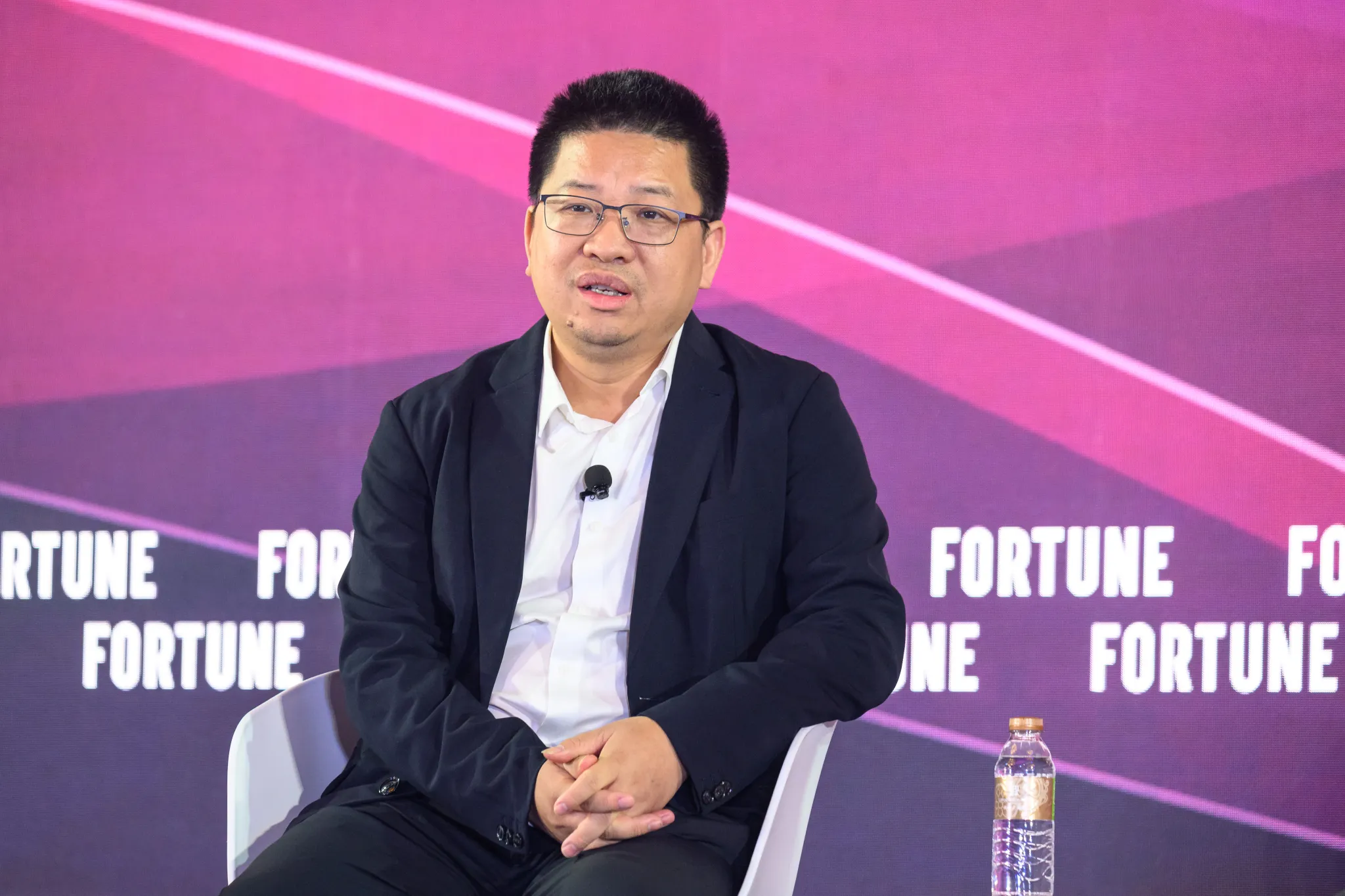
Speaking at the forum, Youyuan Huang, executive vice chairman of BTR New Material Group—the world’s largest producer of battery anode materials—emphasized the scale of China’s power infrastructure expansion. “China’s grid is a very strong and stable one,” Huang said. “But we’ve installed too much green energy.”
The resulting oversupply has intensified the risk of power curtailment, where clean electricity generation must be dialed back or shut off because local transmission networks and battery storage systems cannot absorb the peak loads. Panelists identified artificial intelligence as a primary mechanism to absorb surplus generation and optimize real-time power management.
Modern AI applications require continuous, high-density power supplies. Advanced graphics processing units used in machine learning clusters consume significantly more electricity per server rack than traditional data centers, creating a constant load for excess generation. “With the development of GPUs, the power of a single chip has risen dramatically… This means that if the power drops, [large amounts of] data that’s being computed could be lost,” Huang explained. “ [Energy] guarantees the safety and stability of computing power.”
China’s energy manufacturers and technology developers are turning to artificial intelligence both as a high-density power sink capable of absorbing excess generation and as an automated manager for complex grid networks. Haitian Pang, founder and chief executive officer of Jiangxing Intelligence, detailed how his firm developed an AI-driven management platform designed to serve as an intelligent controller for clean energy installations.
“The supply of wind and solar energy is highly uncontrollable… at night there’s no sunlight, but during the day sunlight floods in,” Pang said. “With an intelligent brain that deeply understands the region’s physical and meteorological conditions, you can forecast wind and solar conditions, and then know what options you need for energy storage.”
Jiangxing Intelligence’s system pairs meteorological forecasting algorithms with automated physical hardware, including autonomous maintenance robots and specialized drones. In arid or remote operating environments where dust and sand degrade solar panel performance, automated drones clean photovoltaic modules using precise water sprays without relying on human maintenance crews. “When wind and sand bury the solar panels, for example, we can dispatch drones that automatically clean them with water,” Pang said. “This way, the entire energy system can run more stably and efficiently.”
The technological density and surplus capacity in China stand in sharp contrast to the energy infrastructure challenges facing neighboring nations across South and Southeast Asia. In archipelagic Southeast Asian nations, geographic fragmentation presents severe structural barriers to constructing centralized high-voltage electricity grids.
“The Philippines has more than 7,000 islands, while Indonesia has more than 10,000, so it remains to be seen how renewable energy can come into play alongside fossil fuels there,” Liu noted. Huang said Chinese companies are directing major capital investments into Indonesia, including heavy development of new data centers, but the lack of accessible green energy grids forces those facilities to rely on traditional fossil fuels.
“We have many investments in Indonesia, where many large-scale data centers are being built,” Huang said. “Yet most of them are powered by traditional energy sources like coal.”
In South Asia, India is navigating a parallel dual-track energy transition. The country has accelerated utility-scale solar and wind deployment to meet international climate targets, while rapid industrialization and urban grid expansion have kept domestic demand for coal-fired power generation near record highs.
“I think a clean energy transition—including a lower-cost energy transition—will certainly remain a continuous pursuit for everyone,” Pang said. Liu noted that national priorities vary based on geography and resource access, while the long-term trajectory toward renewable integration remains uniform across the region.
“The narrative of energy transition differs across countries: for some it’s security, and for others it’s the future,” Liu said. “But they’re all actively embracing renewables.”