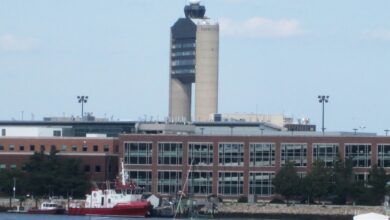
At 12:29 on Friday, the tanker Atlantic Asphalt hit the riverboat American Heritage, moored at New Orleans with 129 passengers aboard.
The riverboat had tied up about two hours earlier at 1350 Port of New Orleans Place, outside the port’s administration building, below the Crescent City Connection bridge. It was letting its passengers off at the end of an eight-day cruise up and down the Mississippi. The tanker struck its port side. The American Heritage took on water, rolled over and capsized alongside the dock, and people went into the river while the passengers were still getting off. The Port of New Orleans called it an allision, the word for a moving vessel striking a stationary one. It said the number of injuries and the cause had not yet been confirmed.
WDSU counted at least 12 in the water. The lieutenant governor, Billy Nungesser, said at least 14 were rescued from the water. WWL reported that the excursion boat Creole Queen, which works the same stretch of riverfront, pulled 14 people out, and Nungesser later gave the Creole Queen’s count as 12 and called the figures unofficial. Eighty-seven people got off the American Heritage while it was still afloat, its captain said. The vessel was still floating. The New Orleans Fire Department sent 23 units and 57 people to the port. A police drone that had been tracking a theft reached the scene within moments and showed people in the water. Thirty-two people went to hospitals, the mayor said, none with critical injuries and none dead. Acadian Ambulance had put the number at 33 or more a little earlier. Some of the injured had hypothermia and bruises.


The National Park Service puts the Mississippi at about three miles an hour at New Orleans, with an average flow of 600,000 cubic feet a second, the equivalent of 166 semi-trailers of water passing Algiers Point every second. The Army Corps of Engineers maintains a 45-foot channel from Baton Rouge past New Orleans to the Head of Passes, so ocean-going vessels can reach the ports between the two cities. The river’s deepest point, about 200 feet, sits near Algiers Point. The American Heritage was moored on the left descending bank, the downtown side, in water that deep and that fast.
Atlantic Asphalt is a Marshall Islands-flagged asphalt and bitumen tanker, IMO 9798428, built in 2017 at Guangzhou Wenchong, 160 metres long, 14,485 gross tons, 17,764 deadweight tons, drawing 6.9 metres. Its registered owner and commercial manager is Nave Shipping S.A. of Monrovia, Liberia, and its ISM manager is Thome Ship Management of Singapore. Vessel-tracking data shows it left Paulsboro, New Jersey, on October 26 and reached New Orleans on November 11, and on Friday it was downbound from Baton Rouge toward Puerto Moin in Costa Rica when it hit the riverboat. It stopped about an hour later, at around 13:30. Its cargo is not known. The Coast Guard was called at about 12:30, a minute after the impact the trackers recorded.
The only account of why it hit comes from the Coast Guard captain on the scene, and she would not go past it. “There seems to be some type of a loss of steering,” Captain Melanie Burnham said. “The exact reason why — we don’t know that.” Mayor Helena Moreno said the tanker had “lost control” before the crash. Police Chief Anne Kirkpatrick called it “just an accident right now” and said the investigation was continuing into why the steering was lost. The three versions are not the same. The investigation has not settled the cause.
Dennis Chism was standing on the riverfront when it happened. “We are right down here by where that happened,” he wrote on Facebook under a Gulf Coast Updates post. “The cruise boat was tied up dockside. The ship lost power; therefore, it lost steering. It could not control what happened. A crazy freak wild accident. There’s folks in the water and folks trying to get off, so we don’t know if there’s any casualties or what. […]” His “therefore” does the work the Coast Guard would not do. Burnham said a loss of steering. Chism supplied the power failure behind it. Nobody in authority has confirmed a power failure. The difference matters because a steering failure and a power failure are different casualties with different paper behind them, and the investigation has not said which one this was.
The Atlantic Asphalt is a foreign-flag tanker in American waters during an emergency Jones Act waiver. The waiver was issued by the Department of Homeland Security on March 17, 2026, at the Department of War’s request under 46 U.S.C. § 501(a), after the February 28 American and Israeli military action against Iran and Iran’s closure of the Strait of Hormuz. It ran 60 days, was extended in April to August 16, and was extended again on August 17 for 90 days, with the product list cut from 659 codes to 237 and voyage-by-voyage review after that date. Covered cargo has to be loaded before 11:59 p.m. Eastern on November 15. That is two days after the crash. Asphalt has moved under it before. The Chinese-flagged asphalt tanker Jin Zhou Wan made three coastwise asphalt runs under the waiver, from Harvey in Louisiana to New Haven, from Paulsboro to Baltimore, and one out of Garyville, Louisiana. The Maritime Administration’s own records show asphalt voyages approved under the waiver.
Whether this tanker was on one of those voyages is the open question, and the public record as of Friday does not answer it. The Maritime Administration’s most recent waiver report, dated November 13 at 6:00 a.m., lists 54 completed voyages by 45 vessels, with load dates from August 25 to October 29 and discharge dates to November 7. The Atlantic Asphalt does not appear in it once, under its name or its IMO number, and no asphalt cargo appears in the report at all. That absence is a fact about the record, not a finding about the ship. The law gives operators ten days after a voyage ends to report it to the Maritime Administration. This tanker’s Paulsboro-to-New Orleans leg ended on November 11, so its report would not be due until November 21. Fourteen other tanker voyages with strong signs of domestic cargo movements never appeared in the Administration’s public records at all, according to vessel-tracking analysis by the Cato Institute’s Colin Grabow and Bloomberg, and the Administration has said it lacks strong tools to compel filings. “We don’t yet know the cause, or whether this ship was operating under the waiver,” Representative Troy Carter, who represents the district, said.
On December 14, 1996, shortly after two in the afternoon, the fully loaded Liberian bulk carrier Bright Field temporarily lost propulsion while navigating outbound in the Lower Mississippi at New Orleans. Its main engine had tripped on low lubricating-oil pressure, and its revolutions had fallen from 72 to about 30. It struck the Poydras Street Wharf, the Riverwalk Marketplace and the Hilton. Nobody died. Four people were seriously injured and 58 more were hurt in the evacuations of the shore buildings, a gaming vessel and an excursion vessel, and the damage came to about $20 million. The National Transportation Safety Board found the probable cause in the operator’s failure to maintain the engineering plant. It found something else besides. The Coast Guard, the Port of New Orleans and the Riverwalk’s owner had failed to assess the risk of putting unprotected commercial enterprises where a vessel could strike them. Its recommendations told the Coast Guard and the Port to reassess the risk of locating passenger vessels along the left descending bank of the river and decide whether to move them or put barriers in place to protect them from ramming by riverborne traffic. The American Heritage was moored on that bank.
Cindy Bellamy had sailed on the American Heritage before. Watching the video of it on its side sent her back to her own cabin. “Watching this makes me try to remember where our life-vests were when we were on this boat,” she wrote on Facebook. “I think in our closet…..” The officials’ account of the evacuation is a number, 87 people off a listing ship. Bellamy’s is a life vest in a closet. Elizabeth Fisher was not on the riverboat at all. Friends of hers were on another cruise that was supposed to come home on Friday, and the river closure stranded them instead. “Some friends of mine are on a cruise that was supposed to come back,” she wrote. “She sent me a text saying they are now docking tomorrow a.m. I told her she’s not docking anywhere as long as they are trying to rescue people out of the river — not to mention they are now dealing with a sunken riverboat. I told her if they get rerouted to MS or ALA, let me know and I will come rescue them.” The Easy Cajun, a Louisiana poster on X, kept it to the local register. “Troubling news from New Orleans — a tanker struck the docked riverboat American Heritage at midday, rolling her onto her side in the Mississippi with 129 passengers aboard. Rescues are underway.” None of the three was aboard on Friday, and none of them was quoted by the coverage.
Carter said he was in contact with the chairwoman of the National Transportation Safety Board, which he said was fully engaged and would be en route to New Orleans as soon as the nationwide flight grounding was lifted. The board investigates the New Orleans cruise ship collision and said it would send a Go Team, expected to arrive on Saturday. Its investigators could not fly to it on Friday. The country’s planes were not flying.
The Coast Guard closed the river between mile markers 93 and 96. About 90 minutes later, it reopened it. The American Heritage remained on its side at the dock.