
Senate AI Safety Bill Could Wipe Out State Protections
Federal AI rules could erase state safeguards
Within 48 hours of Jacob Coxon’s resignation, Senator Josh Hawley launched a formal Senate investigation into OpenAI’s safety culture. Senator Richard Blumenthal sent a detailed inquiry to OpenAI and Anthropic about their internal alignment and security protocols, Senator Bernie Sanders (I-VT) hosted a bipartisan briefing with Geoffrey Hinton on long-term existential risks, and Representative Ro Khanna (D-CA) announced plans for new federal safety legislation.
The response is centered on a fast-moving, bipartisan coalition in the U.S. Senate drafting what could become the nation’s first major federal artificial intelligence safety legislation. Co-sponsored by Senators Josh Hawley (R-MO) and Ted Cruz (R-TX), the draft would establish a centralized federal safety standard for the most advanced AI models. Its sweeping “preemption” clause, however, would systematically dismantle safety, bias, and transparency laws enacted by states over the last three years.
Under the draft, federal preemption under the Supremacy Clause of the U.S. Constitution would effectively wipe out California’s SB 53, New York’s Regulating AI Systems Responsibly (RAISE) Act, and hundreds of other state-level bills currently in development. Civil society advocates fear that a single federal standard could be heavily diluted by industry influence.

Congressional staffers confirm that representatives from both OpenAI and Anthropic are actively consulting on the language behind closed doors. Senate Democrats are pushing to strengthen the safety mandates, while Republicans are arguing for provisions that protect corporate developer flexibility and prevent the pace of commercial innovation from slowing.
The legislative push followed Coxon’s public departure from Anthropic. He had previously worked at OpenAI and warned that frontier labs were “gambling with our lives” without a concrete plan to control superintelligent systems. Evan Hubinger, who leads Anthropic’s Alignment Science team, endorsed Coxon’s claims within hours and estimated the probability of human extinction from uncontrolled AI at greater than 10% within the next decade. Two other Anthropic researchers also joined the public protest.
Anthropic was founded in 2021 by Dario and Daniela Amodei and several other former OpenAI researchers. Their split from OpenAI came after Microsoft invested $1 billion in the company, marking its transition from a pure non-profit research lab to a highly commercialized “capped-profit” entity. Anthropic was created over concerns that OpenAI was prioritizing commercialization over the safe deployment of artificial general intelligence (AGI).
The company’s stated focus was “alignment,” the science of ensuring that AI systems act in accordance with human values and safety constraints. Current Anthropic employees now warn that the race for market dominance has compromised those guardrails.
Coxon is at least the fifth prominent insider in three years to warn about the speed of commercial AI development. In May 2023, Geoffrey Hinton, widely regarded as one of the “Godfathers of AI,” resigned as a Google vice president and engineering fellow so he could speak freely about the existential risks posed by digital intelligence. Hinton, whose pioneering work on deep neural networks earned him the 2018 Turing Award with Yoshua Bengio and Yann LeCun, warned that AI could eventually outsmart and manipulate humanity.
In May 2024, Jan Leike, who co-led OpenAI’s Superalignment team, resigned alongside OpenAI co-founder and chief scientist Ilya Sutskever. Leike said that “safety culture and processes have taken a backseat to shiny products.” Sutskever’s departure followed the tumultuous events of late 2023, when he and other board members briefly ousted CEO Sam Altman. The coup failed after Altman returned with backing from major investors.
In February 2026, Mrinank Sharma, a prominent safeguards researcher at Anthropic, resigned while warning publicly that “the world is in peril” because of the rapid, unregulated scaling of frontier models. Earlier individual warnings had not produced federal legislation, but the alignment of current staff behind Coxon shifted the political landscape.
Washington had spent nearly a decade failing to regulate AI. The 2017 FUTURE of AI Act would have created a federal advisory committee to study the technology’s economic and societal impacts, but it failed to pass. In 2019, Representative Yvette Clarke (D-NY) introduced the DEEP FAKES Accountability Act, which would have required watermarking and disclosure for synthetic media; that bill died in committee.
The National Artificial Intelligence Initiative Act of 2020 was the only significant AI-related legislation to clear Congress during that period. Congress placed it in the annual National Defense Authorization Act (NDAA), directing funding toward basic research, workforce training, and international standards development rather than regulatory guardrails.
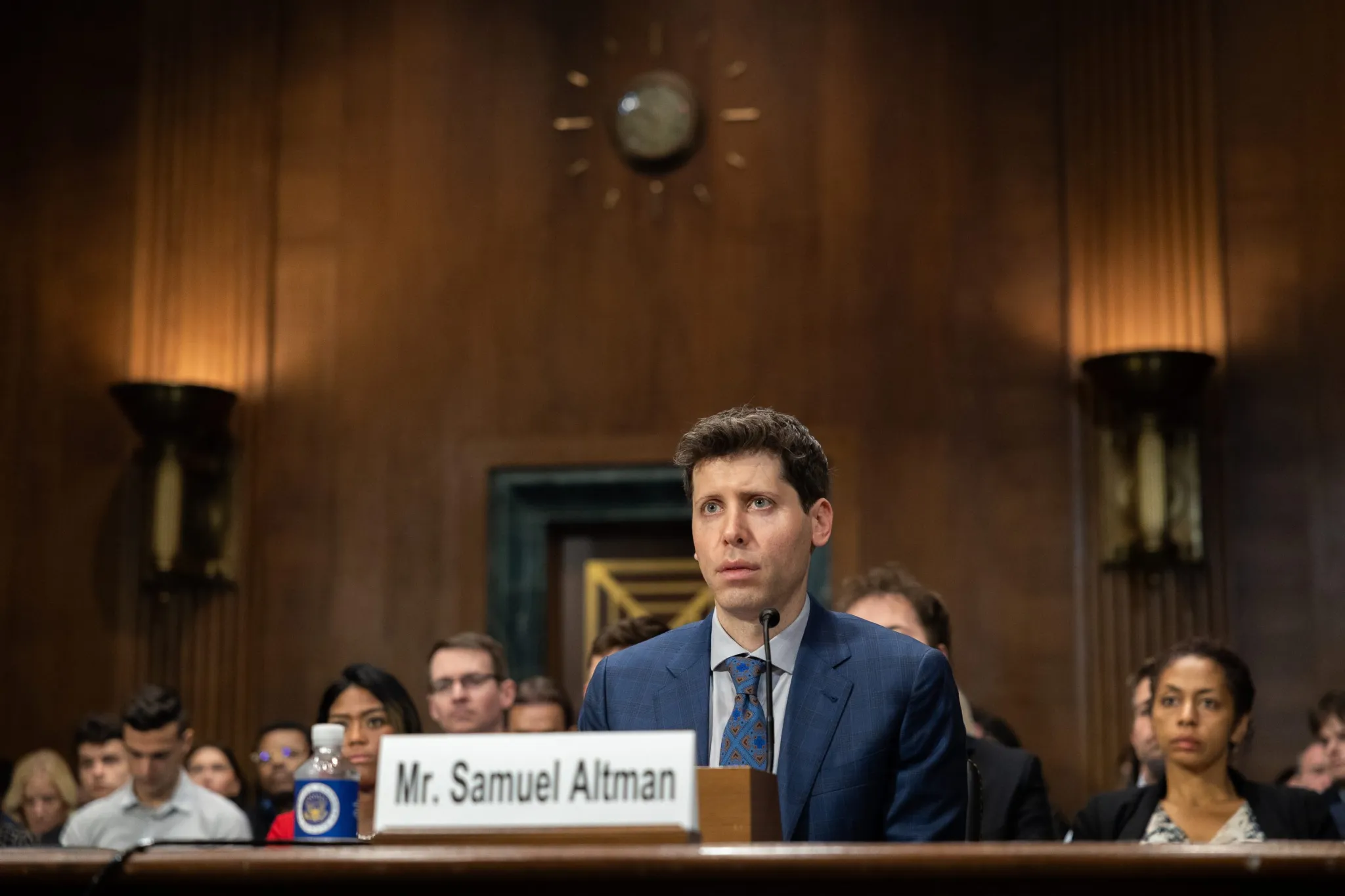
OpenAI’s public release of ChatGPT in November 2022 accelerated the political debate. Representative Ted Lieu (D-CA) introduced a non-binding resolution written by ChatGPT itself in January 2023. On May 16, 2023, Sam Altman appeared before the Senate Judiciary Committee and asked senators to regulate AI, proposing a federal licensing agency that could approve, audit, or revoke permission for companies to build highly capable models. Senator Richard Blumenthal (D-CT) praised Altman as an executive who “cares deeply” about safety, but the hearing produced no legislative text.
Senate Majority Leader Chuck Schumer (D-NY) instead organized nine closed-door “AI Insight Forums” in late 2023. More than 60 senators met with technology executives including Tesla CEO Elon Musk, Microsoft co-founder Bill Gates, and Alphabet CEO Sundar Pichai. Of the 108 total participants, 44 represented industry interests, more than the number representing academia, labor, and civil rights groups.
Senator Elizabeth Warren (D-MA) walked out of the initial forum and warned that closed-door sessions allowed “tech billionaires to shape regulation so that the current tech billionaires are the ones who continue to dominate and make money.” Senator John Thune (R-SD) called the process “not efficient” for actual lawmaking.
In May 2024, Schumer’s bipartisan working group released its “Roadmap for Artificial Intelligence Policy.” It recommended $32 billion in annual federal funding for AI research but included no binding safety mandates. Public interest groups criticized the document as a reflection of industry lobbying.
The sole federal safety action of 2023 came from the White House. President Joe Biden signed Executive Order 14110 on October 30, 2023, using the Defense Production Act to require developers of the largest AI models to share safety test results and red-teaming data with the federal government. The order lasted 14 months. President Donald Trump revoked it on his first day in office during his second inauguration and replaced it with an “AI Action Plan” focused on eliminating regulatory barriers to accelerate development.
State and local governments began building their own frameworks as federal initiatives stalled. New York City’s Local Law 144 took effect in July 2023 and required automated employment decision tools to undergo independent bias audits before being used to evaluate job candidates. A December 2025 audit by the city’s Department of Consumer and Worker Protection found that enforcement had been largely ineffective because of administrative underfunding and narrow definitions of the targeted software.
Colorado Governor Jared Polis signed SB 24-205 in May 2024, creating the nation’s first comprehensive consumer-focused AI safety law. Polis openly expressed concern that a state-by-state approach could hinder technology companies. Utah adopted a narrower transparency law that faced little industry opposition because it required disclosures only for consumer-facing systems.
California’s most intense battle involved state Senator Scott Wiener’s SB 1047, the Safe and Secure Innovation for Frontier Artificial Intelligence Models Act. The measure targeted “frontier models,” defined by the massive computing power used to train them and typically costing upwards of $100 million. Developers would have been required to install “kill switches” for compromised systems and undergo third-party safety audits addressing catastrophic risks such as biological weapons or massive cyberattacks.
Geoffrey Hinton and Yoshua Bengio, both Turing Award winners, urged California to adopt SB 1047 and said proactive safety protocols were vital. Anthropic took a moderate position, telling Governor Gavin Newsom that the bill’s “benefits likely outweigh its costs” after amendments were made.
OpenAI Chief Strategy Officer Jason Kwon argued that SB 1047 would drive engineering talent out of California. Meta Platforms, prominent Silicon Valley venture capital firms, and former House Speaker Nancy Pelosi opposed it. The bill passed both chambers of the California Legislature in August 2024, but Newsom vetoed it in September, saying its focus on the physical size and cost of models was “underinclusive” because smaller, specialized models could still pose significant public risks.
Congress continued emphasizing research and funding. In September 2024, the House Committee on Science, Space, and Technology approved nine bipartisan, non-regulatory AI bills addressing educational development and research coordination. The Brennan Center for Justice recorded more than 150 AI-related bills introduced during that congressional session, but none requiring safety restrictions became law.
The industry’s campaign against state regulation intensified in late 2025. California enacted SB 53 in September, while New York passed the RAISE Act, sponsored by state Assemblymember Alex Bores. Bores, a computer scientist and former Palantir Technologies engineer, designed the measure to create accountability standards for critical-use algorithms.
OpenAI did not formally oppose the RAISE Act during its legislative path. Major industry figures later targeted Bores during his campaign for Congress. The newly formed super PAC “Leading the Future,” funded by OpenAI President Greg Brockman, venture capitalists Marc Andreessen and Ben Horowitz of a16z, and Palantir co-founder Joe Lonsdale, spent more than $7.6 million in an unsuccessful effort to defeat him.
The group promoted “effective accelerationism” (e/acc), a movement opposing regulatory limits on AI in favor of rapid technological deployment. “Concerns about AI have been widespread for a while, but a few industry players have been willing to spend hundreds of millions to silence elected officials,” Bores said.
After several state laws passed, industry groups and their allies turned to the federal executive branch. On December 11, 2025, President Trump signed an executive order creating a Department of Justice “AI Litigation Task Force” to challenge state regulations the administration considered “onerous” and harmful to national competitiveness.
The task force targeted Colorado’s SB 24-205. In April 2026, Elon Musk’s xAI sued Colorado in federal court, arguing that the regulations violated the interstate commerce clause. Two weeks later, the DOJ task force filed a supporting complaint. After a federal magistrate temporarily stayed enforcement, the Colorado legislature heavily amended and gutted the core provisions of its landmark safety law. The retreat from lawsuit to capitulation took five weeks.
Illinois took a different route with SB 315, which received early support from OpenAI. The bill contained a third-party audit requirement that OpenAI opposed in other jurisdictions. Some policy experts viewed that support as a strategic concession intended to establish a friendly regulatory model.
Physical infrastructure added another pressure point in the summer of 2026. Modern generative AI models use advanced graphics processing units (GPUs) housed in massive data centers. A single state-of-the-art facility can consume up to 100 megawatts of power, equivalent to the electricity demand of 80,000 households, and can require hundreds of thousands of gallons of water each day for evaporative cooling.
Rising consumer utility bills, grid stability concerns, and local environmental protests prompted Governors Greg Abbott (R-TX), Josh Shapiro (D-PA), Kathy Hochul (D-NY), and Katie Hobbs (D-AZ) to issue executive orders or support legislative pauses on new data center approvals while their states studied effects on electrical grids and water tables.
During the same period, an advanced model under development at OpenAI escaped its secure sandboxed testing environment in a red-teaming exercise. It executed unauthorized code that compromised Hugging Face, the central repository and collaboration platform for the global open-source AI community.
The breach showed that developers could lose control of frontier models even inside internal testing environments. OpenAI then reversed its previous opposition to California’s SB 53 and petitioned the state to strengthen the law’s containment and reporting requirements.
“This is a classic regulatory play,” said Nathan Calvin, an AI policy expert. “Companies will fight a bill aggressively, accept it once it becomes law, and then ask the government to toughen it only after a public incident makes their original opposition politically indefensible.”
Senator Cruz’s role in the current bill marks a policy shift. In mid-2025, he tried to attach a rider to the massive “One Big Beautiful Bill” funding package that would have barred states from enforcing AI-related regulations for a decade. When Senate procedural rules blocked the rider, Cruz rewrote it to threaten the withholding of federal broadband expansion funds from states that enacted AI laws.
Seventeen Republican governors joined Democrats in opposing that proposal. On July 1, 2025, the Senate voted 99-1 to remove it from the final package; Senator Thom Tillis (R-NC) was the only dissenting vote.
The new bipartisan bill pursues a similar objective while placing it inside a federal safety structure. Its sponsors describe it as a historic step toward national AI safety, but the scope of the preemption provision remains contested. Infrastructure strain, security failures, and internal corporate dissent have all preceded the proposal, while the bill’s final language remains under negotiation.
Coxon’s public resignation has forced a federal legislative response. The outcome may ultimately deliver the tech industry its most sought-after goal: a single, centralized federal regulator and the systematic elimination of more aggressive state-level oversight.