How a Chinese Shoe Deal Pushed NBA Earnings Past $200M
Corporate fallout from Curry's move to Li-Ning highlights the widening financial gap between the NBA and other major U.S. sports leagues.
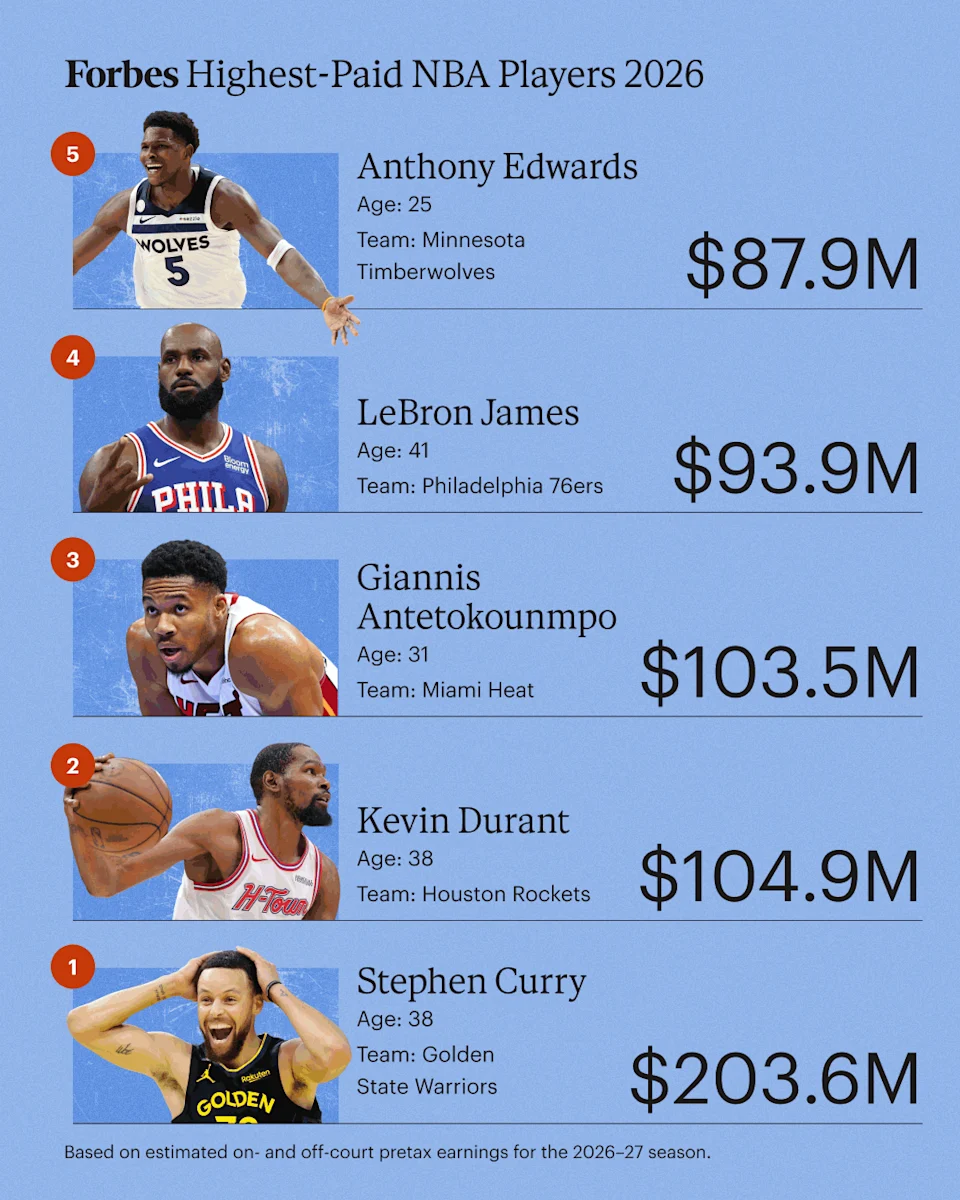
Stephen Curry’s departure from Under Armour last fall triggered a financial earthquake that extended far beyond his own bank account. The Golden State Warriors point guard’s pivot to Chinese sportswear giant Li-Ning helped push his total estimated earnings to $203.6 million for the coming year, according to Forbes, making him the first active NBA player to clear the $200 million mark in a 12-month period.
The ripple effects are already visible on corporate balance sheets. Under Armour disclosed in May that it expects annual revenue to decline 1% following its split with Curry, who had served as the face of its basketball division for over a decade. Meanwhile, Li-Ning committed an estimated $400 million over ten years to secure the 38-year-old sharpshooter, with a signature shoe scheduled for release early next year, Forbes reported.



Curry is not the only NBA star leveraging Asian footwear markets. Oklahoma City Thunder guard Shai Gilgeous-Alexander, who signed a multiyear deal with Nike-owned Converse in 2024, signaled in June that he would begin representing the parent Nike brand instead, according to Forbes. Jimmy Butler, Curry’s teammate in Golden State, also joined Li-Ning’s ambassador roster. Butler is currently recovering from a torn ACL suffered in January and told NBC Sports he is targeting an early 2027 return.
The surge in off-court income has widened the financial gap between the NBA and other major North American sports leagues. The league’s ten highest-paid players are projected to generate $469 million away from the court this season, nearly $90 million above last year’s record of $380 million, according to Forbes. By comparison, the top earners in Major League Baseball pulled in $144 million off the field, while the NFL’s highest-paid players generated $84 million and the NHL managed just $16 million.
Total combined earnings for the NBA’s top ten reached $958 million before taxes and agent fees, a 6% increase from 2025. That figure represents more than double the $449 million recorded a decade ago, driven by a salary cap that climbed to $165 million this season—up 75% from ten years prior under the terms of the league’s collective bargaining agreement, which guarantees players roughly half of all basketball-related income.
Not every veteran is riding the upward curve. LeBron James accepted the veteran’s minimum of $3.9 million to join the Philadelphia 76ers in July after eight seasons with the Los Angeles Lakers, dropping his on-court pay below his $4 million rookie salary from 2003-04. His off-court portfolio expanded to offset the cut. A new deal with prediction market platform Polymarket will pay him $15 million annually, Front Office Sports reported, while his partnership with Fanatics includes helicopter access for commuting between Philadelphia and New York, according to Forbes. James’ total estimated earnings sit at $93.9 million, placing him fourth behind Kevin Durant ($104.9 million) and Giannis Antetokounmpo ($103.5 million).
Antetokounmpo’s summer trade from the Milwaukee Bucks to the Miami Heat carries significant tax implications. Florida levies no state income tax, unlike Wisconsin, potentially saving the 31-year-old forward millions of dollars annually as he approaches eligibility for a contract extension in January, according to Forbes.
Player movement continues to reshape rosters and payroll structures across the league. The Boston Celtics traded Jaylen Brown to the 76ers in July for Paul George and draft picks, leaving Jayson Tatum to adjust alongside new teammates after returning in March from a torn Achilles tendon. Tatum detailed the rehabilitation process in a five-part NBC documentary titled “The Quiet Work,” according to Forbes. In Minnesota, the Timberwolves acquired LaMelo Ball in July to pair with Anthony Edwards, whose estimated $87.9 million in total earnings places him fifth on the Forbes list.

Durant, now with the Houston Rockets, signed a two-year, $90 million extension last October that cost him approximately $30 million against the maximum available. He remains on pace to surpass James as the NBA’s all-time on-court earnings leader in 2027-28, reaching $591 million for his career, according to Forbes. His family office, 35V, recently benefited when Nvidia agreed to acquire AI platform Hugging Face for $12.9 billion.


The broader economic environment presents headwinds despite record individual payouts. The collapse of regional sports network operator Main Street Sports Group stripped 16 NBA franchises of tens of millions of dollars in annual local media revenue each, according to Forbes. Consequently, the salary cap rose by only 6.7% this season, falling short of the 10% maximum annual increase some executives anticipated when the league signed its 11-year, $76 billion national broadcast package in 2024. The cap is projected to climb by a similar percentage in 2027-28.
A decade ago, James held the league’s highest salary at $31 million. This season, 59 players exceed that figure, according to Spotrac. The NBA is now tracking toward its first $70 million individual salary in 2029-30, with at least three different players positioned to cross the threshold, according to Forbes.