Albania Protests: Kushner Project Fuels Tirana Unrest
A Kushner-backed coastal resort and student grievances unite demonstrators demanding the prime minister's resignation.
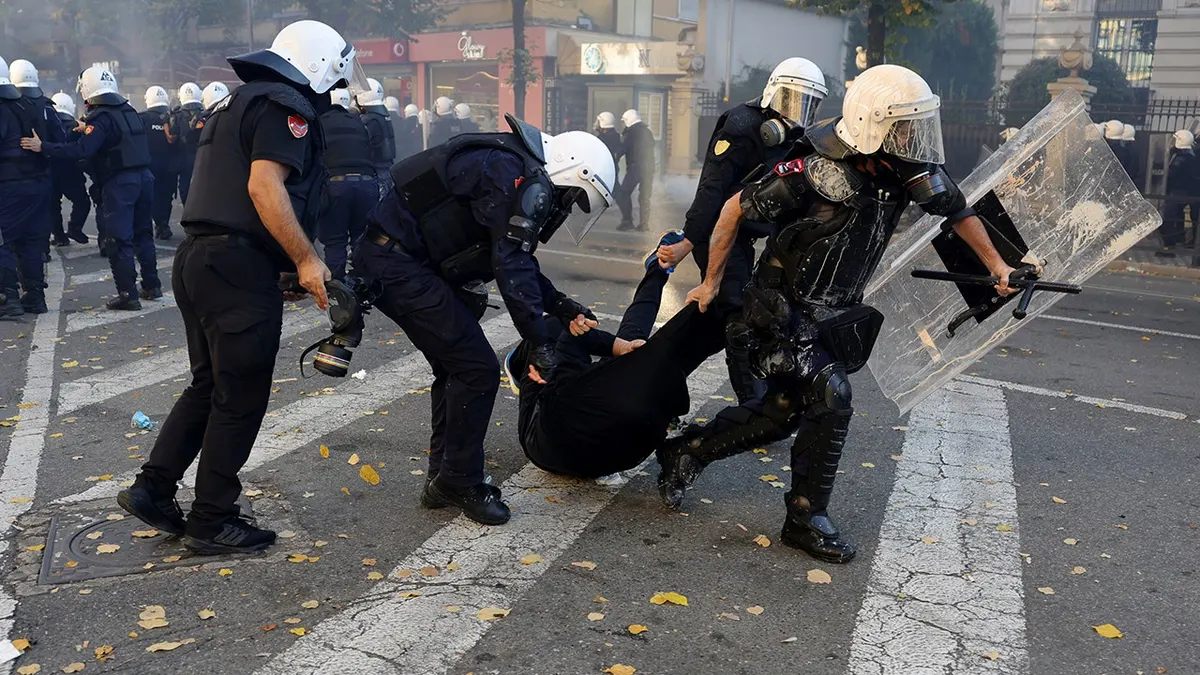
A luxury coastal development venture linked to Jared Kushner has become a flashpoint in Albania’s most severe civil unrest in years, merging with student grievances and long-simmering anti-corruption anger to paralyze central Tirana for three consecutive days.
Riot police deployed tear gas and water cannons Thursday outside the Education Ministry as demonstrators hurled rocks at security cordons. The confrontation marked an escalation from Wednesday night, when crowds attacked government buildings, banks, and commercial storefronts, leaving 89 people injured, including 61 law enforcement officers.
The violence centers on a convergence of distinct grievances that have coalesced into a single mass movement. Affinity Group, a firm backed by Kushner, secured preliminary approval earlier this year to develop a high-end resort complex along Albania’s southern Adriatic coastline. Critics allege the project bypassed standard environmental reviews and was fast-tracked through political favoritism by Prime Minister Edi Rama’s administration. The venture now faces an active anti-corruption investigation, adding legal peril to the public backlash.
Kushner’s international real estate ambitions have drawn scrutiny since he left the White House in 2021. His fund previously targeted developments in Saudi Arabia and the Balkans, raising questions among transparency advocates about potential conflicts between his diplomatic work during the Trump administration and subsequent private business pursuits. In Albania, the coastal project tapped into existing resentment over foreign capital reshaping local economies without benefiting residents.
Organizers rallying under the banner of the “flamingo movement”—named for pink bird signs carried through the streets—are demanding Rama’s immediate resignation after 13 years in power. They accuse his Socialist Party of entrenching systemic graft while ordinary citizens face rising poverty and deteriorating public services.
Agim Nesho, Albania’s former ambassador to the United States, characterized the uprising as a breaking point. He cited the mass exodus of young Albanians seeking economic opportunities elsewhere in Europe as evidence that the political elite has enriched itself while abandoning the broader population.
University students form the other major pillar of the protests. Organizers say their mobilization targets surging higher education costs, inadequate financial aid, deteriorating campus infrastructure, and bleak employment prospects following graduation. Rama told Reuters he remains willing to negotiate tuition policies but drew a hard line against property destruction, arguing that vandalism has no connection to legitimate academic demands.
The prime minister rejected all calls to step down, framing his mandate around securing European Union membership. Albania formally opened accession negotiations in 2022, and Rama won a fourth term last year largely on a promise to finalize entry by 2028. EU integration requires candidate nations to demonstrate robust judicial independence, functional anti-corruption frameworks, and stable democratic institutions. Sustained street violence directly threatens those benchmarks.
An EU delegation in Tirana issued a statement late Wednesday expressing concern over the violent escalation and urging authorities to exercise proportionate force. The bloc’s emphasis on restraint reflects Brussels’ delicate position: it must support a partner government pursuing accession while acknowledging the democratic right to protest systemic failures.
Rama suggested external actors might be exploiting the turmoil to sabotage Albania’s trajectory toward European integration, though he did not name specific countries or organizations.
Security forces maintained heavy deployments across the capital Thursday evening as organizers signaled plans for further demonstrations.