

Turn Cardboard Egg Cartons Into 3D Flower Wall Art
Contaminated pulp cartons rejected by recycling centers can be transformed into framed botanical decor using an ombre shading technique.
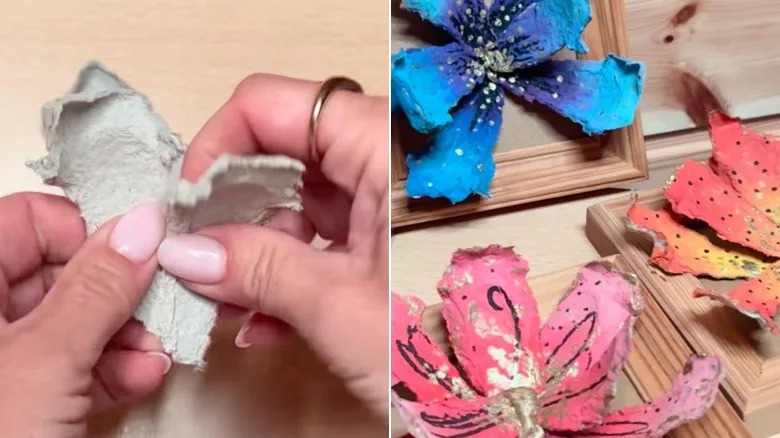
Cardboard egg cartons face an uncertain fate at municipal recycling facilities across the United States. While clean paper pulp is widely accepted in curbside programs, cartons soiled by raw egg residue or moisture are frequently rejected and diverted to landfills. The molded pulp material — typically manufactured from recycled newsprint and cardboard waste — retains structural rigidity that makes it difficult to re-pulp efficiently once contaminated. This disposal bottleneck has driven a surge in upcycling applications, with one of the most visually striking being the conversion of individual carton cups into three-dimensional floral shadow box art.
Unlike plastic or Styrofoam alternatives, which persist in landfills for centuries and shed microplastics, molded fiber cartons provide a porous, paintable canvas ideal for craft applications. Transforming them requires only basic supplies: acrylic craft paint in multiple shades, a black marker, a gold detail marker, and all-purpose tacky glue. Small square picture frames serve as the mounting base. Thrift stores remain the most cost-effective source for frames, though new solid walnut shadow boxes or ornate baroque-style mini frames can be purchased in multi-packs online for under $20.
The construction process begins by separating the carton lid and tearing each cup away from the adjoining matrix. Each cup is then torn into four irregular triangular segments. Tearing the cardboard rather than cutting it with scissors produces frayed, organic edges that mimic natural petal textures far more effectively than straight blade lines.


Achieving a convincing three-dimensional illusion relies entirely on color application. An ombre gradient must be painted onto each triangle, starting with a dark hue such as deep purple or navy blue at the narrow tip and transitioning outward to progressively lighter tones. This shading technique exploits how human vision interprets light and depth; darker recesses and lighter protrusions trick the eye into perceiving volume on a flat surface. Once dry, varied curved lines and dots applied with a black marker introduce the asymmetrical veining found in living botanicals.
Assembly takes place directly on the cardboard backing of the frame after removing the glass or acrylic front panel. Petals are arranged in a circular formation with their narrow, dark-painted tips pointing inward toward a shared center point. A standard configuration uses five base petals secured with glue, followed by three additional petals layered over the gaps to build dimensional height. The flower’s core is finished with metallic gold dots. Repeating this sequence with different color palettes — reds fading to pinks, or oranges brightening to yellows — allows for a diverse gallery arrangement.
The versatility of molded pulp extends well beyond floral motifs. Gardeners routinely use intact egg cartons as biodegradable seed-starting trays, planting the entire cup directly into soil where it decomposes without disturbing delicate root systems. Acoustic engineers have also utilized the parabolic shape of egg cups as inexpensive sound-diffusing panels for small recording spaces. For home decor, the ombre painting method applies equally to monochromatic schemes using charcoal and gray tones, or seasonal palettes suited to specific interior design themes. Glitter paint pens can replace standard markers for added reflectivity, and mixed-shape frames — including oval, rectangular, and shield configurations — break up visual monotony when clustered together on a wall.
According to the Environmental Protection Agency, paper and paperboard products account for roughly 23 percent of all municipal solid waste generated annually in the U.S., making fiber-based packaging diversion a persistent waste management priority. Repurposing contaminated cartons into permanent display pieces removes them from the waste stream entirely. Current thrift retail trends indicate rising consumer demand for handmade, upcycled wall decor, positioning these framed floral pieces as viable items for resale or gifting rather than temporary crafts.









