

Chick-fil-A CEO’s Donations Fuel New Boycott Pushes
CEO Dan Cathy's personal donations to a major donor-advised fund have reignited campaigns to remove the chicken chain from universities and state highways.
New York State lawmakers and University of Notre Dame students are mounting parallel campaigns to block Chick-fil-A from operating on their properties, reviving a decade-long clash over the fast-food giant’s ties to anti-LGBTQ organizations. The coordinated pressure arrives as the chain navigates expansion into airports, university campuses, and highway rest stops — venues where public entities hold direct vendor approval power.
The immediate catalyst is a report detailing CEO Dan Cathy’s personal financial support for the National Christian Charitable Foundation (NCF). While Chick-fil-A corporate halted its direct funding of groups opposing same-sex marriage in 2019, tax filings from the Dan and Rhonda Cathy Foundation show consistent contributions to NCF through at least 2018. NCF operates as a donor-advised fund, the sixth-largest charity in the United States, routing money to thousands of nonprofits. Among those recipients are the Heritage Foundation and Alliance Defending Freedom, both of which actively lobby against the Equality Act, proposed federal legislation designed to expand civil rights protections based on sexual orientation and gender identity.
A company spokesperson stated that Chick-fil-A does not donate to political groups or to NCF directly, noting that NCF holds 501(c)(3) tax-exempt status, which legally prohibits the organization itself from engaging in political campaigning. The distinction between corporate treasury funds and the personal philanthropy of the founding family, however, remains the central friction point for critics who view the Cathy family and the brand as inseparable.


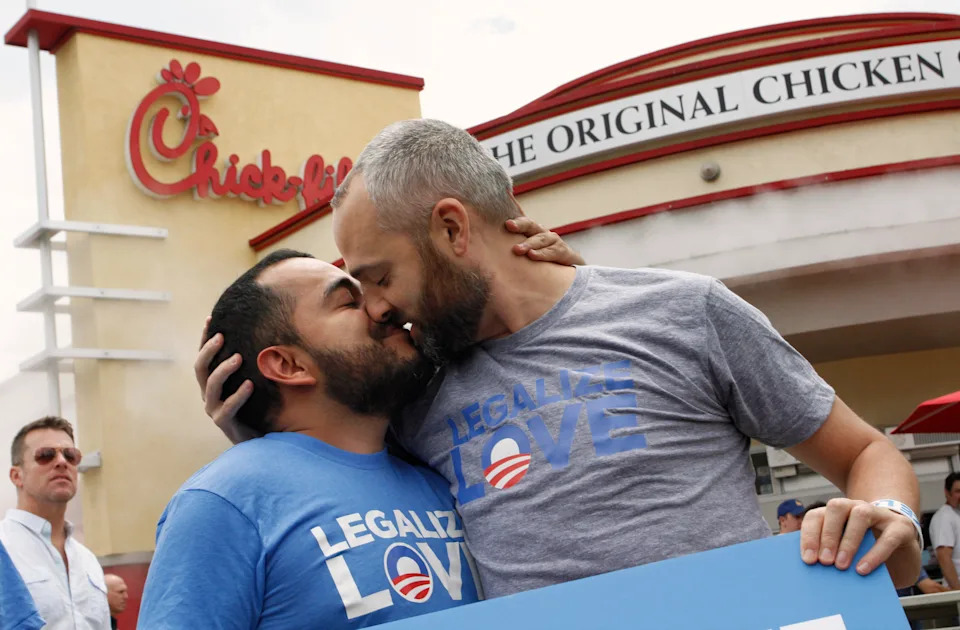
This separation strategy traces back to 2012, when Dan Cathy, then serving as president and chief operating officer, publicly opposed marriage equality in radio and print interviews. His comments triggered national protests, including same-sex “kiss-in” demonstrations at restaurant locations, and prompted then-Arkansas Gov. Mike Huckabee to organize a counter-mobilization dubbed Chick-fil-A Appreciation Day. Investigative reporting by LGBTQ media outlets subsequently revealed that the company’s WinShape foundation had funneled an estimated $5 million between 2003 and 2010 to organizations such as Exodus International, which promoted conversion therapy, and the Family Research Council, designated as a hate group by the Southern Poverty Law Center.
Facing sustained commercial risk, particularly in urban markets and among younger demographics, Chick-fil-A announced a strategic pivot in late 2019. The corporation shifted its charitable focus toward education, youth homelessness, and hunger relief, effectively cutting off direct corporate grants to the Salvation Army and the Fellowship of Christian Athletes due to their historical stances on LGBTQ issues. GLAAD responded with skepticism, pointing out that previous corporate promises to exit the culture wars had proven temporary, and called on the company to implement explicit workplace protections for LGBTQ employees.
Unlike competitors such as McDonald’s or Starbucks, which routinely publish detailed diversity reports and tie executive compensation to inclusion metrics, Chick-fil-A has historically kept its internal employment policies regarding sexual orientation and gender identity less visible to the public. The company currently employs more than 180,000 workers across its franchise network and emphasizes local community engagement, including $25,000 donations to food banks in markets where new restaurants open and meal distributions through its Shared Table program.
The current exclusion efforts carry distinct logistical weight compared to past consumer boycotts. The New York State Thruway Authority controls vendor contracts for dozens of rest areas undergoing renovation, meaning a legislative ban would permanently lock the chain out of high-traffic travel corridors. At Notre Dame, student petitions target the university’s dining services contracts, testing whether Catholic institutions will prioritize alignment with LGBTQ student advocacy over partnerships with a brand rooted in similar religious conservatism.
Dan Cathy assumed the role of chief executive in 2013 and transitioned to chairman of the board in 2021, elevating Andrew T. Cater to CEO. Despite the leadership shift, the founding family retains total ownership of the privately held corporation, which generated roughly $21 billion in systemwide sales in recent years.









