Erin Gates Renovates 1865 Wellesley Home, Shares Lessons in New Book
A three-year kitchen remodel and color-drenched living room lead the project
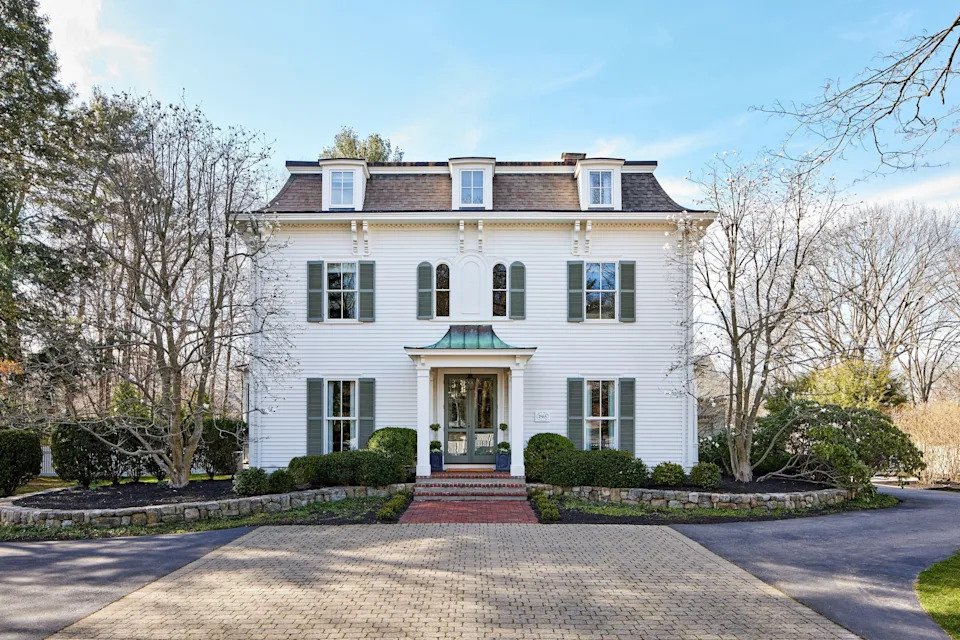
Interior designer Erin Gates did not set out to document a renovation. The book she ended up writing grew out of a house she bought in 2020.
The Wellesley, Massachusetts, property offered 11-foot ceilings, floor-to-ceiling windows and a grand staircase. Gates kept those historic details intact and layered in modern furniture, bold color and practical updates for her young family. The project is now the subject of her new book, “Elements of Timeless Style,” which she says documents not only what worked but the mistakes she made along the way.
The home’s age is part of its story. Built in 1865, the house predates Wellesley’s own incorporation by 16 years: the town was first settled in 1630 as part of Dedham and did not become independent until April 1881. The French Second Empire home is characterized by a steep mansard roof, a symmetrical façade and dormer windows set into the roofline, hallmarks of mid-19th-century design in New England and the Northeast. Gates did not try to modernize the structure itself; the previous owners had already handled the heavier work, leaving her to focus on the interiors.


“It just had a really lovely, graceful feel about it,” Gates said. Her approach to the historic home renovation — respecting the architecture while inserting contemporary pieces — became the through-line of the book. “It felt like a really nice, warm mix of traditional and modern design,” she added.
The centerpiece of the Wellesley home renovation is Gates’ induction range kitchen, which she designed over three years. Five case openings left little room for wall storage, so the team extended the cabinets to the 10.5-foot ceiling.

The kitchen’s standout features — an induction range and a full slab backsplash of strongly veined marble — are Gates’ favorites. One decorative element comes with a warning, though: the copper pots hanging on the pot rail do not work on the induction cooktop. “These are ‘looking pots,’ ” she said. “Items that are more for looks than function. So don’t try to use copper on induction.”

Induction cooktops generate heat from magnetic cookware, which is why the copper set serves only a visual purpose. For homeowners remodeling historic kitchens, that kind of mismatch between period-appropriate aesthetics and modern appliance technology is a common trade-off.
In the living room, Gates took the opposite approach to pattern. She color-drenched the space — painting walls, trim and ceiling in the same hue — settling on Benjamin Moore’s Wales Gray, a subtle blue with gray undertones, after a few test coats. Her husband, a self-described Christmas enthusiast, had declared the room his vision for holiday gatherings the moment he saw it, and a piano that sat in Gates’ childhood home — a housewarming gift from her parents — anchors the seating area.

The room’s scale and abundance of windows, which frame views of a New England winter, made the choice practical as well as aesthetic.
Not every room leans on color. In the family room, which Gates says the household occupies most of the time, she built on a neutral base to keep the space “luxe but livable.” The fireplace there was not original; Gates removed a half wall with an electric unit and replaced it with a full built-in gas range, a change she defended even though some advisers called it a stretch.

The dining room tells a similar story of intentional aging. Every fixture is new — including a custom table Gates designed with Huston & Company to mimic a French antique — but the room was assembled to read as a collected, older space, from vintage chairs to a crystal chandelier.

By her account, the book is a record of one house rather than a prescriptive style manual. It documents the renovation from purchase through completion, including the errors as well as the successes.