Latvian Nationals Arrested Under UK National Security Act After Breaching RAF Molesworth Intelligence Hub
Breach at $556M intelligence hub triggers first major use of UK's 2023 National Security Act
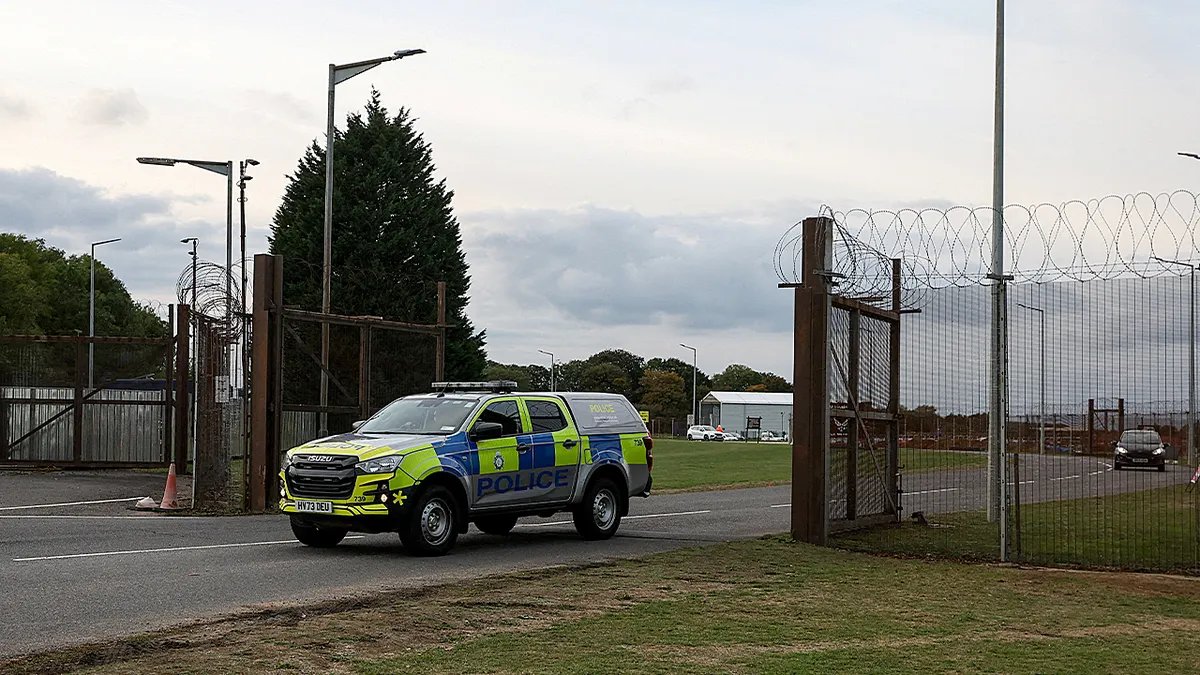
British counterterrorism police arrested two Latvian men legally residing in the United Kingdom early Thursday after they breached the perimeter of RAF Molesworth, a strategically vital installation that serves as the primary intelligence nerve center for U.S. military operations across Europe and Africa. The arrests, made under Section 4 of Britain’s National Security Act of 2023, mark one of the first high-profile applications of the legislation, which criminalizes entering a prohibited place for a purpose prejudicial to UK security.
The suspects, aged 32 and 36, were discovered inside the base around 2 a.m. following an eight-hour security operation triggered when Ministry of Defence Police found an abandoned vehicle near the fence line at approximately 10 p.m. Wednesday. Bomb disposal teams cleared the vehicle before armed officers located a fence breach and detained the men, initially on suspicion of trespass and criminal damage. Both were subsequently rearrested under the National Security Act and remain in custody as detectives execute search warrants at two residential addresses in Peterborough, roughly 15 miles from the base.
RAF Molesworth, managed by the U.S. Air Force’s 423rd Air Base Group, is a non-flying installation that hosts intelligence elements for U.S. European Command, U.S. Africa Command, and the NATO Intelligence Fusion Centre. Its strategic importance is underscored by a $556.5 million expansion currently underway to establish the Joint Intelligence Analysis Complex (JIAC), a facility designed to consolidate 20 separate intelligence facilities and accommodate more than 1,000 personnel by summer 2028. Defense Intelligence Agency Deputy Director Suzanne White described the project last year as enabling “the U.S. and allies’ shared mission of outpacing our strategic competitors and addressing threats together wherever they may arise.”


The National Security Act, which received royal assent in July 2023, replaced a patchwork of outdated espionage and official secrets laws with a modern framework targeting hostile state activity, sabotage, and foreign interference. Section 4 carries a maximum penalty of 14 years’ imprisonment. Legal experts note the legislation was crafted partly in response to Russian GRU operations on British soil, including the 2018 Salisbury nerve agent attack, and growing concerns about Iranian and Chinese intelligence activities in the UK.
U.S. European Command issued a statement Thursday praising the “swift British response” and confirming that “U.S. forces remain at the highest state of readiness” while the global security posture is assessed. The command emphasized the “close partnership with U.S. forces on matters of security.” The Pentagon has not commented on whether the breach compromised any classified operations or facilities.
Counterterrorism Policing London commander Helen Flanagan cautioned against premature speculation about motives, stating investigators have not established any connection between the Molesworth intrusion and recent security incidents at RAF Fairford, a Gloucestershire base used by U.S. strategic bombers. “We’re very aware of the recent heightened interest and concern around military sites,” Flanagan said. “We are keeping an open mind at this stage and inquiries are very much ongoing.”
The Fairford reference follows a series of unexplained drone sightings and perimeter breaches at UK bases hosting U.S. assets over the past 18 months, including incidents at RAF Lakenheath and RAF Mildenhall in Suffolk. British media have reported that security services are examining potential links to Iranian-backed networks, though officials have not publicly attributed any specific incident to Tehran.
RAF Molesworth’s history reflects the evolving transatlantic alliance. Originally a World War II airfield for the U.S. 15th Bombardment Squadron, it was deactivated in 1973 before transitioning to its current intelligence role. The JIAC project, which broke ground in April 2024, represents the largest U.S. military construction program in the UK in decades and is a centerpiece of the Defense Department’s European Infrastructure Consolidation strategy.
Flanagan confirmed Thursday that the investigation continues with no timeline for resolution.