How Los Angeles Renters Redesign Older Apartments Without Major Renovations
Inside a high-impact Los Angeles apartment redesign built around color, vintage finds, and flexible lighting
In Southern California’s dense multi-family residential housing market, tenant occupancy rates exceed 50 percent in West Hollywood and are roughly 60 percent across the city of Los Angeles. Interior designers and creative industry workers are increasingly deploying semi-permanent, high-impact customization techniques within leased properties.

Facing elevated regional rents, tenants in the home furnishings sector are using color saturation, modular layouts, and alternative lighting solutions to overcome architectural limitations in older rental buildings. When Julio Miranda-Martin entered the regional housing market in 2025, he focused specifically on finding a dedicated dining space within budget.


Miranda-Martin, a marketing coordinator for Los Angeles furniture maker Lawson-Fenning and founder of the furniture and lighting line Studio MM, found a listing on Zillow. He secured a 950-square-foot, upper-level unit in a fourplex on the border of West Hollywood for $2,500 per month.
The apartment has a traditional railroad-style floor plan, a sequential spatial layout developed in late 19th- and early 20th-century residential architecture in which rooms connect directly without a central hallway. Its location also provided proximity to Miranda-Martin’s workplace at Lawson-Fenning.
Lawson-Fenning is an established Southern California design firm known for its modern hand-crafted furniture and custom woodwork. It was founded by designers Glenn Lawson and Grant Fenning.
Raised as an only child in Downey, California, Miranda-Martin found that the apartment’s layout offered the necessary footprint to host group gatherings and dinner events. After meeting with the building’s owner and signing the lease, he prioritized two immediate interior modifications before moving in: repainting the interior surfaces and altering the ambient lighting systems throughout the property.
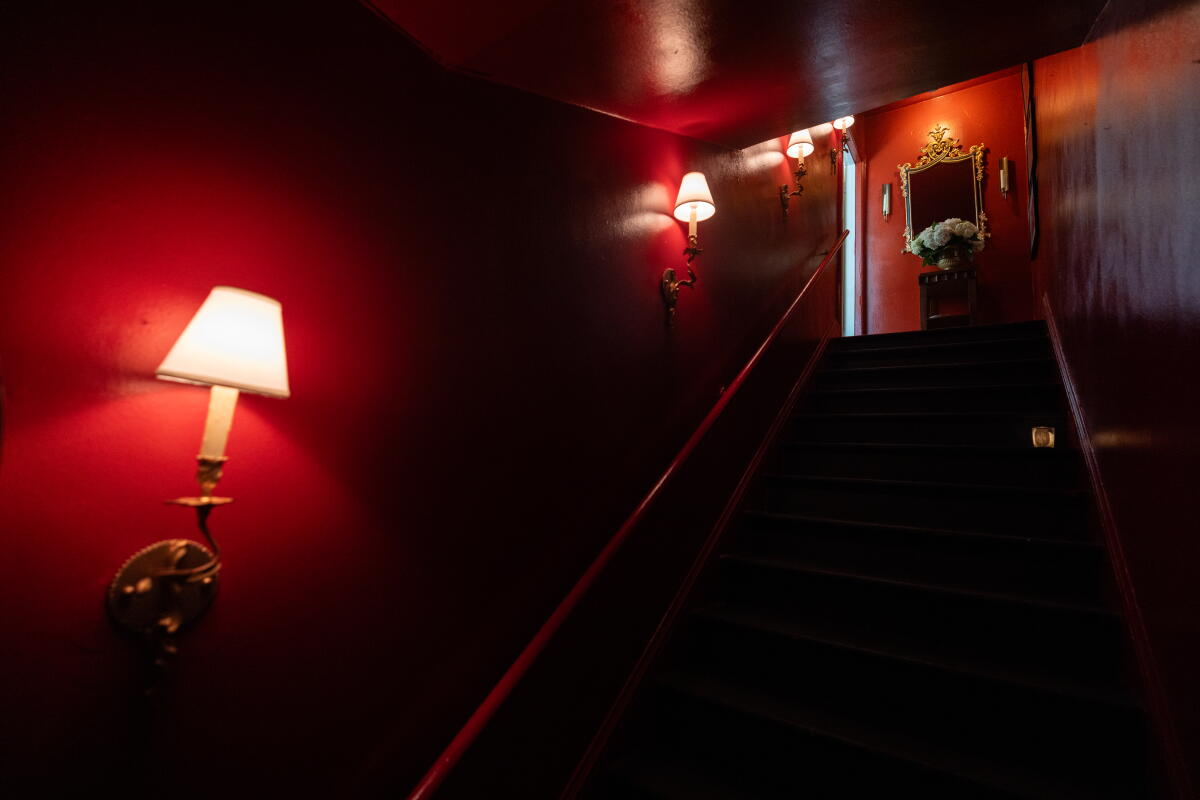
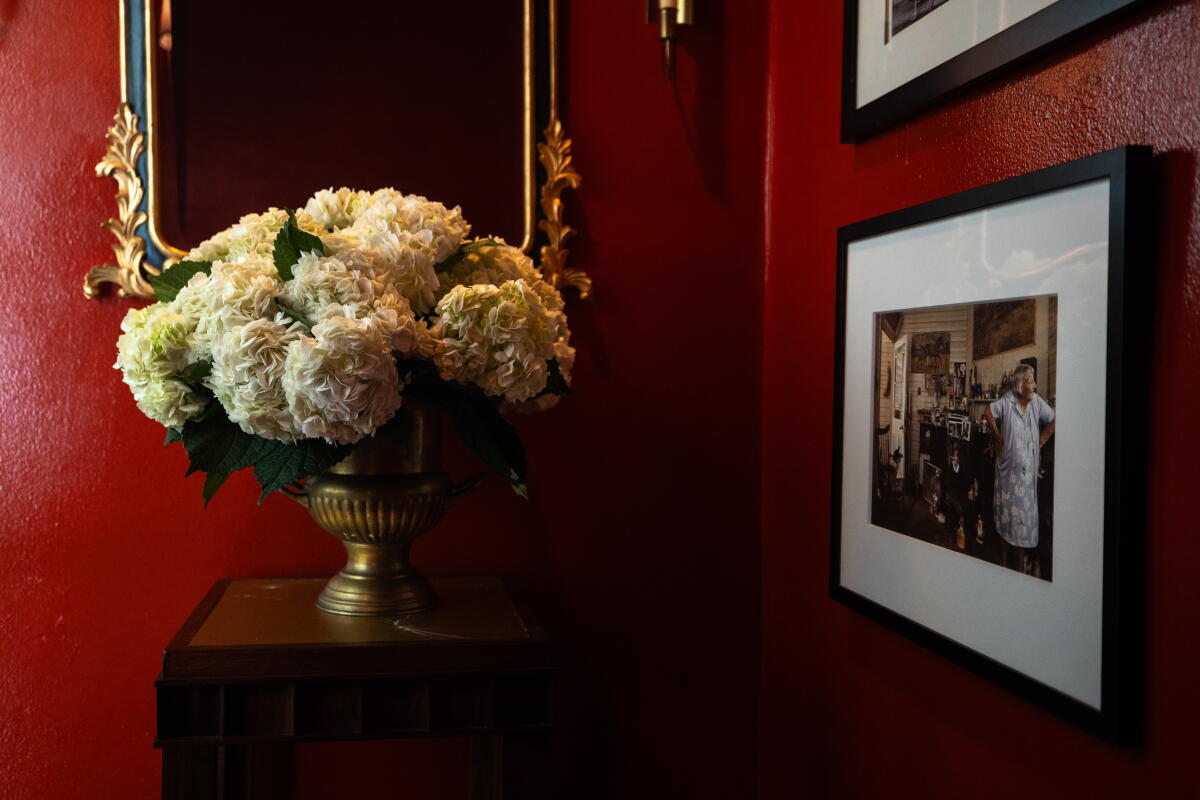
The second-floor entrance stairwell was windowless and had a total absence of natural illumination. Miranda-Martin coated its walls in high-gloss crimson paint.

Without adding recessed fixtures, he established baseline lighting by hard-wiring vintage wall sconces styled after 18th-century brass candlesticks. He acquired the sconces through Facebook Marketplace. At the top of the stairwell landing, he mounted an ornate framed glass mirror to reflect the interior rooms when the main door opens.
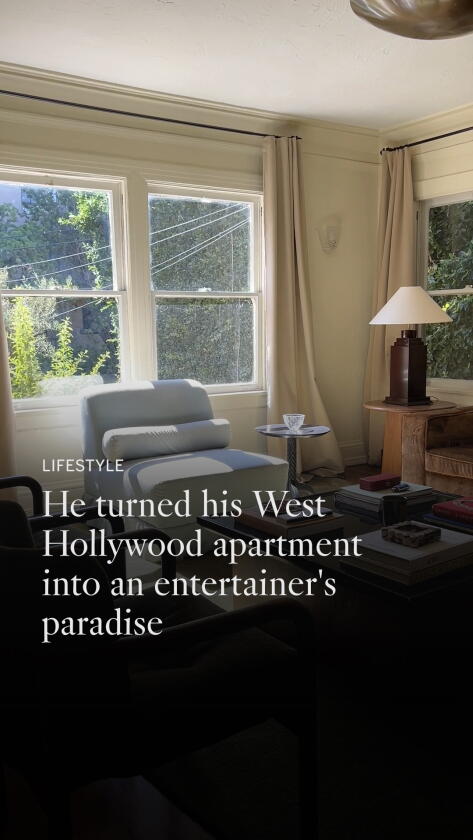
In the primary living area beyond the entryway, the visual palette shifts toward neutral tones designed to absorb natural light. West-facing windows in the living room are painted in Navajo White by Benjamin Moore, a flat off-white paint formulation widely used in interior design to reflect changing daylight hues.

The living room is arranged around a large modular sofa in dark brown velvet. Custom Art Deco-inspired side tables, table lamps, pale blue slipper chairs designed through Studio MM, and moveable pale pink cushioned ottomans provide the remaining furnishings and flexible seating.
Original French doors divide the living room from the adjacent dining room, where a deep chartreuse paint scheme complements the exterior tree canopy visible through the windows.

Instead of installing hardwired overhead lights, Miranda-Martin attached battery-powered, USB-rechargeable LED spotlights to the ceiling with magnetic mounts. He modified their color output with alcohol markers, creating a muted amber beam directed toward wall art.
A shell-encrusted wall mirror faces built-in shelving to visually open the dining room. It is paired with two matching shell sconces sourced from an estate sale in San Francisco.
His reliance on secondhand sourcing reflects broader shifts in the Los Angeles vintage market. Craigslist and Facebook Marketplace remain staple secondary markets, while estate sales in the metropolitan area have experienced notable price increases.
The increases have been driven by a surge in professional resellers and high consumer demand. Larger sales in central Los Angeles often employ private security personnel to manage entry and bag checks.
Additional non-structural alterations include pinch-pleat drapery panels from Ikea hung near the ceiling line to alter visual room height.