U.S. Markets Rally as Bond Yields Retreat From 1990s Highs
Treasury yields retreat from multi-decade highs while jobless claims hit 2023 lows, even as Bank of America's sell indicator nears a critical warning threshold.
Global equity markets surged and sovereign debt selling paused Friday after the yield on the 10-year U.S. Treasury retreated from 5.34% to 5.23%, easing pressure that had driven borrowing costs to levels unseen since the 1990s.
S&P 500 futures climbed 0.5% in early trading, extending a 0.19% gain from the previous session. European equities followed suit, with the Stoxx 600 rising 1.09% and the U.K.’s FTSE 100 adding 0.57%. In Asia, South Korea’s KOSPI advanced 0.46%, while Japan’s Nikkei 225 slipped 0.94%. Markets in India and China remained closed for national holidays.
The bond market reprieve coincided with a sharp pullback in energy prices. Brent crude fell to $99 per barrel from $102 the day prior, providing immediate relief amid escalating geopolitical tensions in the Middle East. The United States has urged European allies to release strategic diesel reserves immediately as conflict involving Iran threatens global fuel supplies. Washington also dispatched additional Patriot missile defense systems to protect Saudi Arabian and Qatari energy infrastructure, according to Axios.


Beneath the macroeconomic volatility, the U.S. labor market continues to defy widespread pessimism. Initial jobless claims for the week ended Sept. 26 totaled 197,000, down 1,000 from the prior week. Continuing claims dropped to 1.701 million, marking the lowest level since 2023. Jefferies economists Thomas Simons and Blake Birkins attributed this resilience partly to demographic shifts, noting that nearly 11,000 Americans turn 65 every day, naturally tightening the available workforce regardless of corporate layoff headlines or anxieties over artificial intelligence displacing jobs.
That underlying employment stability is fueling consumer spending at a pace that outstrips disposable income growth. According to Piper Sandler analysts Jake Oubina and Nancy R. Lazar, American consumption is currently sustained by record household net worth tied to housing and stock valuations. They estimate it would require a 30% drawdown in asset prices to meaningfully stall spending behavior, which accounts for up to 70% of U.S. gross domestic product.
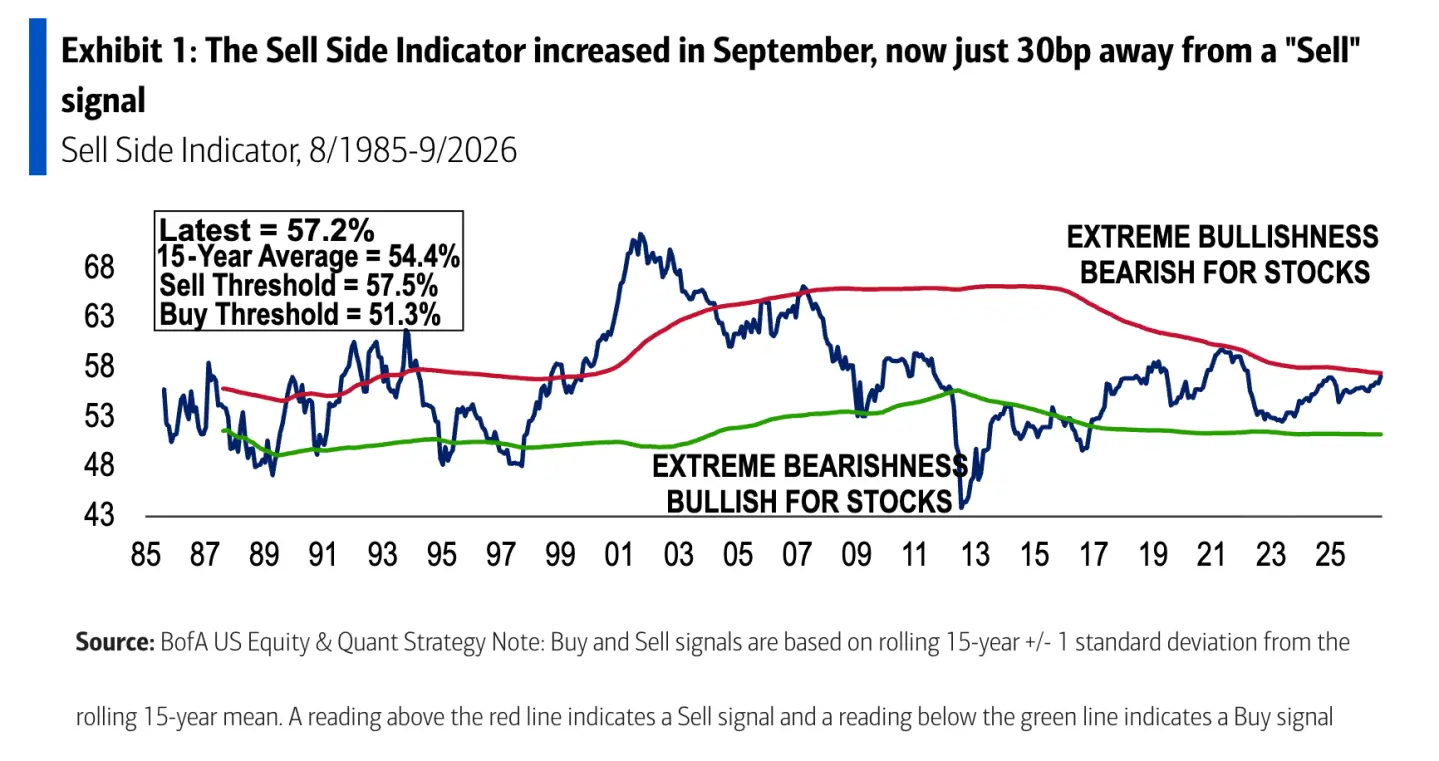
Yet Wall Street strategists are approaching those record valuations with increasing caution. Bank of America’s sell-side indicator, which measures recommended equity allocations in balanced funds, sits just 0.3 percentage points away from triggering a contrarian “sell” signal. Historically, when the indicator reaches this threshold, S&P 500 returns over the following 12 months have averaged 7%, but turned negative 36% of the time compared to a 17% historical baseline dating back to 1985.
Investor anxiety is further complicated by shifting industrial timelines. General Motors CEO Mary Barra acknowledged that the electric vehicle transition is progressing slower than Detroit anticipated, particularly after the Trump administration rolled back key adoption incentives. Automakers previously modeled their production pipelines around EVs comprising 40% to 50% of sales by 2030, a target now widely viewed as unreachable in the near term. Barra stated she no longer makes timeline predictions, though GM plans to introduce eyes-off-the-road highway driving on the Cadillac Escalade IQ in 2028 as a stepping stone toward full autonomy.
Meanwhile, the rapid commercialization of AI continues to generate both massive enterprise value and physical security risks. GPTZero, an AI-detection tool built by Princeton student Edward Tian shortly after ChatGPT’s mainstream debut, was acquired in June by Superhuman, the productivity company formerly known as Grammarly. PitchBook data valued the startup at more than $88 million, delivering at least a 10x return on its $13.5 million in total funding. The platform now serves over 20 million registered users and generates $30 million in annual recurring revenue.
The hardware powering that software boom remains a lucrative target for organized crime. Thieves recently stole two trucks bearing Nvidia logos from autonomous trucking company PlusAI’s warehouse in Fremont, California. Each Nvidia chip can command up to $40,000 on the black market. The hijackers discovered only 20,000 pounds of sand in each trailer, used as ballast for test vehicles. Supply-chain risk management firm Overhaul has tracked more than $150 million in stolen AI equipment cargo since it began monitoring the sector.
Bitcoin traded at $86,137 in morning sessions.