Tesla Emergency Drive Away lets drivers flee Superchargers
The software override bypasses the charge-port lock but carries up to $25,000 in potential hardware damage if used outside a crisis.
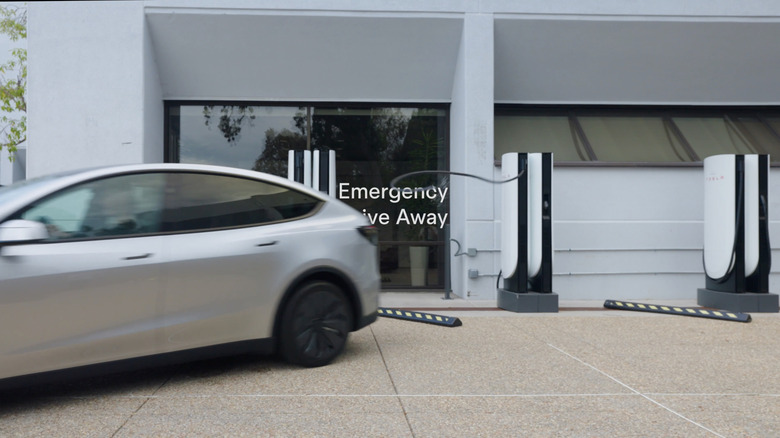
Tesla has deployed a software override allowing drivers to shift into gear and leave a Supercharger stall without disconnecting the cable, a safety mechanism introduced after a fatal shooting trapped a driver inside a charging vehicle in Idaho earlier this year.
The Emergency Drive Away feature requires the driver to hold the brake pedal and tap an activation prompt on the center touchscreen. Once engaged, the vehicle ignores the standard charge-port interlock that prevents shifting out of Park while plugged in. The system explicitly warns users that driving away with the tether attached will destroy both the vehicle’s high-voltage port and the station’s charging hardware.
Under normal operating conditions, Tesla vehicles lock the charging connector into the port to prevent theft or accidental disconnection during a session. Releasing it requires pressing a button on the handle, using the mobile app, or navigating the infotainment menu—steps that consume critical seconds during a violent encounter or natural disaster. The new bypass eliminates those steps entirely when a threat is imminent.


The update follows the killing of a driver inside a Tesla robotaxi at an In-N-Out Burger parking lot in Twin Falls, Idaho, where the vehicle was connected to a charger. That incident exposed a vulnerability in the architecture of electric vehicle charging protocols. Unlike pumping gasoline, which involves a nozzle easily dropped in a panic, DC fast-charging cables are thick, liquid-cooled tethers weighing several pounds, locked mechanically and electronically into the car. Owners immediately demanded a rapid-release option, even suggesting they would accept financial penalties for its use to deter abuse.
Tesla confirmed the feature is currently restricted to U.S.-based Supercharger stalls and requires the latest over-the-air software installation. Vehicles built before 2021, specifically older Model S and Model X sedans, lack the necessary hardware integration to support the override. The limitation stems from differences in the charge-port controller architecture introduced during the company’s subsequent manufacturing refreshes.
The automaker warned that deliberate misuse outside genuine emergencies will trigger additional penalties. When questioned about the financial fallout of tearing a cable out of a live 250-kilowatt V3 or 480-amp V4 Supercharger, Tesla stated that electrical and civil costs could reach $25,000. Standard Supercharger cables contain complex wiring for power delivery, communication handshakes, and thermal management; severing them under load risks arc flashes, coolant leaks, and total destruction of the stall’s internal power electronics.
Whether Tesla intends to waive these repair costs for drivers who can prove they activated the system during a legitimate life-threatening event remains unclarified. The company announced the rollout via its official X account alongside a brief demonstration video, confirming availability across the supported domestic fleet as of early October 2026.