NFL Week 7 Bye Teams Face Key Fantasy Football Questions
Underlying usage trends for the Bengals, Bills, Chargers, and Commanders reveal critical fantasy football decisions ahead of their Week 7 break.
Four NFL franchises sit idle during Week 7, leaving fantasy football managers to evaluate roster vulnerabilities that emerged before the break. The Cincinnati Bengals, Buffalo Bills, Los Angeles Chargers, and Washington Commanders each carry distinct schematic uncertainties into their time off, forcing lineup decisions that hinge on underlying usage trends rather than surface-level box scores.
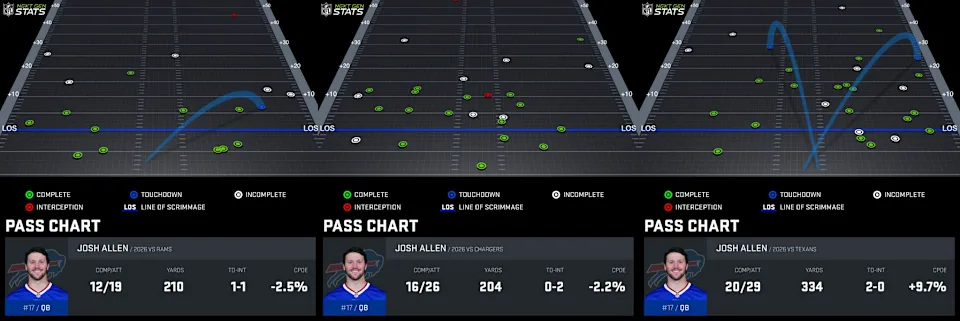
The most pressing concern surrounds Buffalo’s passing attack without wide receiver DJ Moore. Since Moore injured his shoulder in Week 2, quarterback Josh Allen’s distribution has shifted dramatically away from intermediate middle-of-the-field concepts. During Monday night’s loss to the Rams, Allen faced a 39.3% pressure rate—consistent with his recent outings—but altered his philosophy entirely. Wide receivers commanded a season-high 70% target share against New England previously, but the Rams game saw running backs absorb 33.3% of targets and tight ends 27.8%. Allen scrambled on 28.6% of his dropbacks against Los Angeles, a massive spike compared to roughly 3% in prior weeks. For fantasy purposes, tight end Dalton Kincaid becomes the primary beneficiary if Moore remains sidelined, particularly against a Las Vegas Raiders defense that struggled in coverage against New England. Allen’s 2.81-second average time to throw remained stable despite the chaos, indicating the offensive line held up better than the final score suggested.
Jacksonville presents a different dilemma for fantasy rosters built outside of wide receiver Parker Washington. Quarterback Trevor Lawrence operates in one of the league’s most pass-averse environments, ranking 24th in Pass Rate Over Expectation at -3.2% and 26th in dropbacks per game (31.6). However, tight end Brenton Strange has quietly become Lawrence’s preferred safety valve over the middle of the field, commanding a 26.3% target share in that area over the last three weeks. Strange’s metrics align with elite fantasy production thresholds: an 11th-ranked route rate among qualifying tight ends (77.5%), a fifth-ranked targets-per-route-run clip (26.6%), and the second-best yards-per-route-run figure (2.47). Crucially, Strange is deployed almost exclusively as a receiver, carrying a mere 10.2% pass-blocking snap rate. Against a Houston Texans defense that surrendered 185 receiving yards on 16 targets to opposing tight ends like Kincaid and Tyler Warren earlier this season, Strange profiles as a high-floor streaming option.


Los Angeles enters its bye week needing to solve a ground-game identity crisis under offensive coordinator Mike McDaniel. While rookie Omarion Hampton carried second-round draft capital into training camp, Kimani Vidal and Keaton Mitchell have proven far more effective on specific concepts. The Chargers rank 22nd in early-down rushing success rate (41.7%) and 15th in adjusted yards before contact per attempt (0.83), routinely falling behind the chains and leaving Justin Herbert facing the ninth-longest average distance to move on obvious passing downs (8.3 yards). Opponents have adjusted; Denver loaded eight or more defenders into the box on over half of Vidal and Hampton’s early-down carries. The blueprint for attacking Kansas City Chiefs defensive coordinator Steve Spagnuolo in Week 6 lies on the perimeter. Jonathan Taylor and Ashton Jeanty both exceeded a 40% rushing success rate against Kansas City by leaning heavily on outside zone runs—Taylor generated 64% of his success on the concept, while Jeanty hit 60%. Vidal (4.37-second 40-yard dash) and Mitchell (4.37) have combined for 189 yards on 38 outside zone attempts, significantly outperforming Hampton’s efficiency on similar plays and dropping Herbert’s average yards needed for a first down to 7.1.
Washington’s offensive hierarchy has fractured enough to prompt discussions about abandoning non-quarterback assets entirely. Eighth-year veteran Terry McLaurin maintains his traditional deployment—over 80% of snaps on the perimeter with a 12.8-yard average depth of target—but his volume has evaporated. Even accounting for Stefon Diggs’ presence, McLaurin trailed tight end Chig Okonkwo (26.1% target rate, 26.0% air yard share) and Treylon Burks (21.7% target rate) during Week 5. Weather played a role, but interior routes dominated regardless of conditions, neutralizing McLaurin’s boundary skill set. His current weekly output mirrors that of unproven depth pieces like Emeka Egbuka, making his name value in trade markets vastly superior to his on-field production.
The Commanders’ backfield rotation further complicates roster construction. Jacory Croskey-Merritt leads the committee in explosive gains but lacks the early-down efficiency required to separate himself from Rachaad White, while Austin Ekeler continues siphoning passing-down work. Jayden Daniels’ elite mobility inherently caps the ceiling for any Washington running back, creating a dynamic similar to James Cook III’s volatile environment in Buffalo. Croskey-Merritt found limited success on outside zone runs—the same concept Seattle utilized effectively against Washington in Week 5—but continued three-way splits threaten his roster viability beyond the bye.
Cincinnati heads into its own break needing to clean up execution issues publicly acknowledged by Joe Burrow following Sunday’s victory. The Bengals return to action against Baltimore, a divisional matchup that will test whether their time off resolved the operational inconsistencies lingering through the first six weeks.