At 3:06 a.m. on Saturday 14 November, the security staff at Threod Systems, a drone maker in Viimsi just north of Tallinn, stopped a group breaking into the building. The plan, as Prosecutor General Astrid Asi described it the next day, was to smash the windows, pour in flammable liquid and set the building on fire, with an explosion to follow. Nobody was hurt. The building took no significant damage, production and deliveries were not affected, and the eight people detained that night were all residents of Latvia.
The police had been warned. Latvia’s State Security Service, the VDD, passed risk information to Estonia’s Internal Security Service, KAPO, on 13 and 14 November. On the 14th, Latvian officers searched nine properties in Latvia and seized explosive devices, pyrotechnics, ammunition, mobile phones and data storage devices. Prosecutors asked a court to remand five of the eight. Several of them have criminal records, according to Latvia’s prime minister, Andris Kulbergs. An Opel car was set on fire near the site the same night, and investigators believe the group used it to travel to and from Viimsi. Their names have not been released, and the case is being investigated as acts against national security on behalf of a foreign intelligence service, a charge that carries up to 15 years.
KAPO’s director general, Margo Palloson, attributes the operation to Russia’s GRU, though the evidence behind that assessment has not been published. Two days after the attempt he told the broadcaster ERR that Russia is currently targeting around 10 defence industry companies in Estonia, and that the security service had known quite a bit about the Threod attempt in advance. Recruitment runs through criminal networks, social media and pressure on people travelling to Russia, he said, and there have been cases of sabotage and orders for attacks for which people were paid just a few hundred euros. Over recent years KAPO has exposed more than 50 people who collaborated with Russian security services, and 16 collaborators were detained in 2025 alone, most of them ordinary civilians. KAPO posted on X: “We advise against even considering such job offers from Russia.”

The attack on Threod was the second in three months. On the night of 14 to 15 August, a building belonging to Milrem Robotics, the maker of the THeMIS unmanned ground vehicle, was set on fire on Betooni Street in Tallinn. Residents spotted it, and the fire was contained quickly. Two Latvian nationals were detained in Latvia on 17 August and a third the next day, and all three were handed over to Estonia and remanded. On 29 September the Estonian government said it could say with full confidence that the fire was sabotage commissioned by Russian special services. Foreign Minister Margus Tsahkna summoned the Russian chargé d’affaires, and the Kremlin called the accusation groundless. Milrem has more than 150 of its vehicles due in Ukraine, funded by the Netherlands.
The reason Threod is on the list is written in its order book. Founded in Viimsi in 2012, the company builds Eos reconnaissance drones, eOpic camera gimbals and Cata pneumatic launchers, and its drones have flown for Ukrainian forces since 2017, several dozen of them on reconnaissance and artillery guidance. Ukrainian forces use its Cata launchers to send long-range strike drones towards Russia, a company executive said in September 2025. In March 2026 the British Army chose the launcher for its ASGARD programme, in contracts worth about £5.995 million, and in mid-October a Cata B launched Royal Navy strike drones from the aircraft carrier HMS Queen Elizabeth. Revenue reached €38 million in 2024, up 87 percent on the year before.
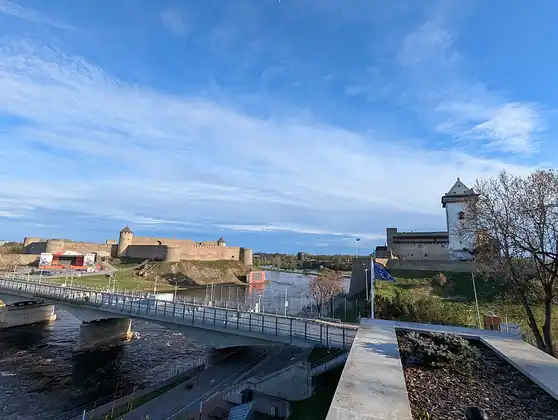
The government made the closure formal on 20 November, in Decision No. 195. From 7 a.m. on 1 December, five road crossings will close for six months: Narva-1, Narva-2, Koidula, Luhamaa and Saatse. Only three of them are in active use, and at Narva, the busiest, Russia suspended vehicle traffic in February 2024, leaving pedestrians. Rail freight will continue, under strict customs checks. The stated purpose is to make it harder for Russian intelligence services to recruit and influence people, and to help prevent sanctions evasion. The eight came from Latvia, and so did the warning that stopped them. Crossings fell from more than four million a year before 2022 to about 760,000 in 2026, and goods exports to Russia are down to about a third of their 2021 level.
Not everyone in Narva thinks the closure is the answer. Interior Minister Igor Taro told ERR the suspects had not entered Estonia from Russia at all, they arrived from Latvia. Katri Raik, the former mayor, said families spent the evening of 15 November discussing how to visit relatives, and that after the closure the route from St Petersburg to Narva runs through Istanbul. “Narva is no longer a bridge city, but a dead end,” she said. Vladimir Aret, the owner of Hotel Narva, said businesses had expected a closure for about a year but two weeks was too little notice, and Ruslan Dõškant, who runs the Old Trafford restaurant, called the decision the wrong answer and said it would push more people to leave. President Ülle Madise urged caution so that emotions would not drive security policy. And in the threads where Estonians are discussing the closure, one commenter points to the people the decision strands on the other side. “It also means the citizens of Estonia living on legally Estonian land that was stolen by Russia in 1945 can no longer enter Estonia. Many of them worked in Estonia and crossed the border daily or weekly,” wrote u/lendlevtaldrik on Reddit.
Moscow answered on Monday 23 November, summoning Estonia’s chargé d’affaires, Marek Uhtegi, and accusing Tallinn of hostile actions “on the verge of triggering open war”. The foreign ministry’s list of grievances ran from the border closure to Estonia tacitly allowing Ukrainian drones through its airspace and obstructing Russian cargo ships in the Baltic. It added the ban on Russian and Belarusian grain transit, a bid to ban the Russian language and a threat to close the Russian Orthodox Church. It said Russia “reserves the right to take comprehensive political and diplomatic measures”. The Kremlin’s spokesman, Dmitry Peskov, said Estonia was “building a wall”, and foreign ministry spokeswoman Maria Zakharova said the closure “infringes the rights and interests of a substantial number of our compatriots”. Estonia’s foreign ministry denied allowing its territory to be used for military operations by another country. NATO Secretary General Mark Rutte, in Berlin, said the alliance was monitoring Estonia and the Russian missile incursion into Poland, and that there were “options available to respond”.
The border is not the only place the war is arriving. On Saturday 21 November, two drones hit the Russian-flagged cargo ship Sparta II in international waters in the Gulf of Finland, about three nautical miles from the Russian border, while it was bound for Kaliningrad. The ship’s 16 crew members were evacuated to a nearby Russian vessel. The fire was fought by the Finnish Border Guard, an Estonian navy patrol ship and the Russian rescue ship Murman, and a Russian helicopter violated Finnish airspace by more than four kilometres. The ship drifted into Finnish waters, anchored off Loviisa, and was towed out on Saturday night. It arrived in St Petersburg on Monday. Finland’s defence forces said Ukraine was likely behind the strike. Finland’s prime minister, Petteri Orpo, wrote on X that “war is spilling over into our immediate vicinity”. Estonia’s navy commander, Ivo Vark, told ERR that further attacks in the Gulf of Finland cannot be ruled out. Earlier in November, Finland detected a strike on a Russian warship in the gulf, which Ukraine took credit for, and Helsinki raised concerns with Kyiv.
The people who live with the border read the Estonia border closure differently from the people who announced it. “Narva is a kind of unique city: it was a single city during Russian Empire, and now it’s split in two (Narva in Estonia and Ivan-Gorod in ruzzia) right across the river, with a big bridge that doubles as controlled border crossing point.” That is u/No-Refrigerator-1672 on Reddit, who added that Valka/Valga, a city split between Estonia and Latvia, still lets people walk between its two halves freely. The officials speak of recruitment channels and hybrid war. The voices from the border speak of time. “I have never been to russia, so never crossed border to east. But that border should have been closed already in 2022,” wrote u/M2dis. Both comments were posted on 20 November, the day the closure was made formal. “Too late, but at least it was finally closed. No country should have open borders with an agressor,” wrote u/dustofdeath.
An unnamed European intelligence officer told the investigative reporter Holger Roonemaa that Russia’s FSB questions travellers entering Russia about the defence industry, seizes their devices and sometimes tries to recruit them. Estonia’s three road crossings are the main points where its residents enter Russia by land.