“The Americans raised a question: ‘What if Ukraine joins NATO? Would Ukraine withdraw from Donbas?’ This was the first time this had been raised.” Volodymyr Zelensky told reporters that on Friday, and his office released the remarks on Saturday. He called it proof that NATO is “again on the agenda”, and said that if the Americans confirmed the offer with the other allies, he would put it to Ukrainians: “do we accept it or not? I have no right to make that decision on my own.” He named the price of his yes: guarantees from NATO and the European Union, a strong army with its funding assured, money to rebuild, Article 5 as “an absolute minimum”, and no recognition of occupied territory as Russian. When he asked whether American soldiers would be deployed under such guarantees, the American side answered “No,” he said; what was described to him was bilateral guarantees “similar to those Israel has.”
Three days earlier, Zelensky had reported the same question differently. In a Telegram post during the Abu Dhabi talks on Tuesday, he said the Americans asked whether Kyiv would “trade the Donbas for security”, and that when he asked whether that meant NATO membership, the answer was no, it meant “something similar.” He added the warning that has followed every version of this trade: “No one believes that Putin will stop if we give up the Donbas. He might pause, but then he will return in a year, two years, or five years.”
Whether the envoys used the NATO wording in Dublin on Thursday, after their meeting with Putin in Moscow, is not on the public record. Zelensky did not say which American asked the question, or on what day. The White House has said nothing on the record about a Donbas-for-NATO exchange. The version the Americans did put on the record themselves came a day before the Telegram post, and it was addressed to Moscow, not Kyiv. A senior American official told Politico on November 9 that Washington had asked Russia to accept “an Article 4 and an Article 5-like security guarantee” for Ukraine, “along with NATO providing the same”, in exchange for Kyiv ceding the rest of Donbas. Secretary of State Marco Rubio, asked about it the next day, said no final plan had been approved, and that whatever guarantees emerged would have to be acceptable to Russia as well. Europe will send three to five representatives to the next round of talks, chosen by the end of November.
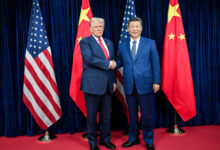

In February 2025, Defense Secretary Pete Hegseth said the United States does not believe NATO membership for Ukraine is “a realistic outcome of a negotiated settlement”, and ruled out American troops in any guarantee, a position Donald Trump endorsed the same day. Nine months later, the 28-point American plan asked Ukraine to do the opposite of what Friday’s question implies: its seventh point prohibited NATO membership, and its twenty-first withdrew Ukrainian troops from the fortified Donbas and recognised Crimea, Luhansk and Donetsk as de facto Russian, including by the United States. The plan also capped Ukraine’s army at 600,000.
Mark Rutte, NATO’s secretary general, named the countries withholding it in Warsaw last December: “countries like Hungary, the United States, Slovakia, and maybe a couple others”, “for practical reasons, NATO is not possible now.” He had said earlier that month that there was no consensus on Ukraine joining. In April he named Germany too, and said accession was “not currently on the agenda.” In Berlin last December, Zelensky himself offered to set the NATO bid aside for legally binding guarantees, “already a compromise on our part”, and the European Union’s foreign policy chief, Kaja Kallas, said accession was no longer on the agenda. At a briefing with Chancellor Friedrich Merz the next day, Zelensky clarified that the constitutional course toward NATO would stay.
Valerii Zaluzhnyi spent twelve years bringing Ukraine’s army up to NATO standards. In August, the former commander-in-chief told a meeting of Ukraine’s ambassadors in Kyiv: “I know NATO very well. For about 12 years, I personally worked on bringing Ukraine closer to NATO standards, and every year I heard the same fairy tale that we would join soon. Unfortunately, we will never join NATO.” Days later he said he backs the alliance but it must rebuild its doctrine first, and the Foreign Ministry said his words had been taken out of context.
Kyiv still controls 20.12 percent of Donetsk Oblast, 5,382 square kilometres by the Institute for the Study of War’s October count, including Sloviansk, Kramatorsk, Druzhkivka and Kostiantynivka, the fortified belt Russia has failed to take. In Abu Dhabi, Russian officers claimed Moscow already held half of that ground; Zelensky said his negotiators answered with video, and the Americans backed Kyiv’s picture of the front. The Economist reported that American negotiators had also proposed redrawing the two oblasts’ administrative borders, so Russia could claim the whole of Donbas without Ukraine surrendering the ground it still holds, a proposal whose legal status for that ground nobody has explained. Vladimir Medinsky, who led Russia’s delegation, told Russian television there was no possibility of territorial exchanges at all.
Article 73 of Ukraine’s constitution says questions of altering the country’s territory are decided exclusively by an all-Ukrainian referendum. Article 19 of the martial-law statute bans national referendums while martial law runs. Parliament extended martial law for the twenty-first time on October 26, by 293 votes, through January 29, 2027, 1,800 days after it began. A referendum cannot be held until martial law ends, and a territorial change cannot be made without one.
For five days running, Starshield terminals in the occupied territories have been restricted to speeds of up to 161 km/h, which the Ukrainian side says makes it impossible to intercept jet-powered Shahed drones before they cross the front line. SpaceX cites technical reasons. Zelensky’s reading was political: “If you impose restrictions there, you are already partially refusing to recognize the temporarily occupied territories as ours.” Ukraine is testing alternative satellite links with France, Norway, Denmark and Finland, with Germany to join.
“Do you think the US can be guarantors????? They already were, in Budapest. Our guarantor is our armed forces. In this world, the word trust has disappeared,” Lyudmyla Shakhbazova wrote on Facebook on Saturday, answering a Ukrainian news page’s question about whether the swap was acceptable. “No one is taking us into NATO. Hand over Donbas. And what then?” Iryna Martsenkevych wrote under the same post. Ivan Ogolobyak, there too: “What NATO guarantees? They themselves need to be given guarantees. NATO is a complete zero in case the situation escalates.” On Threads, remingtonsteale put it in English: “The US cannot be trusted, they screwed Ukraine over with the Budapest agreement already and that was before Trump.”
Two of the four reach for 1994, when the United States, Britain and Russia assured Ukraine’s security in exchange for its nuclear weapons. The memorandum did not stop 2014, or 2022, and the commenters treat it as the test the new guarantee has already failed. Zelensky asks society whether it accepts the Donbas NATO swap; the first answers say the question is wrong, because the guarantee is the part nobody trusts. Martsenkevych states as a fact what Rutte’s record states as a procedure: no one is taking Ukraine into NATO.
Kostiantynivka, the city Russia’s “humanitarian operation” was meant to empty, is still in Ukrainian hands after a year and a half; Zelensky said the operation was an attempt to force the army out and open the way to Kramatorsk and Sloviansk, and that Ukraine gave the Americans a list of seven or eight villages near Oleshky where civilians, including children, are genuinely trapped. Russia ignored it. October was the costliest month of the war for Russian forces by Kyiv’s count: 54,000 killed or severely wounded.
The talks did produce one agreement. The White House said they made progress toward a prisoner exchange of more than 1,000 people each way; Kyiv puts the expected number at 1,200 to 1,300.