China’s ‘Industrial Victory’: Heatwaves Expose Europe’s Reliance on Beijing for Cooling
Beijing frames record appliance sales as a strategic manufacturing triumph over European competitors.
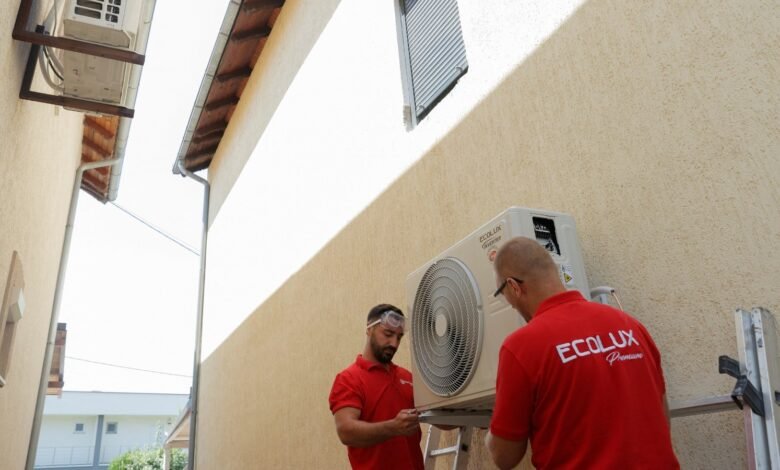
As record-breaking temperatures scorched France, Britain, and Spain this June, the surge in demand for relief has highlighted a widening industrial gap between Europe and China. Beijing is increasingly framing the massive influx of Chinese-made air conditioners into European homes not merely as a seasonal spike, but as a strategic “industrial victory” that underscores the continent’s manufacturing vulnerabilities.
Customs data from China reveals that exports of air conditioning units to France, Britain, and the Netherlands jumped by more than 55% in May compared to the previous year. This surge comes as the International Energy Agency notes a global trend toward increased cooling demand, yet only an estimated one-fifth of European households currently possess air conditioning systems.
Major Chinese manufacturers, including Midea, Haier, and Gree, have moved aggressively to fill this void. A standout performer has been Midea’s “PortaSplit” unit, a portable system specifically engineered to bypass strict European building regulations that often prohibit permanent modifications to historic or residential facades. According to a regional sales manager cited by the state-run Xinhua news agency, Midea has sold over 200,000 units of this model in Europe this year—double its volume from last year.
This dominance is fueling internal Chinese narratives regarding the country’s economic evolution. State-owned media outlets have celebrated the stockouts of these units as evidence that China is successfully shedding its reputation for low-end electronics in favor of high-value innovation. Chinese diplomats have even circulated footage of Midea’s automated facilities, which are capable of assembling a new unit every six seconds.
Beyond the logistics of manufacturing, the trend highlights a deeper friction regarding trade imbalances and what economists call the “Second China Shock.” While European firms possess the technical expertise to design cooling systems, they struggle to compete with China’s massive scale and integrated supply chains. Tianchen Xu, a senior China analyst at the Economist Intelligence Unit, noted that European manufacturers lack the capacity to produce such specialized units in high volumes at competitive costs.
Beijing’s official stance remains focused on the pragmatic nature of the exchange. Foreign Ministry spokesperson Mao Ning recently stated that trade is driven by market demand and economic integration. Similarly, Ding Chun, director of the Center for European Studies at Fudan University, argued that the phenomenon is centered on meeting the daily needs of people, regardless of the broader geopolitical climate.
In China, the saturation of cooling technology has reached a point where the number of air conditioning units exceeded the total number of households by 2024. In contrast, European consumers remain constrained by both infrastructure and regulatory hurdles, leaving them increasingly dependent on Chinese agility to navigate a warming climate.