Tether Secures Shariah Certification for Gold-Backed XAUt Token to Tap $3 Trillion Islamic Finance Market
Amanah Advisors grants Shariah compliance approval for XAUt, opening doors to Islamic institutional investors across the Middle East and South Asia.
Digital asset issuer Tether has secured Shariah compliance certification for its gold-backed token, XAUt, following an independent evaluation by Islamic finance advisory firm Amanah Advisors.
The certification establishes a clear framework for Islamic institutional investors, sovereign wealth funds, and retail wealth managers across the Gulf Cooperation Council (GCC), South Asia, and North Africa to gain exposure to tokenized physical precious metals. Under Islamic jurisprudence, financial transactions must strictly prohibit interest (riba), excessive uncertainty (gharar), and unbacked financial leverage.
To satisfy these requirements, XAUt is structured as a direct allocation instrument. Each digital token represents ownership of one troy ounce of physical gold stored in Swiss vaults. Tether’s transparent audit mechanisms and physical redeemability were key elements in demonstrating compliance with classical Islamic rules governing currency and precious metal exchanges.
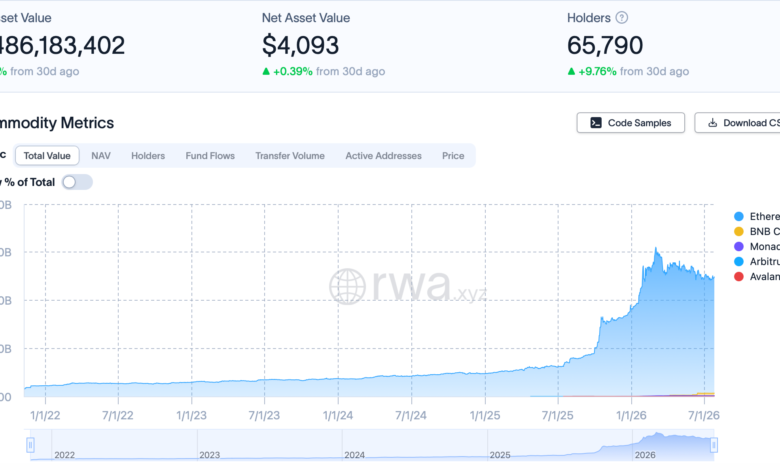
The approval comes amid significant growth in the market for tokenized real-world assets. Data compiled by RWA analytics platforms shows that XAUt’s on-chain asset valuation grew from approximately $700 million in mid-2025 to roughly $2.5 billion, placing it among the largest gold-backed digital products in the digital asset industry.
Tether’s latest reserve disclosures indicate that total holdings backing the asset exceed 707,000 troy ounces of physical gold, representing a market value of over $3.3 billion as of late March.
The global Islamic finance sector, estimated to control over $3 trillion in assets, has traditionally taken a cautious approach toward unbacked cryptocurrencies due to concerns over intrinsic value and speculative trading. However, tokenized real-world commodities and asset-backed stablecoins are increasingly viewed as compatible with Shariah principles.
This certification is part of a broader trend of crypto products aligning with Islamic compliance standards across the Middle East. Earlier this year, Palm Azgar Finance launched its Shariah-compliant PUSD stablecoin on the ADI Chain to enable dual-currency settlement alongside dirham-denominated assets. In 2025, Bahrain-based AlAbraaj Restaurants Group adopted Bitcoin as part of its corporate treasury strategy while announcing plans to establish Shariah-compliant digital financial tools.
Institutional momentum is particularly concentrated in Dubai, where the Virtual Assets Regulatory Authority (VARA) recently issued its 50th virtual asset service provider license, pushing the emirate’s count of regulated crypto entities beyond established centers like Hong Kong and Singapore.