Microsoft Unveils MAI-Cyber-1-Flash and MDASH to Tackle Code Vulnerabilities at Half the Cost
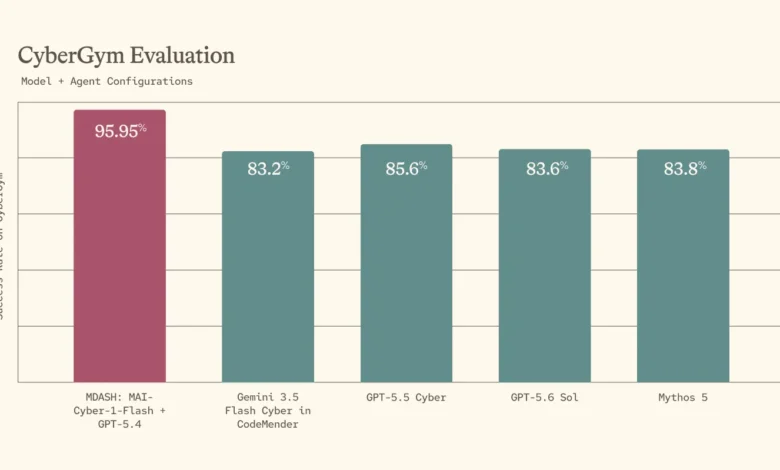
The multi-agent vulnerability scanner claims a 95.95% score on the CyberGym benchmark, beating rival tools while lowering operational costs.
As corporate software portfolios expand, the race to secure open-source codebases from exploits has increasingly shifted toward automated artificial intelligence workflows. Seeking to drastically lower the operational costs of automated vulnerability discovery, Microsoft has introduced its first domain-specific security model, MAI-Cyber-1-Flash, alongside an upgraded version of its multi-agent auditing system known as MDASH.
In technical evaluation benchmarks published by the company, the combined setup reached a 95.95% resolution rate on CyberGym, a standard testing framework that challenges AI models to identify and reproduce 1,507 known vulnerabilities spread across 188 open-source software projects. The result surpasses scores posted by competing systems, including OpenAI’s GPT-5.5 Cyber (85.6%), Anthropic’s Mythos 5 (83.8%), GPT-5.6 Sol (83.6%), and Google’s Gemini 3.5 Flash Cyber (83.2%). While these figures were self-reported by Microsoft and are awaiting placement on CyberGym’s official public leaderboard, the test environment relies on standardized, reproducible evaluation criteria.
Traditional static code scanners have long been plagued by high false-positive rates, forcing enterprise security teams to spend hundreds of hours sifting through non-critical alerts. By pairing specialized, lightweight models with multi-agent orchestration, cloud providers are attempting to automate the complex process of writing working exploit proofs to confirm security flaws prior to human intervention.
Instead of relying entirely on massive, expensive frontier models to evaluate code line by line, Microsoft’s new architecture distributes computational tasks. MAI-Cyber-1-Flash acts as the primary worker, executing up to 90% of routine scanning and reasoning jobs. Only the most intricate 10% of code anomalies are escalated to OpenAI’s GPT-5.4 model for deep analysis. Because language model providers charge based on processing units called tokens, this tiered workload routing cuts total execution expenses in half compared to Microsoft’s previous top-tier MDASH configuration.
Addressing the release, Microsoft Chief Executive Officer Satya Nadella highlighted that combining MAI-Cyber-1-Flash with the MDASH framework allows the software giant to deliver elite security performance at half the price of leading market models.
The underlying MDASH machinery relies on an ecosystem of over 100 specialized AI agents working in tandem. Within this setup, individual agents are assigned distinct roles: auditing source files, challenging potential findings through internal debate, filtering duplicate reports, and building functioning proof-of-concept demonstrations to verify that bugs can be triggered in isolated sandbox environments.
This reliance on automated verification reflects a broader structural shift within cybersecurity research. As access to general AI models becomes commoditized—with independent security researchers replicating advanced bug-hunting capabilities for less than $30 per repository scan—the competitive advantage is pivoting away from raw model access and toward robust verification pipelines. Cybersecurity researcher Dawid Moczadło noted that the primary technical barrier in modern vulnerability hunting has transitioned from finding basic anomalies to validating actual threat risk without overwhelming developers with false alarms.
Microsoft is currently offering MDASH in private preview integrated directly within Microsoft Defender through its Security Exposure Management suite. Enterprise users can run repository audits on Git platforms, categorize detected bugs from unverified suspicions to confirmed exploits, and utilize Defender Command Line Interface tools to auto-generate remediation patches for developer review. The preview release restricts repository sizes to approximately 256 megabytes with a limit of one concurrent scan per tenant, with Microsoft planning to extend the multi-agent architecture into real-time threat monitoring under its upcoming Project Perception framework.