
Bitcoin’s New Compass: Saylor Declares Halving Cycle Dead, Points to Capital Flows
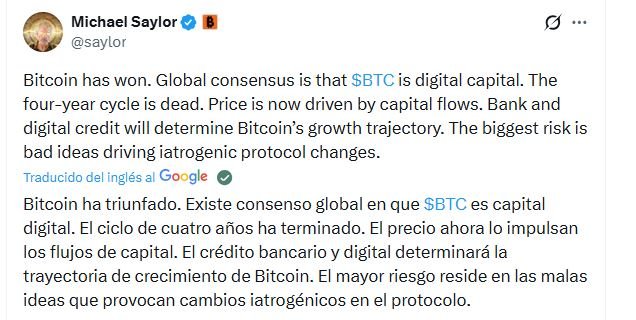
Michael Saylor, chief of Strategy, delivered a sharp verdict today, April 4, 2026: Bitcoin’s long-revered four-year cycle is over. He declared it dead.
The global consensus now frames BTC as digital capital. Its price, Saylor asserted on X, no longer dances to the halving beat. Instead, capital flows dictate its trajectory.
This isn’t a minor pronouncement. Saylor’s company, Strategy, commands the largest corporate treasury of Bitcoin, holding 762,099 BTC—a staggering $51.39 billion. His words carry weight. He sees bank and digital credit as the new engines for Bitcoin’s growth. This perspective underscores a fundamental shift: Bitcoin’s valuation moving beyond its intrinsic issuance mechanics to broader financial integration.
For years, the halving event defined market expectations. Every four years, Bitcoin’s protocol cuts the supply of new coins to miners by half. Historically, 2012, 2016, and 2020 halvings preceded massive bull runs in 2013, 2017, and 2021. The logic was simple: less new supply, sustained demand, higher prices. The most recent halving occurred in 2024, yet Saylor now dismisses this pattern.
The advent of spot Bitcoin exchange-traded funds (ETFs) in major markets like the U.S. has democratized institutional access, pouring unprecedented volumes of capital into the asset. This structural change significantly amplified external financial forces over internal supply mechanisms, giving credence to Saylor’s argument.
Saylor also sounded a stark warning. The greatest risk to Bitcoin, he stressed, isn’t market volatility or external attacks. It’s “bad ideas that generate iatrogenic changes in the protocol.” The medical term “iatrogenic” describes harm caused by an attempted cure. Applied to Bitcoin, it means well-intentioned modifications that inadvertently damage its core properties: limited supply, network security, or decentralization. Bitcoin’s strength, in this view, lies in its predictable, unyielding rules. Tampering with them, even to ‘optimize,’ could erode the very trust that underpins its value as digital capital.