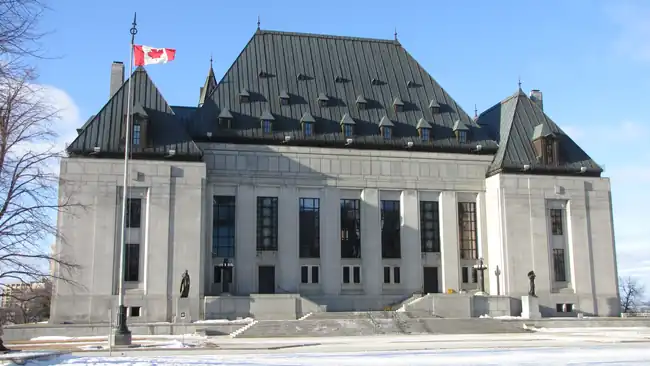
The Supreme Court of Canada dismissed the appeals against Quebec’s laicity Act on Friday and left the law valid and operative, with one exception. Section 8, the face-uncovered rule, infringes section 3 of the Charter as it applies to members of the National Assembly. Seven judges sat in English Montreal School Board v. Quebec (Attorney General), 2026 SCC 41, and produced four sets of reasons across 955 paragraphs. The hearing ran from 23 to 26 March 2026.
The Act the court examined is the statute passed on 16 June 2019. Its section 6 bars persons listed in Schedule II from wearing religious symbols while exercising their functions. Schedule II in that Act has 10 paragraphs: the president and vice-presidents of the National Assembly, clerks and sheriffs, tribunal and commission members, inquiry commissioners, labour arbitrators, the justice minister and government lawyers, penal prosecutors’ lawyers, lawyers and notaries under contract, peace officers, and principals, vice-principals and teachers. The list a reader meets in most coverage stops at teachers, police officers and prosecutors. The Schedule itself runs to 10 paragraphs in the 2019 Act, and Bill 9 later extended it to 19.
Bill 9, assented on 2 April 2026, added paragraphs 11 to 19 to Schedule II. The additions cover subsidized private-school personnel in the presence of students, regular service providers in those schools, immigrant reception, francization and integration service providers, childcare centre, CPE and home childcare coordinating office personnel, persons providing services in childcare facilities, the National Director of Youth Protection and youth protection directors, and Santé Québec personnel working in youth rehabilitation. A childcare worker in a CPE and a francization instructor hired through an integration provider now sit in the same Schedule as a police officer and a teacher, under the same section 6 ban. Friday’s reasons do not mention paragraphs 11 to 19. The judgment was reserved before Bill 9 was assented, and the appeals attacked the 2019 Act.

tufailhussaink wrote: “I am deeply troubled by this morning’s Supreme Court ruling on Bill 21 and am profoundly concerned about what this decision means for the rights and freedoms of millions of people across Canada.”
Each layer carries its own grandfather freeze date, and the dates do not line up. Section 31 of the 2019 Act exempts persons in paragraphs 2, 3, 7 and 9 who held their function on 27 March 2019, provided they stay in the same function with the same organization. Paragraphs 4 and 5 run to the end of the mandate. Paragraph 6, except the justice minister, freezes at 27 March 2019 in the same function with the same authority. Paragraph 8 covers contracts concluded before 16 June 2019 unless renewed. Paragraph 10 freezes teachers at 27 March 2019 in the same function with the same school board, a phrase Bill 9 amended to predominantly within the same school service centre. Wagner C.J. described the transitional provisions at paragraph 24 as “exempting certain persons listed in Sch. II” who held a function on 16 June 2019 in the same function and body. Karakatsanis and O’Bonsawin JJ. gave the practical version at paragraph 757: a person in a covered function stays stuck and cannot transfer, with the example of Dadouche, barred from transferring from Montreal.
Bill 94 froze its exception earlier than its own assent. The Act was tabled on 19 March 2025 and assented on 30 October 2025, extending the ban to all school staff interacting with students, to volunteers and parents in schools, and barring prayer on school premises. The grandfather exception reaches only to the tabling date, so a support worker hired or moved between 19 March and 30 October 2025 is not exempt. In Montreal, the Centre de services scolaire de Montréal recorded about 150 support staff who did not comply, and the Education Ministry database listed 1,135 unfilled support-staff jobs across Quebec, about 3% of the workforce. That staffing count was published on 18 November 2026, nine days before the judgment. Friday’s ruling neither caused those departures nor reverses them.
Bill 9 set three more freeze dates in its section 16. Paragraph 11 freezes at 26 November 2025 in the same function predominantly with the same organization. Paragraphs 12, 13, 16 and 17 cover non-employment contracts in effect on 2 April 2026 unless renewed. Paragraph 14 freezes at 26 November 2025 in the same service with the same organization, and paragraph 15 at 26 November 2025 in the same function with the same organization. Paragraphs 18 and 19 freeze at 25 February 2026. A youth protection director and a CPE educator therefore keep an exemption only if they held the function on their paragraph’s date and stay where the paragraph requires. The 2019 freeze date of 27 March 2019 does no work for either of them.
the.reading.dissident wrote: “Forcing people not to wear something is equally wrong as forcing someone to wear something.”
https://www.instagram.com/p/DgRTTPRDepH/
Bill 9 also starts in stages. Its section 29 brought most of the Act into force on 2 April 2026, with section 6, the second paragraph of the new section 10 of the Laicity Act, and the new sections 10.1 to 10.3 following on 1 September 2026. The private-education accreditation provisions in sections 22 and 23 follow on 2 April 2029. The same Act enacts a separate statute on accommodations for vivre-ensemble, whose section 14 operates notwithstanding sections 2 and 7 to 15 of the Constitution Act, 1982, and whose section 13 operates despite sections 1 to 38 of the Quebec Charter. Prohibited collective religious practice under that statute carries fines of $125 to $375 for a natural person and $375 to $1,125 for others. None of those start dates or fines was before the court on Friday.
The override that shields the 2019 Act runs on a clock with its own date and vote. Bill 52, introduced on 8 February 2024, passed on 2 May 2024 by 83 votes to 26, was assented on 7 May 2024 and came into force on 16 June 2024, re-enacting section 34 of the Laicity Act. The five-year period under section 33 of the Charter therefore runs to June 2029. All seven judges agreed the override was validly used in this case, on different reasoning. Wagner C.J., at paragraph 295, treated the section 33 requirements as formal only, following Ford. Kasirer J., at paragraphs 563 to 586, accepted implied limits on section 33 and found Bill 21 neither changed the constitutional structure nor amended section 33. Karakatsanis and O’Bonsawin JJ., at paragraphs 824 to 856, held section 33 cannot extinguish rights permanently or protect a law contrary to the fundamental character of a free and democratic Canada, and found Bill 21 did neither. Martin J. left the existence of further substantive limits undecided.
The court split on whether it could say the Act breaches the Charter while the override stands. Wagner C.J., Côté and Rowe JJ. held at paragraph 312 that “a declaratory judgment is not available” where section 33 is used. Kasirer J., Martin J. and Karakatsanis and O’Bonsawin JJ. held that superior courts retain the jurisdiction. No declaration issued. Kasirer J. at paragraph 587 and Karakatsanis and O’Bonsawin JJ. at paragraph 954 would have declared sections 6 and 8 in breach of sections 2(a), 2(b) and 15(1), unjustified under section 1. Martin J. saw no need for a separate declaration after her section 28 finding, and the Wagner group refused the power outright, so no majority formed for a declaration. Justice Minister Sean Fraser’s statement on Friday took the other side of that split: “Canadians have the right to know when their Charter rights have been unjustifiably infringed when the notwithstanding clause has been invoked.”
drkristopherwells wrote: “Courts can rule and provide important information on constitutionality of legislation, even when shielded by the use of notwithstanding clause.”
Section 28 divided the court 4 to 3. Wagner C.J., Côté and Rowe JJ. at paragraphs 142 to 197, with Kasirer J. at paragraph 521, held the Act is not invalid under section 28 and that the section grants no independent right. Martin J. at paragraphs 590 to 596 and 726 would have held sections 6 and 8 in breach of section 28 and of no force. Karakatsanis and O’Bonsawin JJ. at paragraphs 893 to 955 would have declared sections 4(1), 6, 7, 8, 13, 14, 16 and 18 invalid. Section 23 divided 4 to 2, with Martin J. not deciding: Wagner C.J. at paragraph 397 found no breach of minority-language education rights, Kasirer J. agreed, and Karakatsanis and O’Bonsawin JJ. at paragraphs 857 to 892 found a breach and proposed reading the Act down. The one unanimous result concerned section 3. Wagner C.J. at paragraphs 338 to 342 held section 8 breaches section 3 as it bars MNAs from sitting with a covered face, with no justification available, and at paragraph 348 held section 6 as it applies to ministers does not breach section 3.
The face rule that fell for MNAs stands for everyone else the Act names. Section 8 requires personnel to exercise their functions with faces uncovered, and requires a person receiving a service to uncover where identity or security requires it, failing which the service may not be received. Section 9 excepts health, handicap and the requirements of the function. Schedule III lists MNAs among the personnel covered by the face measures. Friday’s exception removes MNAs from that application. It leaves the service-recipient rule, the section 9 exceptions and the personnel rule in place.
jmercierca wrote: “Quebec was never a Muslim society and newcomers need to adapt to the local culture.”
https://www.instagram.com/p/DgP_M6yCNxw/
Wagner C.J. recorded at paragraphs 26 and 27 that the Act affected many people severely and produced feelings of stigma and job losses. Karakatsanis and O’Bonsawin JJ. wrote at paragraph 770, “They fall most heavily on Muslim women,” and cited evidence of job offers withdrawn from teachers and hiring files closed for women. Martin J. at paragraphs 702 to 710 found sex-based discrimination falling particularly on Muslim women and deepening existing disadvantage. Kasirer J. adopted the trial judge’s findings of serious adverse effects on Muslim women. The National Council of Canadian Muslims posted on Friday, “We will not stop our fight. This is not the end.” The Canadian Civil Liberties Association posted, “The fight for equality and freedom does not end with today’s decision.”
The oldest layer in the record is a count. In November 2018 and January 2019 the Ministère de l’Éducation et de l’Enseignement supérieur surveyed school authorities on how many employees wore religious symbols and how many accommodation requests they had received, without notifying the employees counted. The trial record shows 1,164 schools responded, about 45%, between 19 November and 14 December 2018. The trial judge found Muslim women felt stigma, fear and humiliation from the surveys and held the purpose legitimate, to know how many people were affected. Wagner C.J. at paragraphs 398 to 400 dismissed the FAE challenge, holding no breach of rights was established. The other judges did not decide the point.