Astrolab’s LUMIS Wants to Rent the Moon Power and 5G as a Service
The south pole's sunlight is so fussy that moving a tower fifty metres can cost hundreds of hours of darkness. That is why the Moon is getting a landlord.
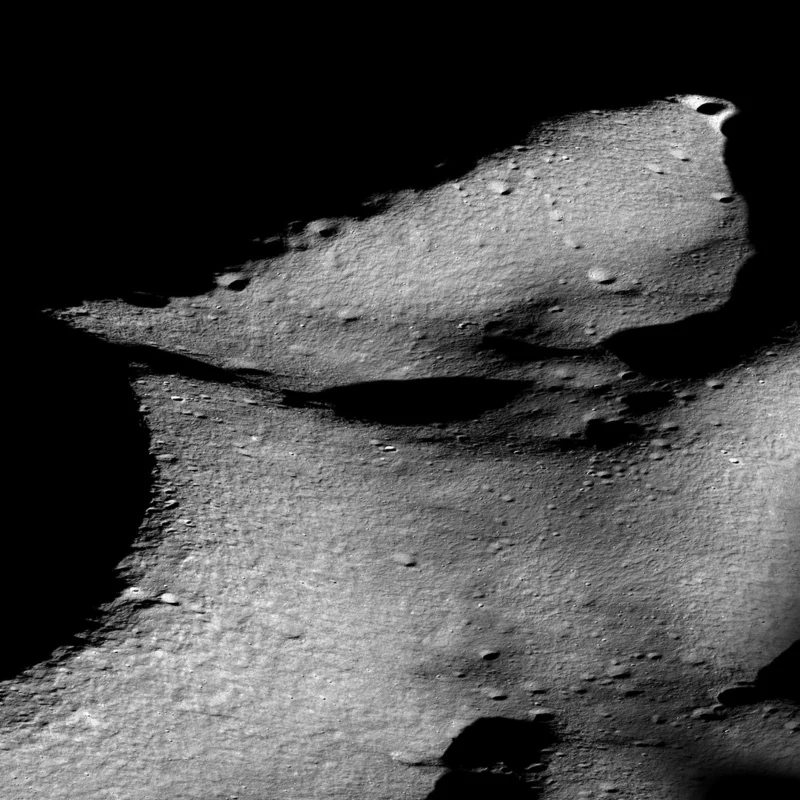
The ridge runs from the rim of Shackleton crater toward de Gerlache, a spine of high ground at the Moon’s south pole where the Sun never climbs more than a degree or two above the horizon. Light pools on the high ground and dies in the hollows. Three points on Shackleton’s rim stay sunlit, between them, more than 90 percent of the time, while the floor of the crater below has never seen sunlight at all and sits near minus 183 degrees. Move fifty metres sideways and a site can gain or lose hundreds of hours of darkness.
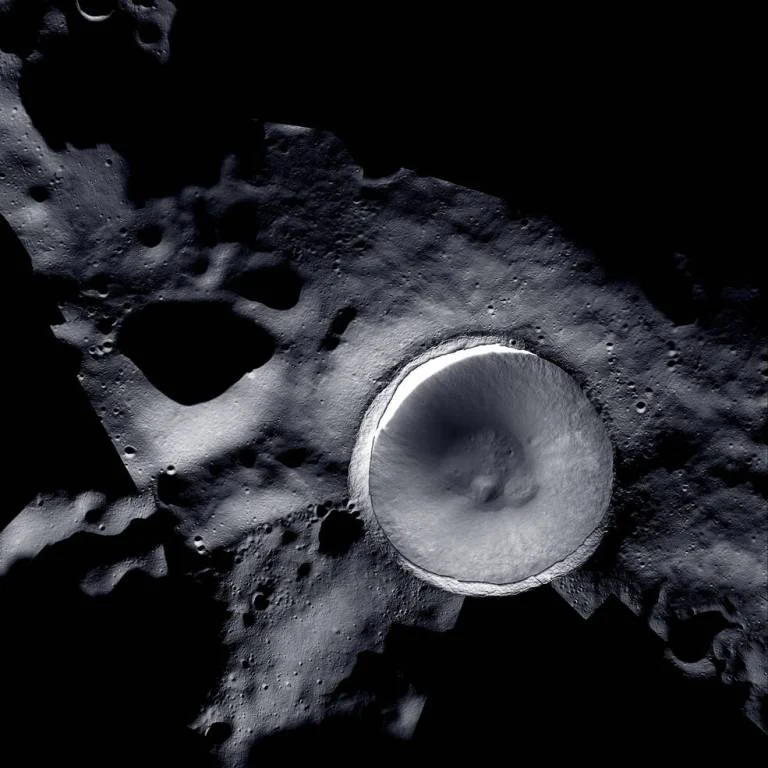
Astrolab, a California company that builds lunar rovers, unveiled the network on November 4. It is called LUMIS, the Lunar Utility Module for Industrial Services: a tall solar tower with batteries, radios and a computer, built to be carried by the company’s FLEX rover to wherever the light and the line of sight to Earth are best, then linked to other nodes by relays stretching more than a hundred kilometres. The first demonstration nodes would make two kilowatts each. Later ones would make twenty, and a linked grid could pass a hundred. The company wants the first node on the Moon in 2028. It would fly aboard a SpaceX Starship.
“The Lunar Operations Company” is what Astrolab calls itself now. Its announcement says customers “would pay for access and usage rather than build and operate their own infrastructure,” with shared equipment for small users and dedicated kit for big ones. The system is called Lunar OS. It sells power, connectivity and data as a service.
The Moon has had a phone network before. It lasted 25 minutes. Nokia Bell Labs flew its Lunar Surface Communications System to the south pole in March 2025 aboard Intuitive Machines’ Athena lander, which came down on its side about 400 metres from its target near Mons Mouton. The network powered up, talked to mission control in Sunnyvale, and ran without interruption for the 25 minutes its solar panels could feed it. The first call was never placed. The rover and hopper it was meant to connect had gone cold in the meantime, their temperatures fallen below operating range, and Intuitive Machines ended the mission the next day. Nokia called it a delivery anyway, the first cellular network on the Moon, and Thierry E. Klein, president of Bell Labs Solutions Research, said the company had “delivered and deployed the first cellular network on the Moon” despite “the very challenging circumstances.”
A lunar night lasts about 354 hours almost everywhere on the Moon, fourteen and three-quarter Earth days of darkness, with the surface falling toward minus 173 degrees. Astrolab’s node is designed to keep working for more than 400 hours on its own reserves, which covers a whole night with about 46 hours to spare. At the pole it is a different sum. An older NASA study of candidate sites around Shackleton put the worst dark intervals at roughly 73 to 117 hours, so the same reserve covers the worst polar darkness three times over, and the mildest more than five times over. The reserve is sized for the Moon’s worst case.
A 2021 study of the peaks of eternal light, the ridges the industry calls by that name, found that towers up to 20 metres tall could draw about 55 megawatts of time-averaged power from ground lit more than 70 percent of the time, though towers shading each other cut the total. That is why LUMIS is a vertical tower rather than a panel laid flat. On the Moon, height is sunlight. The scale of the plan follows the same logic. A linked grid of more than 100 kilowatts would be roughly half the generating capacity of the International Space Station, which reached about 215 kilowatts when its eighth and final roll-out array went in on November 5. The first node, at two kilowatts, makes about what a household kettle draws.
Astrolab holds a contract worth up to $1.9 billion to develop the Lunar Terrain Vehicle for the Artemis programme, one of three teams sharing a programme worth up to $4.6 billion over thirteen years, with Axiom Space and Odyssey Space Research as its teammates. Its FLEX rover, the vehicle that would carry the LUMIS nodes, was first shown as a working prototype in March 2022 and driven across the dunes of Dumont Dunes in California by the retired astronaut Chris Hadfield, who sits on Astrolab’s advisory board.
Starship has never landed on the Moon. Astrolab wants the first LUMIS node on it in 2028, aboard a commercial FLEX mission on SpaceX’s Starship. NASA’s own timeline, laid out in October, has SpaceX demonstrating propellant transfer in orbit in the first quarter of 2027, a procedure that has never been done, and flying an uncrewed Starship to the lunar surface late in 2027. Artemis III, once the mission that would land astronauts, is now an Earth-orbit rehearsal, no earlier than June 2027, and the first landing has moved to Artemis IV in early 2028. LUMIS is targeted for 2028. The uncrewed Starship landing that has to happen first is targeted for late 2027.
Astrolab’s smaller rover, FLIP, is booked on Voyager Technologies’ Griffin-1 lander, a Falcon Heavy flight to Nobile Crater near Mons Mouton, no earlier than January 2027 after slipping from late 2026. FLIP weighs about 500 kilograms, the largest commercial payload ever booked for the lunar surface, and NASA has designated the mission Moon Base II. Griffin-1 has finished its environmental trials at NASA’s Jet Propulsion Laboratory and returned to Pittsburgh for final assembly. The record it flies against is unforgiving. Of the four commercial landers NASA has sent to the Moon since January 2024, only one, Firefly’s Blue Ghost, landed upright and completed its mission. Two tipped over, and one crashed.
On X, one space enthusiast repeated the numbers back as proof the future had arrived, writing that “Lunar infrastructure is getting real” and listing the same figures Astrolab announced: two kilowatts now, twenty later, a hundred in a grid, 2028. A space-industry account called the integrated offering “exactly what sustained operations need.” They are not arguing about the network. One takes the announcement at face value, and the record, 25 minutes and a tipped lander and a hopper gone cold, is the part neither of them mentions. Another, replying to Astrolab’s own post, asked for pictures that looked like the place itself. “Please use pictures more closely resembling the actual application environment. With cables (as on the website article , that was good) and dust and bright sun areas and deep shadows.”
Full-scale models of the FLEX rover and the LUMIS node are on display inside a NASA hangar at the Kennedy Space Center. Astrolab is based in Hawthorne, California, and its LUMIS testing will run from its facility at the Texas Space Institute in Houston.