Dolan Keeps Control as Knicks, Rangers Split Into Two Stocks
The tax-free distribution begins trading under new NYSE tickers MSGK and MSGR on Oct. 27, separating two franchises valued at a combined $16.95 billion.
James Dolan will run two separate publicly traded companies by next week. The Madison Square Garden Sports board finalized a tax-free spin-off on Sept. 30 that cleaves the New York Rangers from the New York Knicks, creating distinct equities for investors while leaving the Dolan family firmly in charge of both.
The corporate breakup lands just as the Knicks begin defending their first NBA championship in 53 years. The team defeated the San Antonio Spurs in five games in June, a title run estimated to have generated at least $380 million for New York City. Tonight’s banner-raising ceremony against LeBron James, making his debut with the Philadelphia 76ers, is commanding an average resale price of roughly $2,600 per ticket on SeatGeek.
Shareholders of record at the close of trading on Oct. 20 receive one share of the new Rangers entity for every two shares they currently hold. The distribution is scheduled for Oct. 26, pending final league approval. Regular-way trading under the new tickers—MSGK for MSG Knickerbockers Corp. and MSGR for MSG Rangers Corp.—begins Oct. 27. When-issued trading for the Rangers stock opens tomorrow under the symbol “MSGR WI.” Existing shareholders retain their current number of shares in the renamed Knicks holding company, which also keeps the G League’s Westchester Knicks. MSGR takes the NHL franchise, the American Hockey League’s Hartford Wolf Pack, and the MSG Training Center in Greenburgh, N.Y.


Wall Street is now forced to price two pure-play sports assets instead of one conglomerate. The parent company carried a market capitalization of roughly $9.8 billion before the split. That figure sits well below independent valuations. Sportico estimates the Knicks are worth $12.8 billion—nearly double the NBA average of $6.64 billion—and places the Rangers at $4.15 billion. Both rank second in their respective leagues, trailing only the Golden State Warriors and the Toronto Maple Leafs.
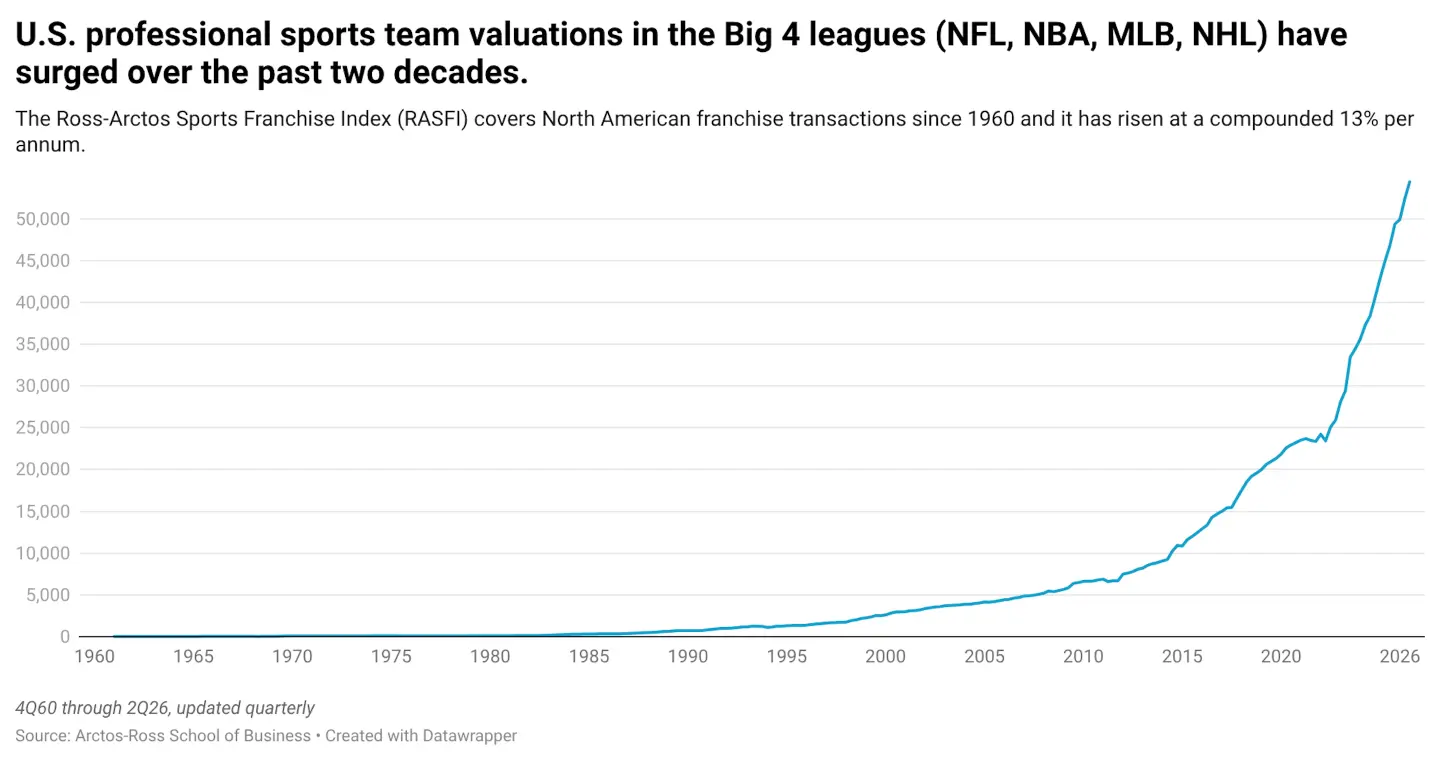
The valuation gap between public market capitalization and private appraisals reflects broader mechanics in sports ownership. Franchise values across the NFL, NBA, MLB, and NHL have compounded at 13% annually for more than six decades, according to the Ross-Arctos Sports Franchise Index. Recent transactions underscore the premium buyers pay for finite supply. The Khosla family closed a $9.612 billion purchase of the Seattle Seahawks in September. A month earlier, Bob Iger and Josh Kushner agreed to buy the Los Angeles Lakers for $12.5 billion, pending league approval. Private equity capital flowing into ownership groups continues to push those benchmarks higher.
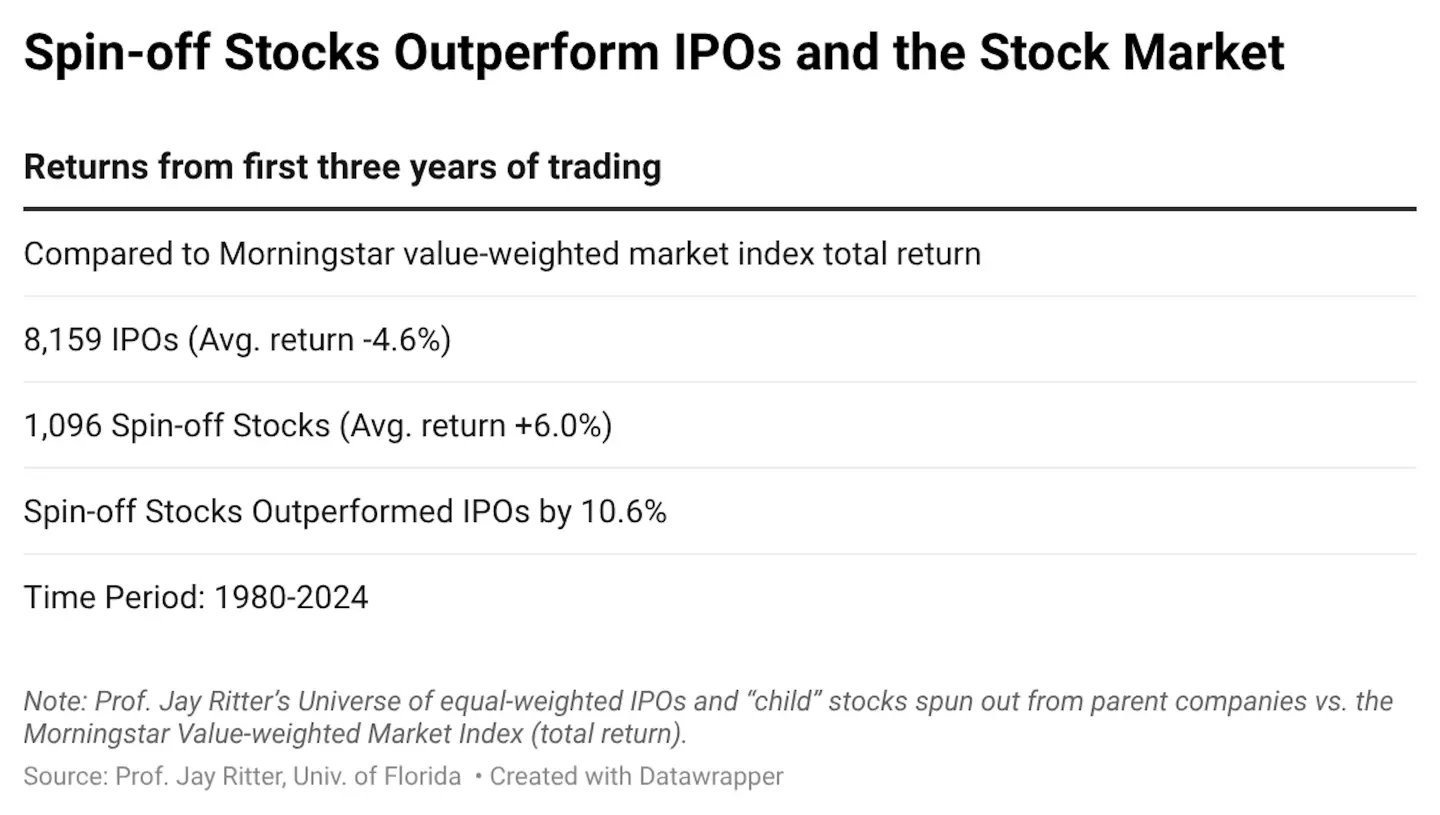
Historical data suggests the structural mechanics of a spin-off offer retail buyers a different risk profile than a standard initial public offering. Jay Ritter, a finance professor at the University of Florida and director of The IPO Initiative, told Fortune that spun-off stocks outperformed the Morningstar value-weighted market index by 6% over their first three years of trading between 1980 and 2024. The average IPO trailed the market by 4.6% from its offer price during the same period, giving spin-offs a 10.6-percentage-point historical edge.
Much of that outperformance materializes on the first day of independent trading, according to Ritter. He attributed the advantage to scale. In his dataset, 70% of spin-offs had inflation-adjusted sales of $100 million or more, compared with 41.4% of IPOs. Buyers acquire sports teams for financial returns alongside intangible perks, he noted, but individual investors should temper expectations. “I would expect that most publicly traded sports teams will be priced to offer investors a competitive financial return,” Ritter told Fortune. “There is less chance of a complete failure (compared to IPOs), but also less chance of huge upside potential than is true with other businesses—especially compared to the pharmaceutical business or tech.”
MSG Sports shares hit all-time highs during the Knicks’ playoff run and have gained more than 50% this year. Investors weighing entry points face shrinking regional cable fees, persistent inflation pressures on revenue growth, and a front office led by Dolan as executive chairman and CEO of both newly independent boards.