Tesla Roadster’s Fan Tech Has a 56-Year Racing History
From a banned 1978 F1 winner to a $132,300 British EV, active suction predates Elon Musk's sports car by 56 years.
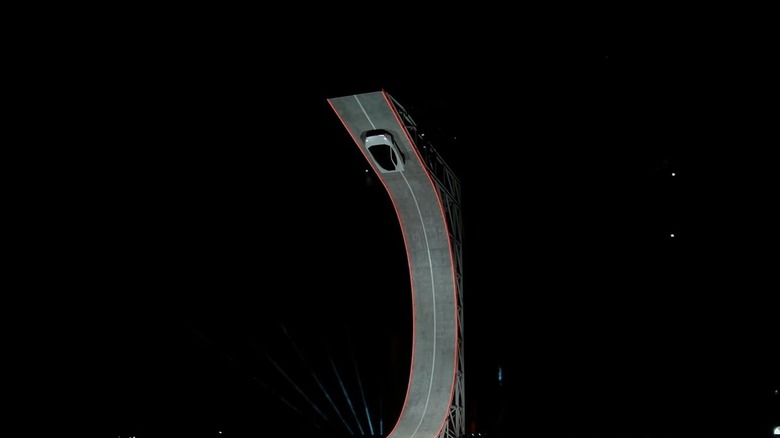
Tesla demonstrated its next-generation Roadster driving up a C-shaped ramp, stopping while perpendicular to the ground, then jumping off and flipping upright before landing. The automaker credited a multi-mode fan and ground sealing system that pulls air from beneath the chassis to generate suction. Elon Musk said production begins in 2028, with reservations requiring $50,000 for the base model or $250,000 for the “Thrust” trim equipped with the downforce hardware.
McMurtry Automotive responded on Instagram with a video of its Spéirling hanging upside down and the caption “Welcome to the club.”
Fan-generated downforce is not new. It dates back more than half a century to unrestricted motorsport series where engineers exploited low-pressure zones beneath vehicles to defy aerodynamic limits.

In 1970, racing drivers Jim Hall and Hap Sharp entered the Can-Am Championship with the Chaparral 2J. According to Revs Institute Automedia, the prototype used a modified 7.6-liter Chevrolet V8 engine. Its suction technology originated as a General Motors project called the “Suspension Test Vehicle” until Hall recruited its developer, Don Gates. Two fans adapted from a military tank engine pulled air out of an enclosed area sealed by transparent polycarbonate skirts. That setup generated between 1.25 g and 1.5 g of suction. Tesla claims the Roadster will produce up to 2 gs.
The Can-Am series collapsed shortly after, partly because cars like the 2J made competition unviable for teams without aerospace-level budgets.
Formula 1 saw its own version eight years later. Designer Gordon Murray built the Brabham BT46 for the 1978 season. The team installed a single large rear fan connected via clutches, claiming it was primarily for engine cooling to satisfy regulations. Skirts covered the gap between the car’s floor and the track surface. Unlike the Chaparral, the BT46’s suction increased with vehicle speed. Niki Lauda drove it to victory at the 1978 Swedish Grand Prix. It never raced again. F1 officials effectively banned the design immediately after that single event.
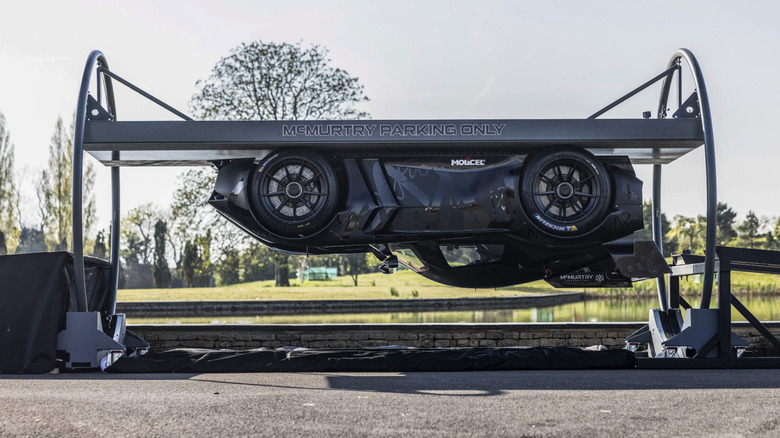
McMurtry unveiled the final production version of its electric Spéirling Pure in July 2026. The British company’s Downforce-on-Demand system uses two fans to extract air from under the car, allowing cornering forces exceeding 3g, according to the manufacturer. Production is capped at 100 units starting at $132,300, with initial customer deliveries scheduled before the end of this year.