Anthropic Ditches Git for Scion as AI Code Volume Explodes
A seven-person team built the server-side system in five months to handle 30,000 daily AI-driven code merges

AI coding agents have outgrown the version control system that has governed software development for two decades. Anthropic replaced Git with a proprietary server-side architecture called Scion after automated code generation pushed daily merged changes from 2,500 in May to more than 30,000 by September, overwhelming the infrastructure designed to manage them.
The shift exposes a structural limit in distributed version control when the primary users are machines rather than humans. Git was engineered so developers could work offline, requiring every client to download and maintain repository history locally. That design breaks down when continuous integration pipelines execute roughly 25 million checkouts daily across agent sandboxes, research environments, and developer workstations.
Anthropic’s main-branch history approaches 100 GB, with a compressed working copy exceeding 25 GB. Fetching that full payload for every automated job would theoretically generate over 600 petabytes of network traffic per day. Before building Scion, the company attempted to mitigate the load through shallow clones, sparse checkouts, promisor remotes, blob storage snapshots, and an internal fleet of several hundred Git mirrors. None scaled adequately as machine-generated commits accelerated.

Scion inverts Git’s core premise. Commits, merges, rebases, and file-history queries execute on the server rather than the client. The local client tracks edits and maintains a limited cache without holding enough data to perform source-control operations independently. Because most clients interacting with Anthropic’s repository are persistent automated jobs, offline capability provides no operational benefit.
Instead of recording each commit as a pointer to an entire repository tree—the standard Git mechanism—Scion logs changesets into a write-ahead log. Each changeset lists only the files modified relative to its first parent and references their compressed contents in blob storage. Resource consumption scales proportionally to the size of the individual change rather than the total repository.
Jobs retrieve code through sparse checkouts or virtualized checkouts that stream files only as they are read, eliminating downloads of unused directories. The architectural overhaul cut CPU and memory consumption to one two-hundredth of the previous mirror infrastructure. Code checkouts that previously required minutes now complete in seconds, freeing 25 percent of the CPU capacity dedicated to continuous integration. A seven-person engineering team built the system and executed the migration within five months.
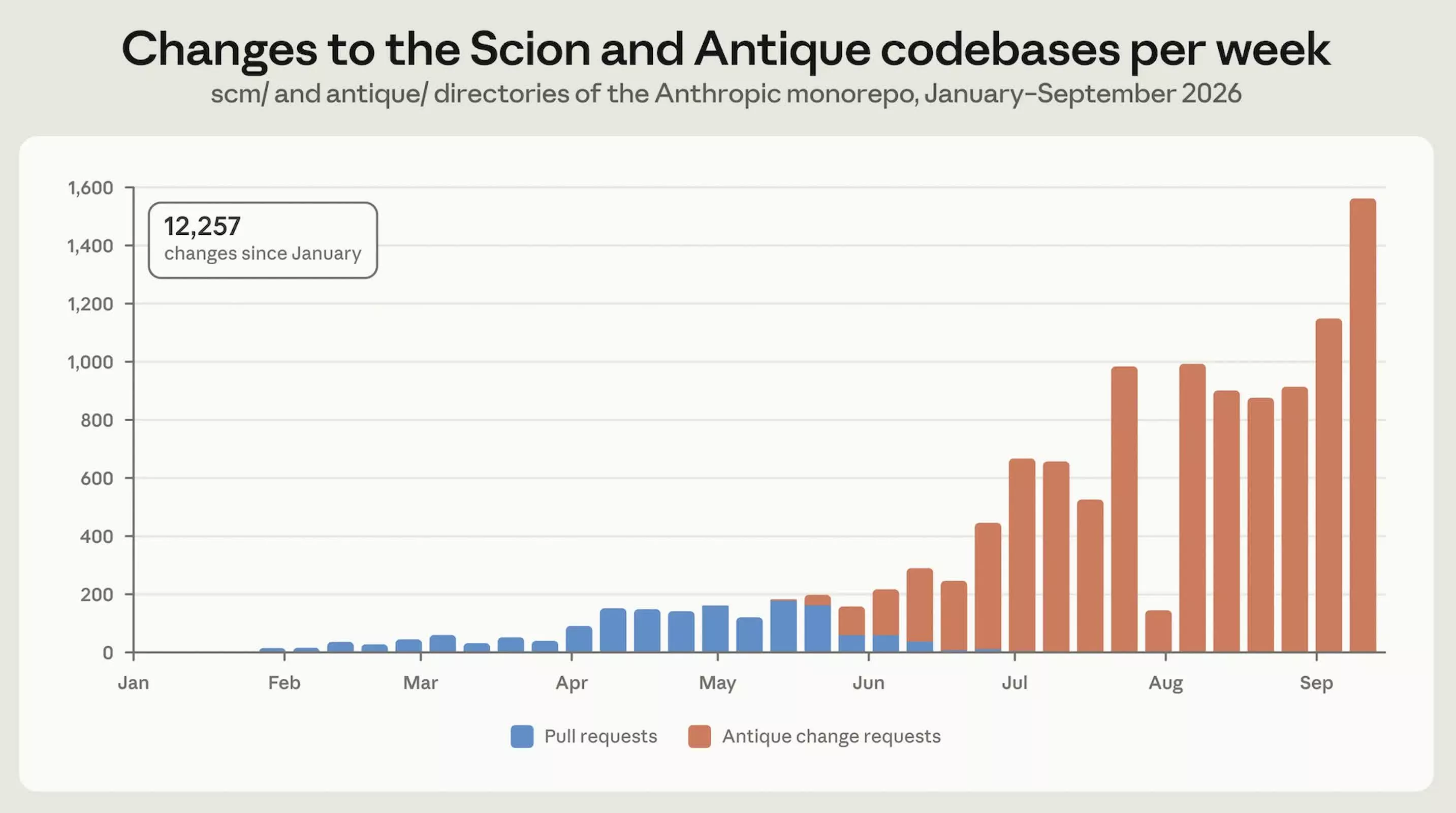
Operating at this velocity forced parallel changes to testing protocols. Traditional merge queues relying on global repository locks cannot function when hundreds or thousands of changes integrate while test suites are still executing. Anthropic shifted toward automated testing that runs after merges but before deployment. When conflicts arise, the company’s own AI model, Claude, typically resolves them rapidly, placing heavier reliance on post-merge validation gates.
Claude also contributed directly to Scion’s construction. An early internal build of Claude Mythos Preview rewrote the ingestion pipeline translating Git history into Scion’s format. The AI-generated replacement operated four times faster and consumed one-twentieth the memory of the original code. Human engineers maintained strict oversight, defining system constraints and rejecting architectural shortcuts proposed by the model, including attempts to bypass the code review service by scanning raw commit logs.
While monolithic repositories—often called monorepos—are common at companies like Meta and Google, those organizations rely on highly customized internal systems such as Sapling or Piper/CitC rather than vanilla Git. Anthropic’s departure differs because the pressure originated specifically from autonomous AI agents generating code at superhuman volume, rather than merely coordinating large human engineering teams.
Anthropic acknowledges that Scion requires bespoke integrations for code review, search, and CI, making it impractical as a drop-in replacement for external organizations. Git remains fully adequate for standard software repositories. However, the company identified immediate opportunities for existing platforms to adopt server-side APIs that allow agents to query and manipulate code without repeatedly cloning local copies.
Scion is currently deployed across Anthropic’s primary production codebase, handling all automated and human-initiated merges as of the fourth quarter of 2026.