Rust AI-Built Office Suite Targets Microsoft Word, Excel, PowerPoint
WordCraft, GridCraft, and DeckCraft use native Rust instead of Electron, reaching 60% overall feature parity in early alpha.
A developer leveraging generative AI to rebuild Adobe Creative Cloud from scratch has shifted focus to a far larger target: the Microsoft Office monopoly. Brandon Thomas is using Anthropic’s Claude Opus 5.5 to engineer open-source, native alternatives to Word, Excel, and PowerPoint, writing the entire suite in Rust.
The project, comprising WordCraft, GridCraft, and DeckCraft, bypasses the cross-platform frameworks that typically bloat modern desktop software. Instead of relying on Electron or Tauri — web-technology wrappers used by applications like Slack and Visual Studio Code that consume significant memory — the suite uses a single Rust codebase compiled for Windows, macOS, Linux, and BSD. The applications also run directly in web browsers via WebAssembly, eliminating the need for local installation entirely.
This architectural decision carries immediate practical weight for enterprise environments. Native Rust binaries execute significantly faster and consume less RAM than Electron-based equivalents, offering organizations a potential path away from both Microsoft licensing fees and the performance overhead of web-wrapped desktop apps.


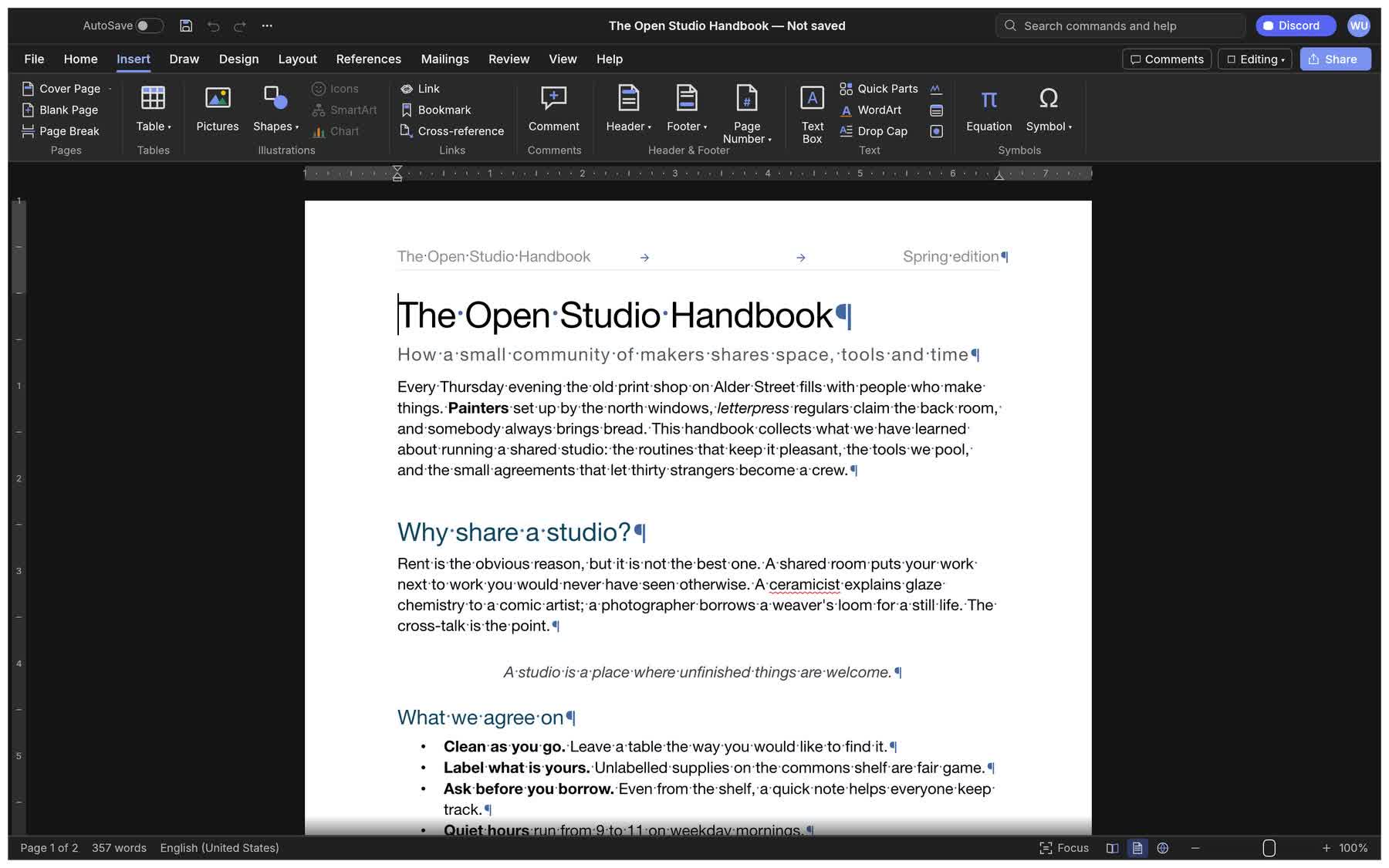
WordCraft currently leads development among the three. It reads and writes .docx natively while supporting imports and exports across .odt, .rtf, .html, .md, .txt, and legacy .doc files. PDF exports generate selectable text with intact links and bookmarks rather than flattened images. The application replicates Microsoft Word’s ribbon interface, track changes, styles, tables, and mail merge capabilities pulling from CSV files or Outlook contact lists. Crucially, spelling and grammar engines operate offline, avoiding the cloud-dependency that characterizes many modern AI-assisted editors. Approximately 88% of Word’s ribbon commands are functional.
GridCraft, the spreadsheet application built to mirror Excel, implements roughly 98% of standard worksheet functions and 89% of ribbon and menu commands. It handles .xlsx natively and exposes an architecture fully scriptable by autonomous AI agents, a capability absent from traditional spreadsheets without third-party plugins. DeckCraft targets PowerPoint parity at 79% across 191 tracked features, including advanced formatting and PDF export, handling .pptx files.

None of the applications are ready for production deployment. All three remain in alpha. Aggregate feature parity with Microsoft Office sits near 60%, with GridCraft estimated at 50% readiness for professional workloads and DeckCraft at 55%. The source code is distributed under MIT and Apache 2.0 licenses, permitting unrestricted commercial use and modification.

The effort represents a broader stress test for what the industry disparagingly calls “vibe coding” — generating complex software through natural language prompts rather than manual engineering. While AI-generated code frequently struggles with edge cases, security vulnerabilities, and maintainability, targeting a clean-room reimplementation of mature productivity software forces the model to handle intricate file format specifications like Office Open XML, which governs .docx, .xlsx, and .pptx structures.
Thomas previously applied this identical methodology to replicate Adobe’s Creative Cloud suite. By maintaining the same underlying technology stack — Rust paired with Claude Opus 5.5 — the developer is attempting to prove that AI-assisted engineering can scale beyond isolated scripts into cohesive, multi-application ecosystems.
Microsoft Office remains deeply entrenched globally, anchored by decades of macro compatibility, enterprise integration, and proprietary formats. Competitors like LibreOffice have long offered free alternatives but historically struggled with exact visual fidelity and seamless format rendering. An AI-generated suite prioritizing strict UI and format replication attacks the primary friction point preventing user migration.
Active commits to the WordCraft repository continue as of October 2026, with development focused on closing the remaining 12% gap in ribbon command implementation.