Prop 40 Wealth Tax Battle Splits California Labor Ahead of Vote
Construction unions and SEIU-UHW clash over a billionaires tax meant to replace $100 billion in slashed federal healthcare funding.
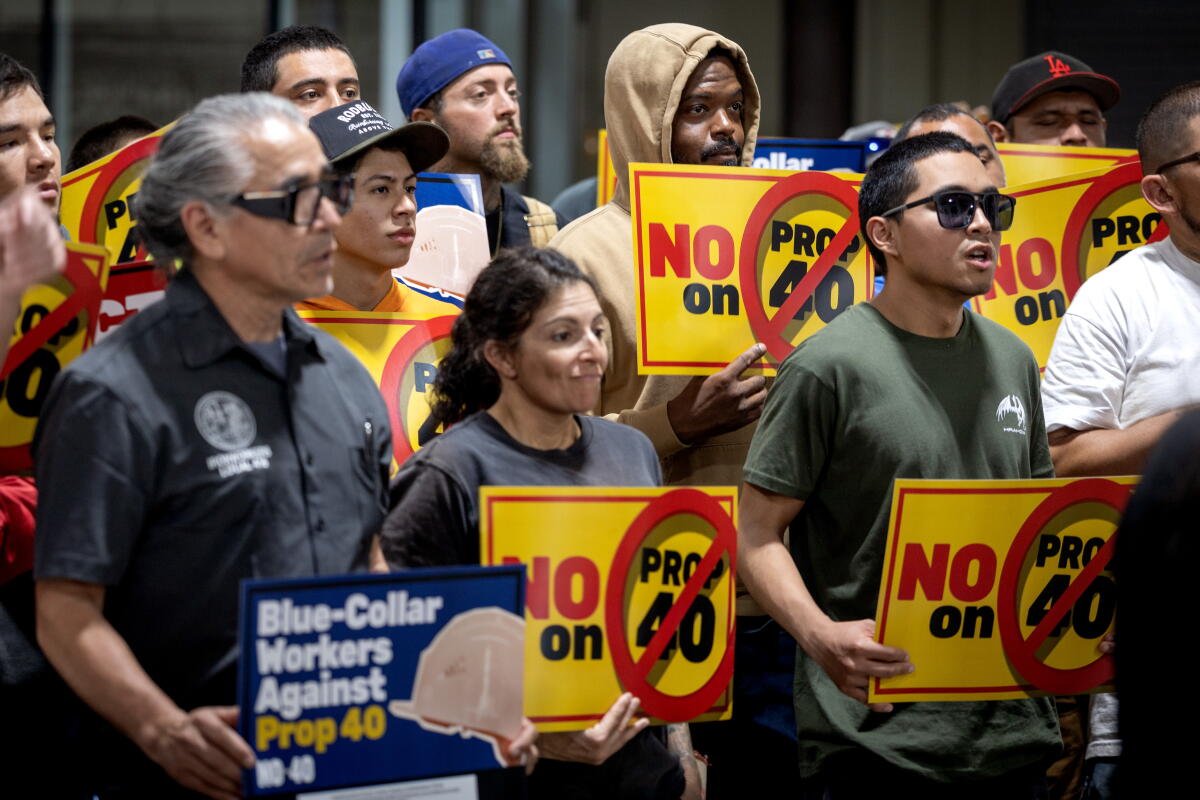
A rare fracture within organized labor has become the defining fault line in California’s Proposition 40 campaign, transforming what backers envisioned as a straightforward wealth tax on billionaires into one of the most expensive and ideologically complex ballot fights in U.S. history.
With the Nov. 3 election approaching, the measure designed to levy a one-time tax on the state’s wealthiest residents to backfill federal healthcare cuts is facing fierce resistance not only from the technology industry but from the very union members who typically anchor progressive tax campaigns. Building trades leaders have mobilized against the proposal, warning that its statutory language contains provisions capable of reaching middle-class retirement accounts and home equity.
Sen. Bernie Sanders (I-Vt.) traveled to Los Angeles on Monday to frame the initiative as a national test case for taxing extreme wealth. Speaking at the Novo in downtown Los Angeles alongside Rep. Ro Khanna (D-Fremont), Sanders targeted billionaire tech founders by name, drawing boos from the crowd when mentioning Elon Musk, Mark Zuckerberg and Sergey Brin. The rally featured artist Shepard Fairey unveiling campaign banners and rapper Common performing freestyle verses demanding the ultra-wealthy pay their share.


Hours earlier and miles away at an Ironworkers training facility in La Palma, a coalition of construction unions laid out a sharply different interpretation of the same legislation. Xochitl Medrano, political director for the district council of the Ironworkers of the State of California and Vicinity, argued that the measure functions as a “trap door” for working families rather than a shield against oligarchic wealth. Union apprentices attending rigging and collective bargaining workshops chanted opposition slogans while leaders dissected the fine print.
The intra-labor conflict exposes the mechanical difficulty of drafting wealth taxes in a state where asset valuation is notoriously complex. Unlike income, which is liquid and easily tracked through payroll systems, wealth often exists in unrealized capital gains, private business valuations and real estate. Prop. 40 was engineered by the Service Employees International Union-United Healthcare Workers West (SEIU-UHW) specifically to generate revenue offsetting $100 billion in federal healthcare funding reductions approved by congressional Republicans and signed by President Trump last year. Supporters like Datosha Williams, a healthcare customer service worker and SEIU-UHW member, view the tax as the only viable barrier preventing hospital closures and emergency room bottlenecks for vulnerable patients.
Construction unions counter that relying on volatile wealth-tax revenue to fund permanent healthcare infrastructure creates severe fiscal risk. California already operates with a budget heavily dependent on the top 1% of earners, whose income fluctuates wildly with stock market performance. Andrew Gonzales, council representative for the Los Angeles and Orange Counties Building and Construction Trades Council, noted that wealthy residents are proactively relocating or restructuring assets ahead of the vote, immediately straining current state revenue projections. This mirrors the fallout from 2022, when a mass exodus of high-net-worth individuals following similar policy debates contributed to a $30 billion state budget deficit the following year.
To neutralize the tax entirely, opponents have placed two competing nullification measures on the ballot. Under California’s unique multiple-measure election laws, if either Proposition 41 or Proposition 42 receives more total votes than Proposition 40, the wealth tax is voided regardless of whether it secures a simple majority. This structural quirk forces proponents to not only win a majority but outpoll specific rival initiatives.
Campaign finance filings reflect the scale of the corporate response. More than $300 million has flowed into the fight, with nearly all contributions directed toward defeating the measure. Because California law exempts ballot initiatives from the campaign donation caps that apply to candidate races, tech executives and venture capital firms have been able to write uncapped checks to opposition committees.
Voter sentiment remains deeply divided and appears to be softening for proponents. A late September poll conducted by UC Berkeley and the Los Angeles Times found 45% of likely voters supporting Proposition 40, while 42% opposed it and 13% remained undecided. That represents a measurable decline from six weeks prior, when support stood at 48% against 41% opposition.
County registrars across California began mailing official voter information guides and sample ballots to registered voters in early October, with early in-person voting locations scheduled to open statewide later this month.