U.S. Navy Seizes Six Million Barrels of Iranian Crude Under Revived Medieval Prize Law
Military seizes six million barrels of crude under constitutional prize law as tankers cross the Atlantic.
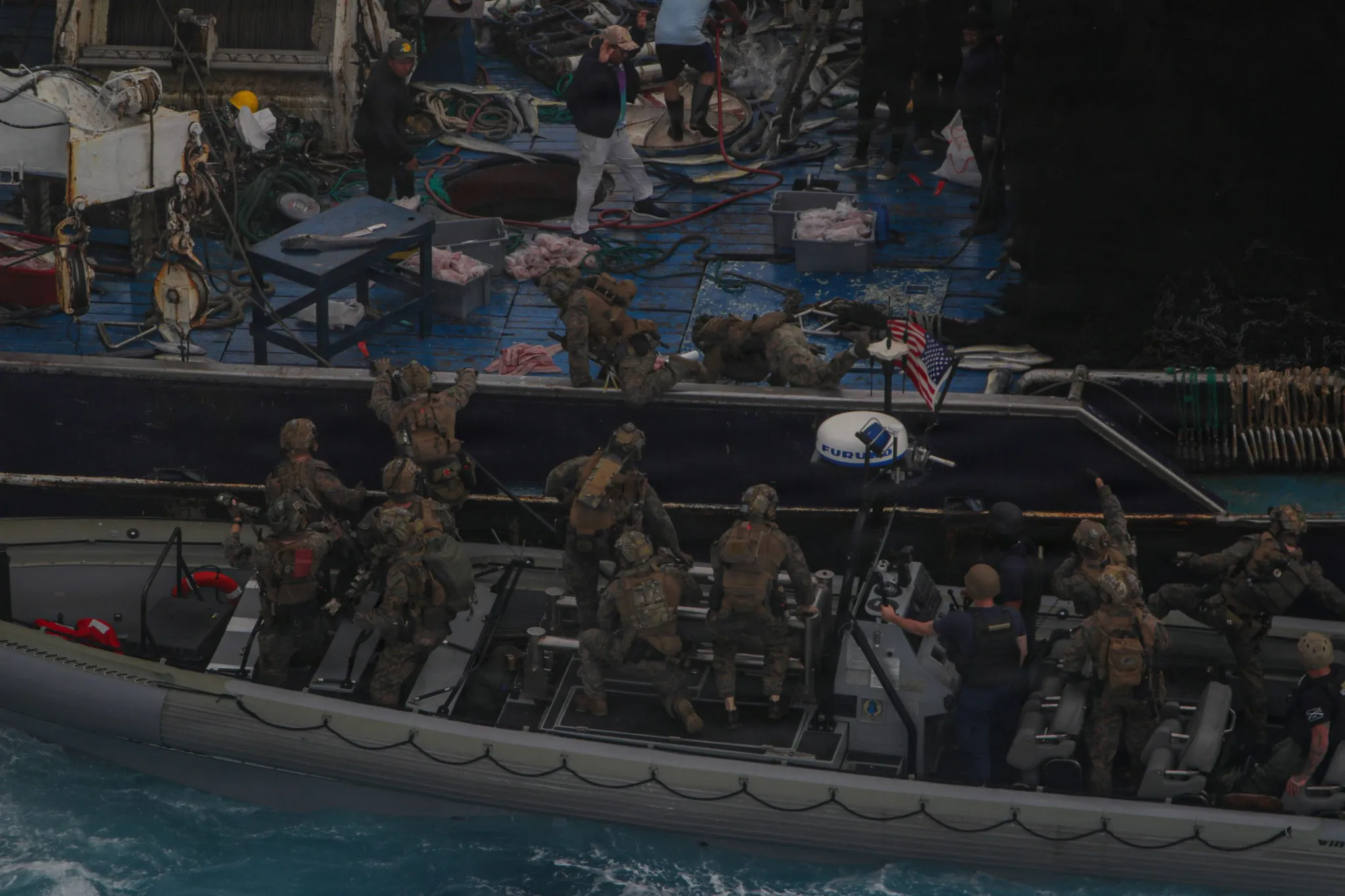
The United States is executing a high-stakes maritime operation that blends modern naval power with legal mechanisms dating back to the Middle Ages. Three Very Large Crude Carriers (VLCCs), collectively holding approximately six million barrels of oil valued at nearly $600 billion based on current Brent futures, are currently transiting toward American ports after being seized by U.S. forces in international waters. This maneuver marks a significant escalation in economic warfare against Iran, bypassing traditional sanctions enforcement through direct asset capture.
The vessels involved—the Tifani, the Majestic X, and the Lenore (also identified as the Davina)—were intercepted during distinct operations earlier this year. The Tifani and Majestic X were boarded in the Indian Ocean in April, while the Lenore was interdicted in June. As of late September 2026, tracking data confirms the first two ships have navigated past Brazil, while the third has cleared the Cape of Good Hope, entering the South Atlantic en route to North America. Each VLCC carries up to two million barrels, representing a substantial portion of global daily consumption capacity now under U.S. control.
This seizure strategy relies on “prize law,” a doctrine rooted in customary international maritime law and codified in the U.S. Constitution’s Captures Clause. Unlike standard civil forfeiture procedures used by agencies like the Coast Guard or ICE—which require proving specific statutory violations such as money laundering or sanctions evasion within domestic jurisdiction—prize law permits the Department of Defense to seize enemy assets during armed conflict without prior warrants. The legal threshold shifts from criminal proof to wartime necessity, allowing military commanders to act swiftly against state-sponsored actors.


The revival of this ancient framework follows a complex diplomatic timeline. President Donald Trump initially imposed a naval blockade in April targeting traffic to and from Iranian ports. Although a brief ceasefire lifted restrictions over the summer, the administration reimposed the blockade weeks later, signaling a pivot from kinetic military strikes to sustained economic attrition. By invoking prize law, the White House avoids the lengthy judicial battles typical of OFAC-related seizures, potentially accelerating the liquidation or redistribution of the captured crude.
Jurisdictional authority for these cases rests primarily with federal courts in Texas, specifically the Southern District. Houston serves as both a hub for major energy refiners and the seat of the U.S. Attorney’s office handling these matters. Aaron Reitz, the U.S. Attorney for the Southern District of Texas, confirmed his office is prepared to adjudicate the disposition of the vessels once they arrive. In recent statements, Reitz emphasized that national security imperatives justify the use of military seizure powers when conventional law enforcement tools prove insufficient against hostile state infrastructure.
Historically, prize law saw its most prominent American usage during the Civil War, when President Abraham Lincoln utilized the Prize Act of 1812 to blockade Confederate ports. It was also invoked during the Spanish-American War. Its application today represents a rare instance of peacetime-adjacent conflicts leveraging full-scale war powers, raising questions about long-term implications for freedom of navigation norms among neutral shipping nations. With Brent crude trading near $106 per barrel, the financial stakes extend beyond mere policy demonstration; the eventual sale or retention of these millions of barrels could influence regional supply dynamics and refine margins along the Gulf Coast.