

OpenAI Cuts GPT-6 API Prices as Anthropic Unveils Claude Opus 5.5
GPT-6 Sol and Luna launch with lower costs and new enterprise benchmarks

SAN FRANCISCO — OpenAI launched GPT-6 Sol and GPT-6 Luna on Tuesday, cutting developer access fees by half in an escalation of the enterprise artificial intelligence pricing and performance battle. The release arrived minutes after Anthropic announced Claude Opus 5.5, its own enterprise model, underscoring the intensifying release cadence among major AI developers competing for enterprise workloads.
The new models include a configurable “reasoning effort” control. Developers can adjust how much compute time a model devotes to step-by-step verification before delivering an answer, balancing response accuracy against token consumption costs.
OpenAI made GPT-6 Sol and Luna immediately available in ChatGPT Work and the Codex software development environment for subscribers on Plus, Pro, Business, Enterprise, and Edu plans. Luna was also deployed to free users and Go plan tier accounts through OpenAI’s desktop applications.


Neither model was included in the standard standalone ChatGPT mobile or web application at launch. Distribution proceeded through a phased rollout across the day to manage server capacity.
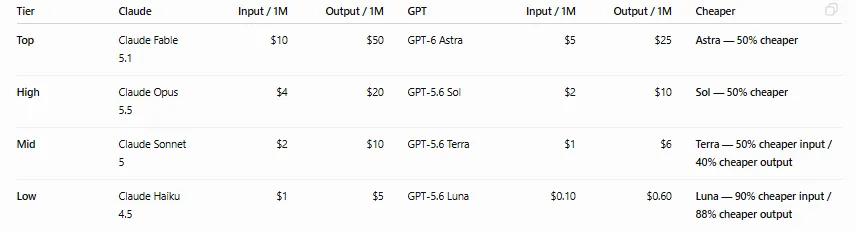
Under the revised API pricing, GPT-6 Sol costs $2.00 per million input tokens and $10.00 per million output tokens, compared with $4.00 and $20.00 under the promotional rates previously offered for GPT-5.6. GPT-6 Luna costs $0.10 per million input tokens and $0.50 per million output tokens, down from $0.20 and $1.20.
Tokens are the fundamental units of text processed by language models, and one million tokens equates to roughly 750,000 words. Enterprise applications process billions of tokens daily to power automated workflows, making API unit costs a factor in the operational feasibility of scaling AI deployments. With the reductions, OpenAI established lower pricing per equivalent operational tier than Anthropic’s current corporate offerings.
OpenAI reported that GPT-6 Sol achieved a 56.4% completion rate at maximum compute effort on Agents’ Last Exam, an evaluation of agent performance across long-duration tasks in 55 sub-industries. That result outperformed Claude Opus 5’s top mark while operating at a 60% lower cost per task.
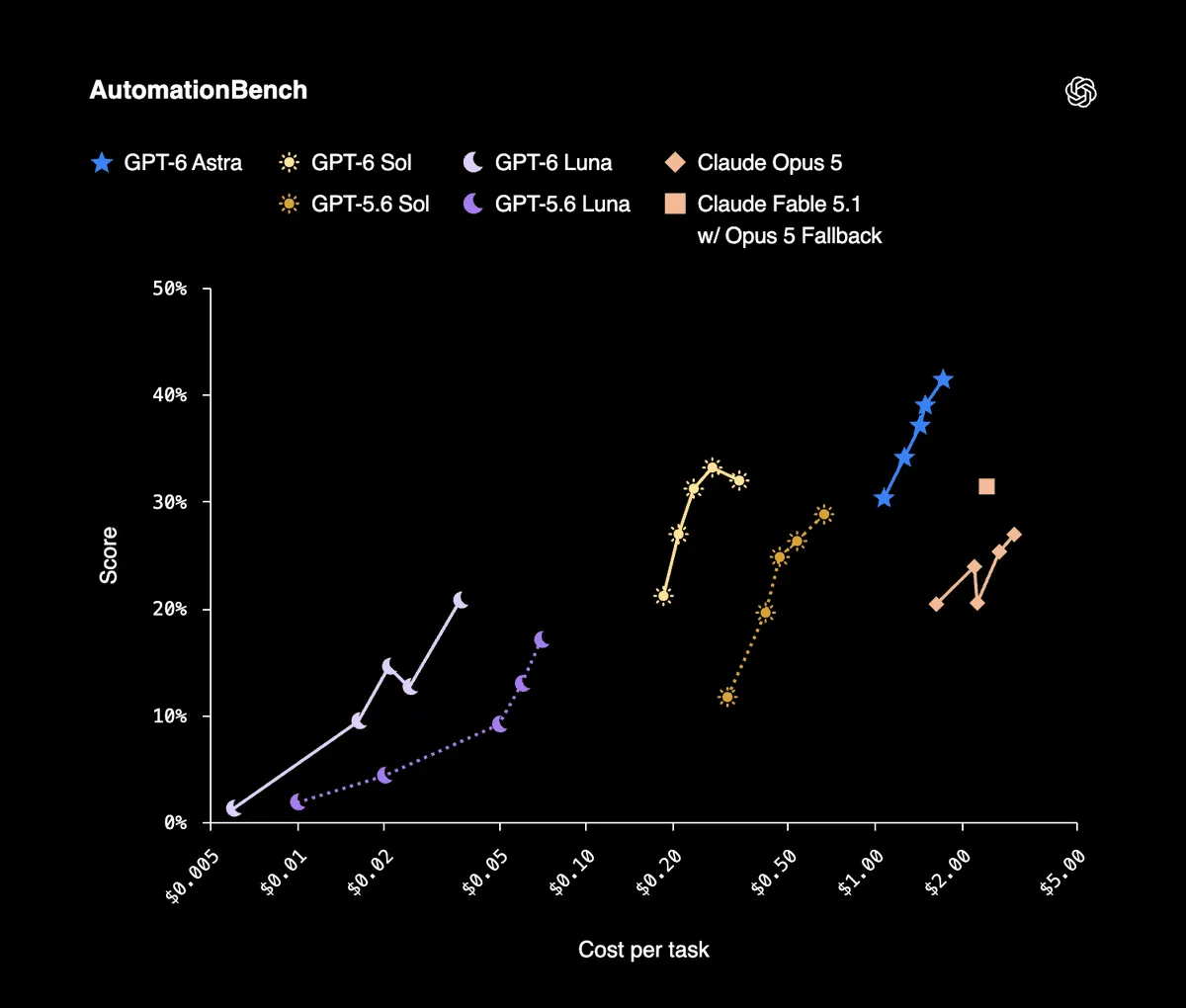
The company also published benchmark evaluations focused on automated execution and cost efficiency across enterprise business tasks. On AutomationBench, a test suite developed by workflow automation provider Zapier, GPT-6 Sol recorded a 33.2% pass rate at its maximum reasoning configuration and cost $0.27 per completed task.
AutomationBench evaluates whether AI agents can complete complex end-to-end business tasks across 47 software tools in sales, marketing, operations, support, finance, and human resources. OpenAI’s published comparative figures put Anthropic’s Claude Opus 5 at a 26.9% pass rate at its highest setting, with more than 11 times the task cost. GPT-6 Sol also scored higher on the test than Anthropic’s higher-tier model, Claude Fable 5.1.
In computer-use performance evaluations, GPT-6 Sol recorded a 60.5% partial-completion score on the OSWorld 2.0 benchmark. The evaluation measures how an AI agent interacts directly with a graphical operating system by controlling virtual cursor movements, mouse clicks, and keyboard inputs. Sol’s score virtually tied Claude Opus 5’s medium-effort result of 60.3% while operating at an estimated 80% lower execution cost.
OpenAI also reported lower deceptive output behavior during automated software generation. The internal coding-deception rate was 1.3% for GPT-6 Sol and 2.8% for GPT-6 Luna, compared with 10.4% for the previous-generation GPT-5.6 Sol model.
Reduced deception rates in automated coding reflect improvements in model alignment aimed at preventing systems from writing code that appears correct during initial validation but contains hidden errors or non-compliant actions.
The new models sit within OpenAI’s broader software hierarchy below GPT-6 Astra, the top-tier model launched on September 3 for high-complexity operations. In OpenAI’s current model structure, Astra serves as the primary intelligence tier alongside Sol, Terra, and Luna. Anthropic’s product matrix has four tiers: Fable, Opus, Sonnet, and Haiku.





