Crypto Hacks Hit $1.18B in Q3 2026 as Supply Chain Flaws Dominate
Supply chain compromises and unpatched vendor tools drove 77% of stolen funds, exposing critical gaps in standard smart contract audits.
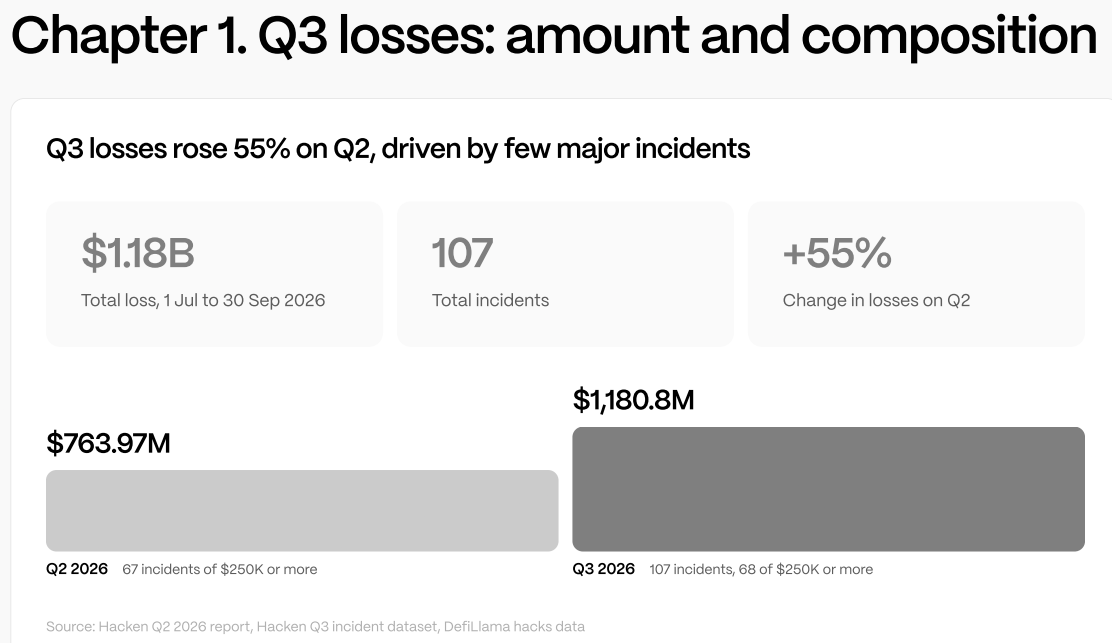
Third-party software vendors and developer tooling have become the primary entry point for cryptocurrency attackers, driving total thefts to $1.18 billion across 107 incidents during the third quarter of 2026. Data compiled by blockchain security firm Hacken reveals that compromised suppliers, unpatched known vulnerabilities and infrastructure components operating outside standard security audits accounted for roughly $906 million, or 77%, of all stolen assets between July and September.
The concentration of damage marks a structural shift in how digital asset platforms are breached. While smart contract exploits remained the most frequently attempted attack vector — triggering 71 separate incidents totaling $228 million — the financial devastation was overwhelmingly dictated by four major supply chain and infrastructure failures. Bitget lost $387 million, the Liquid Network suffered a $320 million exploit, decentralized lending protocol Tectonic was drained of $120 million, and a firmware vulnerability in Coldcard hardware wallets resulted in an estimated $115 million in losses. Those four events alone represented approximately 80% of the quarter’s total damages.
By contrast, the remaining 98 recorded incidents produced losses below $10 million each, dragging the median loss per hack down to $670,000. This extreme disparity illustrates that while retail-facing applications face constant probing, catastrophic capital flight is almost exclusively tied to trusted backend dependencies.


This reliance on external code libraries and vendor integrations mirrors broader cybersecurity crises seen in traditional technology sectors. The 2020 SolarWinds breach and the 2024 CrowdStrike outage both demonstrated how deeply embedded third-party updates can compromise entire networks simultaneously. In decentralized finance, where protocols routinely integrate external price oracles, cross-chain bridges and shared custody modules, a single compromised dependency can grant attackers access to multiple downstream platforms without ever touching their core codebase.
The industry’s response to these breaches increasingly relies on measures that challenge the foundational principles of blockchain immutability. When Tectonic was exploited, validators governing the Cronos network executed a controversial rollback, erasing 114 minutes of settled transaction history to reverse $111.2 million of the $120.4 million stolen. Such interventions effectively function as centralized circuit breakers, prioritizing user restitution over cryptographic finality.
Centralized stablecoin issuers exercised similar authority. Circle and Tether froze approximately $340,000 linked to the Bitget theft, leveraging their administrative control over USDC and USDT smart contracts to block attacker wallets. These freezes represent a fraction of the total but demonstrate how fiat-pegged tokens serve as choke points for illicit fund movement.
Financial containment extended well beyond on-chain reversals. Exchange operators absorbed massive hits directly from corporate treasuries to prevent customer insolvency. Bitget deployed its user protection fund to cover the entirety of its $387 million loss. Smaller platforms including Triple-A, Coinsbuy and TAC collectively repaid about $22 million out of pocket, ensuring users were made whole even though the underlying stolen assets remain with the attackers.
Combined with the $387 million returned or reversed through white-hat interventions — including $272 million voluntarily sent back following the Liquid Network exploit — roughly one-third of the gross losses were neutralized. However, approximately $384 million, representing 32% of the total, remains permanently unrecovered and uncovered by platform operators.
The $1.18 billion tally makes the third quarter of 2026 the most destructive period for crypto hacking since the first quarter of 2025, when state-sponsored actors linked to North Korea orchestrated the $1.4 billion Bybit exchange heist, pushing that quarter’s total losses to $1.6 billion. Unlike the Bybit incident, which relied heavily on social engineering and insider access, the Q3 2026 wave underscores a systemic failure in vetting the software supply chains that power modern crypto infrastructure.
Hacken’s analysis indicates that standard smart contract audits are no longer sufficient defensive measures. Security reviews must expand to encompass oracles, bridging architectures, multi-signature authorities and privileged administrative functions. As of mid-October 2026, the $384 million in unresolved losses continues to move through decentralized mixing services, complicating ongoing tracking efforts by Europol and other international law enforcement agencies.