Tinder Launches Group Hangouts Feature to Expand Beyond One-on-One Dating
Following strong engagement with double dates among users under 30, the Match Group-owned app now supports activity-based meetups for groups of three or more.
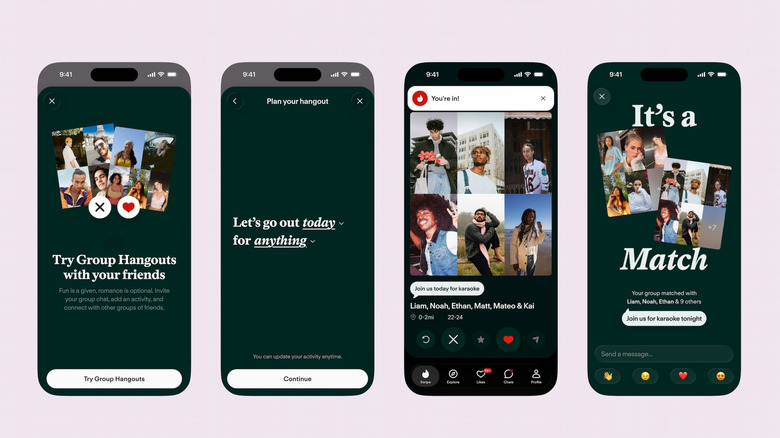
Tinder is rolling out a group hangouts feature in the United States and select international markets, allowing users to organize activity-based meetups with multiple people rather than relying exclusively on traditional one-on-one matching. The launch marks a structural shift for Match Group’s flagship dating app as it attempts to capture younger users who increasingly treat digital platforms as social discovery tools rather than strictly romantic ones.
The new capability builds directly on Tinder’s double date option, which debuted last year. Internal data from the company indicates that roughly 90 percent of users engaging with double dates are under 30. Matches formed through that format generated 35 percent more messages than standard pairings. Tinder interpreted the higher engagement volume as evidence that Gen Z and younger millennial users prefer lower-pressure environments where friends act as social buffers during initial interactions.
To test whether that preference scales beyond four people, Tinder ran early trials of group hangouts in Australia. According to the company, 40 percent of invitations sent during those tests were accepted. While acceptance rates for experimental features often run higher than long-term retention metrics, the Australian data provided enough signal for Tinder to authorize a wider release.


Setting up a group requires a user to create a team, select a specific activity as the focal point, and invite friends until the roster reaches at least three members. Once that threshold is met, the group profile enters a discovery pool visible to other trios, quartets, or larger clusters. When two groups match, the platform opens a shared group chat to coordinate logistics. Users retain the ability to exit a group or a specific hangout conversation at any time, with Tinder stating that its standard safety protocols remain active across the feature.
The pivot toward platonic-adjacent socializing reflects broader pressures across the online dating industry. Match Group reported declining paying subscribers across its portfolio throughout 2024 and 2025, prompting aggressive experimentation with non-dating use cases. Competitor Bumble introduced Bumble BFF years ago to facilitate same-sex friendships, while Hinge has leaned heavily into algorithmic compatibility to justify premium subscriptions. Tinder’s approach differs by keeping the mechanic rooted in collective, activity-driven gatherings rather than splitting the app into separate friendship and romance silos.
Activity-based matching also mirrors trends seen outside the traditional dating sector. Platforms like Meetup have long facilitated interest-based group gatherings, and newer apps such as Thursday built entire models around single-day, event-driven socializing. By integrating activities directly into the matching flow, Tinder is attempting to merge the scale of a global dating network with the localized utility of an event planner.
For users in supported regions, the group hangouts interface is accessible from the top of the application’s home screen. Tinder plans to expand availability to additional markets following the initial U.S. rollout.