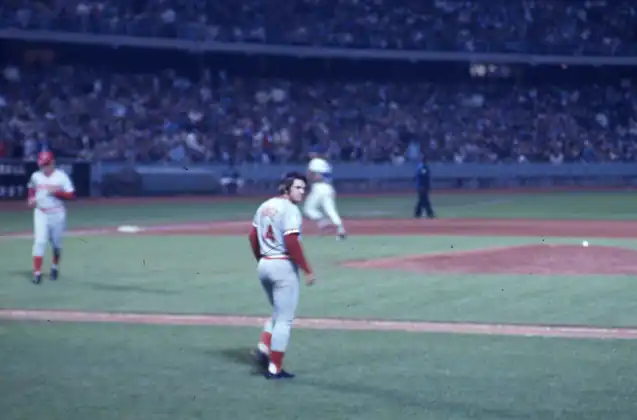
By Thursday evening, the Justice Department’s public list of President Donald Trump’s clemency grants carried no entry for Pete Rose. The list’s latest grant was dated October 13. Trump had announced the pardon hours earlier, at 4:11 p.m., in a post on Truth Social, calling it a “Complete and Total Pardon” for the late baseball star. The pardon, so far as the public record shows, exists as a post.
Rose pleaded guilty on April 20, 1990, to two counts of filing false federal income tax returns, admitting he had failed to report $354,968. Judge S. Arthur Spiegel sentenced him to five months in prison, a $50,000 fine and 1,000 hours of community service. He reported to the federal prison camp at Marion, Illinois, on August 10, 1990, and was released on January 7, 1991. He repaid the Internal Revenue Service $366,042. His probation at Talbert House ended that April. Spiegel had told him at sentencing that once he completed his sentence he “will have paid his debt to society.”
“He is dead. Not sure why this is a priority other than obfuscation. Release the Epstein files,” wrote u/Ok-Procedure348 on r/Reds, the Cincinnati supporters’ forum, hours after the post went up. The Pete Rose pardon forgives the tax sentence, and it is the only conviction a presidential pardon could reach. It was closed 35 years ago.

The lifetime ban that kept Rose out of baseball was never a court’s sentence. Rose agreed to permanent ineligibility in August 1989, after John Dowd’s investigation found he had bet on the Reds while playing for and managing them. A fan on the same thread asked what the pardon could actually touch. “The only thing he can be pardoned for is his tax evasion conviction correct?” wrote u/udee79. No presidential pardon can lift a punishment baseball imposed on itself, and the post says nothing about the ban. What lifted it was a decision by Commissioner Rob Manfred in May 2025, who ruled that permanent ineligibility ends at death because “a person no longer with us cannot represent a threat to the integrity of the game.”
“Today you’re allowed to gamble on games. How about that?” Trump said in October. Legal sports betting changed the law. It did not change Major League Rule 21, which still says any player or official who bets on a game he has a duty to perform “shall be declared permanently ineligible.” The rule draws no line between betting on your team to win and betting on it to lose. Rose bet on the Reds while he was playing for and managing them, which is the duty the rule names, and the text is still posted in every major-league clubhouse.
Trump called 4,256 hits a record “in a Season.” It is a career total. And the “40 years of hell” he cited on November 9 lasted 35 years, from the August 1989 ban to Rose’s death in September 2024.
Rose’s name has never appeared on a Hall of Fame ballot. Before it can, the Historical Overview Committee must put him on an eight-name ballot for the Classic Baseball Era Committee, which next meets at the Winter Meetings in December 2027. Sixteen members vote, weighing “record, ability, integrity, sportsmanship, character and contribution to the game.” Twelve votes are needed. A candidate who draws fewer than five votes does not come back on the next ballot.
A sworn statement filed in federal court in July 2017 says Rose began a sexual relationship with a woman identified only as Jane Doe before her 16th birthday. Rose acknowledged the relationship but said it began in 1975, when she was 16. He was never charged. The statute of limitations had expired. “For the tax evasion, the betting on baseball, or the statutory rape?” asked u/GoDores2005 on the same r/Reds thread. The committee’s rules list character among the things it weighs, without saying how.
“There will come a day when that dumb motherfucker gets into the hall, and I’m so glad he won’t be alive to see it,” wrote u/the_vole. Ten comments had appeared on the thread by the time it was read, and none of them welcomed the pardon.
In December 2015, Manfred rejected Rose’s application for reinstatement in a written decision, saying Rose had shown no “credible evidence of a reconfigured life” and had kept betting on sports, including baseball. The league also held a notebook of 1986 betting records kept by Rose’s associate Michael Bertolini, evidence Dowd never had. In May 2025, the same commissioner reversed the ban because Rose had died. Trump had promised the pardon in February 2025, saying he would sign it “over the next few weeks.” Twenty months passed. On November 9, asked about the pardon at the White House, he seemed unsure what Rose had been convicted of, asking why he would need one, and was told: tax charges.
The pardon names Rose alone. Shoeless Joe Jackson, reinstated alongside him, was not pardoned.