Brazil’s B3 Stock Exchange Registers First Tokenized Livestock Debt Secured by AI-Monitored Cattle
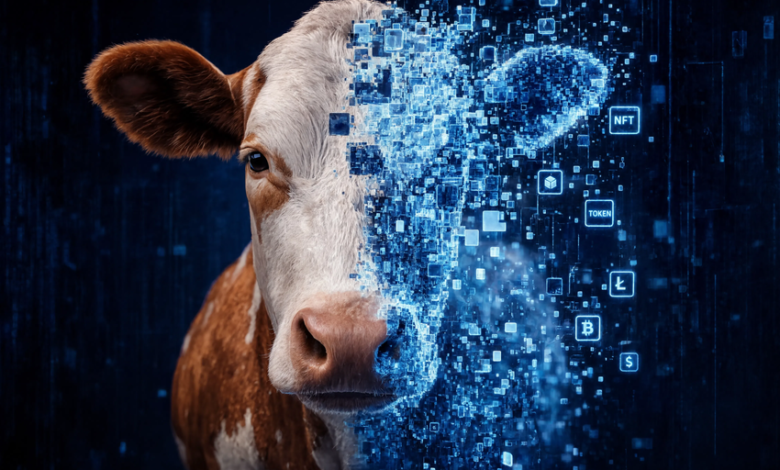
In a historic milestone for agricultural finance and digital asset tokenization, Brazil’s national stock exchange, B3, has officially registered its first credit facility collateralized by tokenized live cattle. The transaction, backed by ten high-value dairy cows wearing artificial intelligence-powered tracking collars at Fazenda Engenho Velho in Imbituva, Paraná, offers a blueprint for leveraging real-world asset tokenization to unlock liquidity during severe agricultural credit crunches.
The R$100,000 (approximately $19,420) financing was extended through a Cédula de Produto Rural Financeira (CPR-F)—a specialized financial rural product certificate—issued by central bank-authorized direct credit company BMP. To monetize the debt, credit fund Target FIDC acquired the underlying credit rights and formally registered the structured note on the B3 exchange. The total valuation of the ten cows serving as guarantee was assessed at R$120,000 ($23,310).
Rather than relying on traditional, time-consuming on-site farm appraisals, the credit structure relies on continuous biometric monitoring. Each cow is fitted with a smart sensor collar engineered by agricultural technology startup Cowmed. The collar captures real-time health, behavioral, and location metrics, converting these data points into a cryptographically hashed, unique digital identifier on a blockchain. This tamper-evident digital twin connects directly to the debt contract, providing continuous verification of animal vitality and location without physical site visits.
Historically, institutional lenders apply discounts as steep as 60% on livestock assets to mitigate risks associated with mortality, disease, or theft. Under conventional lending practices, a cow valued at R$20,000 paper value might yield only R$8,000 in acceptable collateral value. Continuous automated monitoring bridges this informational asymmetry, eliminating structural haircuts. Target FIDC director Humberto Brenner noted in remarks to Globo Rural that financial institutions are increasingly requiring verifiable, real-time collateral data to manage risk exposure.
The timing of this pilot deal comes as Brazilian farmers navigate a significant liquidity squeeze. According to credit research firm Serasa Experian, judicial recovery filings—Brazil’s legal equivalent of Chapter 11 bankruptcy protection governed by Federal Law No. 11,101—surged to 1,990 cases in 2025, up nearly fourfold from 534 cases recorded in 2023. Elevated benchmark interest rates, depressed international commodity prices, and localized extreme weather events have collectively choked off traditional bank financing channels across South America’s largest agricultural producer.
CPRs were originally created under Law No. 8,929 in 1994 and significantly modernized through the landmark Agro Law (Law No. 13,986) in 2020. This legislative evolution allowed financial institutions and capital market vehicles to issue digitized CPR-Fs registered with central depositories like B3, laying the legal foundation necessary to integrate decentralized ledger technology and smart contracts into traditional agribusiness debt securities.
Cowmed chief executive officer Thiago Martins explained to CNN Brazil that transforming tangible biological assets into monitored digital instruments enables farmers to secure credit at lower costs and higher borrowing ceilings. The move mirrors a broader global migration of real-world assets onto blockchain infrastructure. Across global decentralized finance platforms, total value locked in tokenized real-world assets—primarily U.S. Treasury bills and commercial real estate—has surpassed $10 billion as institutional investors seek yield backed by physical collateral.
Cowmed currently tracks roughly 100,000 animals across 1,200 agricultural operations in six countries, including Brazil, the United States, Canada, Uruguay, Paraguay, and Bolivia, representing a total herd valuation of R$2 billion ($395.4 million). Martins estimates that up to 20% of this monitored herd—valued at R$400 million ($77.6 million)—could be converted into tokenized credit guarantees over the next two years. Target FIDC is already assessing four additional Brazilian farming operations, targeting R$5 million ($971,000) in tokenized livestock loans by the end of 2026.