Galaxy Digital Secures 15-Year Naming Rights for Texas Tech Football Stadium in Landmark Crypto-Sports Deal
The 15-year deal renames the university's football stadium and establishes Galaxy as the official digital asset partner of Texas Tech Athletics.

In a major convergence of collegiate sports, high-performance computing, and digital assets, Galaxy Digital, a leading digital asset and AI infrastructure company, has signed a 15-year naming rights agreement with Texas Tech University. Under the terms of the expansive partnership, the university’s football stadium in Lubbock will be officially renamed Galaxy Stadium beginning with the 2026 season.
The long-term collaboration goes far beyond a simple branding exercise. The partnership also makes Galaxy the official data center and digital assets partner of Texas Tech Athletics, with the companies planning to collaborate on student-athlete name, image and likeness (NIL) opportunities, artificial intelligence initiatives and workforce development programs. This multi-layered integration highlights a growing trend of digital asset firms leveraging sports sponsorships to build local economic ties and foster technical talent pipelines directly from major academic institutions.
According to Friday’s announcement, the stadium will debut under its new name on Sept. 5, 2026, when Texas Tech opens its football season against Abilene Christian. While the financial terms of the agreement were not disclosed, a 15-year stadium naming rights deal at a major Power Four conference university represents a significant, multi-million dollar capital commitment.
Deepening Roots in West Texas
For Galaxy Digital, the partnership is a natural extension of its physical footprint in West Texas. The company already operates the Helios data center campus in nearby Dickens County, located about 60 miles east of Lubbock. Originally established as a dedicated Bitcoin mining facility, the site has evolved to meet the demands of the modern computing landscape, boasting 1.6 gigawatts of approved capacity for artificial intelligence and high-performance computing (HPC).
By aligning with Texas Tech, Galaxy is positioning itself to tap into the university’s engineering and computer science talent. The planned workforce development programs are designed to prepare students for careers in emerging technologies, addressing a critical talent shortage in the rapidly expanding fields of AI infrastructure management and digital asset custody.
Texas Strengthens Its Crypto Industry Footprint
The partnership comes as Texas strengthens its position as a hub for the crypto industry, combining major Bitcoin mining investment with growing political influence and pro-crypto legislation. The state’s unique, independent power grid (managed by ERCOT), abundant renewable energy resources, and business-friendly regulatory environment have made it the premier destination for energy-intensive digital infrastructure.
Texas is already home to some of the industry’s largest Bitcoin (BTC) miners and digital infrastructure operators, including Riot Platforms, Cipher Mining, Core Scientific, CleanSpark, IREN and Hut 8. The sector continues to see rapid consolidation and capital deployment. For instance, in February, Bitcoin mining hardware maker Canaan acquired a 49% stake in three operating Texas mining facilities from Cipher Mining for nearly $40 million. More recently, MARA Holdings announced plans to acquire a 2-gigawatt powered site in Texas to develop a digital infrastructure campus supporting both HPC and Bitcoin mining. This massive expansion of infrastructure has also buoyed related public companies; for example, Bitdeer stock jumps 14% as company expands US mining hardware production, demonstrating robust investor appetite for US-based digital asset infrastructure.
Beyond commercial expansion, Texas has become a focal point for crypto-backed political spending. In May, industry-affiliated political action committees (PACs) spent more than $10 million supporting candidates in Texas congressional primary runoffs, with all six backed candidates winning their respective races. This political push has translated into concrete policy support at the state level.
Last year, Gov. Greg Abbott signed legislation creating the Texas Strategic Bitcoin Reserve. The state has continued to mature its approach to holding sovereign digital assets; in May, state officials began transitioning the reserve’s holdings from a spot Bitcoin ETF to directly custodied bitcoin, signaling a commitment to long-term, self-sovereign digital asset management.
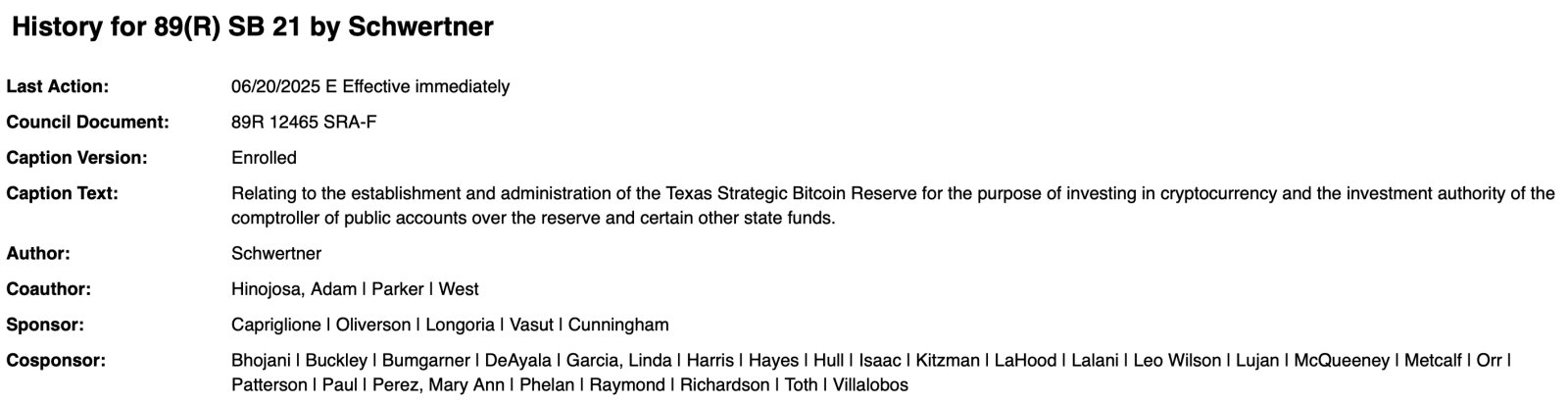
Texas Senate Bill 21 established the Texas Strategic Bitcoin Reserve. Source: Texas Legislature
By securing the naming rights to Galaxy Stadium, Galaxy Digital is not just buying a billboard in West Texas—it is anchoring itself to one of the state’s most culturally significant institutions. As the lines between high-performance computing, artificial intelligence, and digital assets continue to blur, such partnerships are likely to become the blueprint for how infrastructure giants establish local legitimacy and secure the talent needed to power the next generation of technology.