Bitcoin’s ‘Garden-Variety’ Downturn Signals Maturing Market Cycle
Real Vision analyst Jamie Coutts identifies slowing downside momentum as Bitcoin enters a "garden-variety" correction phase.
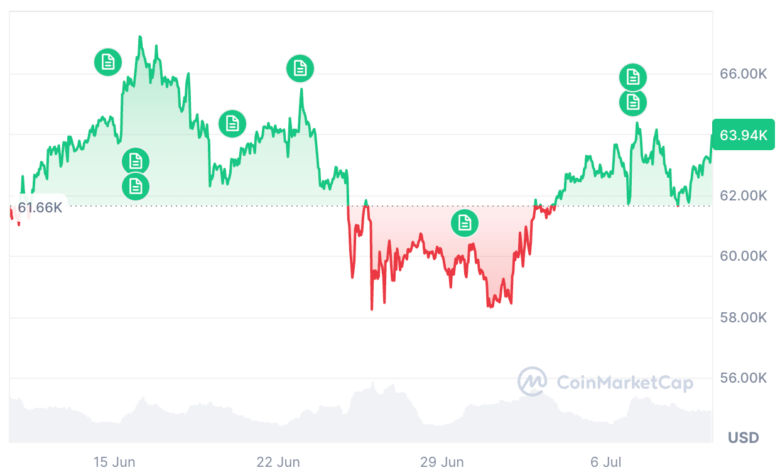
Bitcoin is currently navigating the “second half” of what analysts describe as a standard market correction, marked by a significant reduction in price swings compared to previous years. Jamie Coutts, chief crypto analyst at Real Vision, characterized the current environment as a “garden-variety bear market” during a recent discussion with Cointelegraph, suggesting that while the downturn persists, the most aggressive selling pressure may have already peaked.
The current price action sees Bitcoin trading near $63,000, a level representing a roughly 50% retracement from its October 2025 peak of $126,100. This drawdown is notable not just for its depth, but for its relative stability; Coutts observed that Bitcoin’s volatility has effectively halved relative to the prior market cycle. This compression in volatility often signals a maturing asset class, as the wild fluctuations that defined Bitcoin’s early years give way to more predictable, albeit currently bearish, trends.
Technical indicators are beginning to reflect this shift in momentum. Coutts pointed to a “bullish divergence” appearing on longer time frames, a signal that the acceleration of negative momentum is slowing down. While this does not equate to an immediate trend reversal, it suggests that the market is exhausting its downward energy.
The underlying causes of the recent slump extend beyond simple price speculation. While global liquidity conditions—often dictated by the monetary policy decisions of central banks—have tightened, Coutts also cited a deterioration in onchain fundamentals as a primary driver of the fourth-quarter decline.
Looking toward the next two to three years, Coutts maintains a price target between $200,000 and $250,000. This forecast is more conservative than the $1 million valuations proposed by figures like ARK Invest’s Cathie Wood. Coutts suggested that reaching the million-dollar mark is likely a function of future “money printing” and may not materialize until 2032 or 2033.
The long-term trajectory of the network faces structural hurdles beyond market liquidity. By 2027, the Bitcoin community may need to implement significant protocol changes to mitigate the risks posed by quantum computing. Coutts warned that developers who dismiss the potential for quantum advancements to compromise network security are on the “wrong side” of the issue.
Emerging technologies like artificial intelligence could also redefine Bitcoin’s utility. Coutts noted that the proliferation of AI agents—autonomous software entities—will require digital wallets to store value. Whether these agents will mirror human economic behavior or opt for Bitcoin as a primary reserve remains a critical unknown for the next decade.