
Bitcoin Plunges as Geopolitical Storm Ignites Market Fear, Forcing Analyst Reversal
Middle East Tensions Fuel Fear, Force Analyst Reversal
Bitcoin’s grip on the crucial $70,000 mark has shattered. A sharp market downturn now grips investors, pushing the premier cryptocurrency into a zone of extreme fear not seen for weeks.
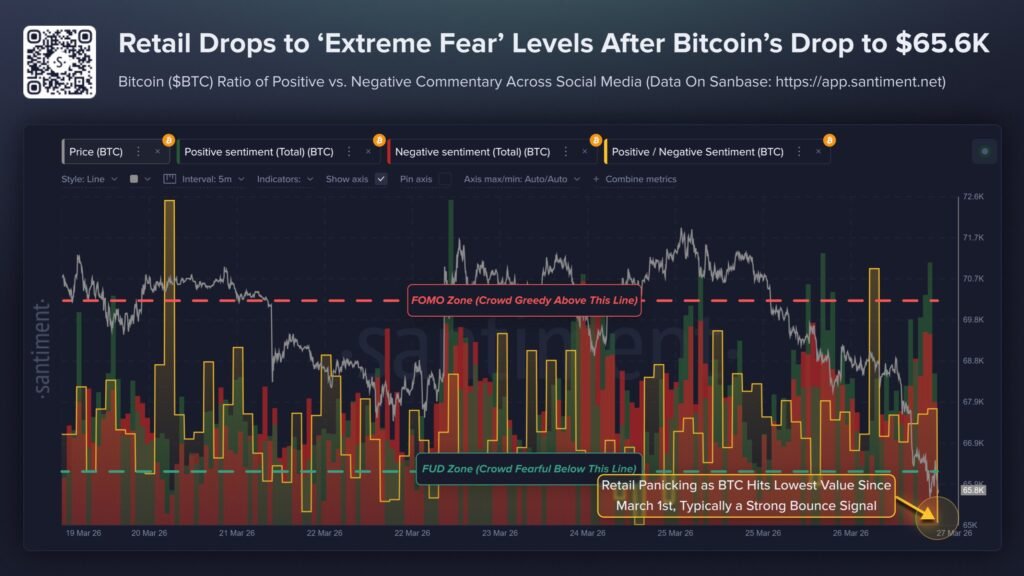
The digital asset experienced a precipitous drop on March 27, shedding 4% in 24 hours and a total of 5.6% over the past week. Its price plunged to $65,600, a level untouched since the first of March. Currently, Bitcoin hovers around $65,700, a stark contrast to its recent sideways movement near that psychologically significant threshold.
Investor sentiment has flipped dramatically. Optimism, prevalent just days ago, has given way to profound pessimism. Data from analytics firm Santiment reveals the market’s dive into an ‘extreme fear’ phase. This widespread apprehension, paradoxically, can be a necessary precursor to recovery. Markets often move against the majority’s expectations; widespread fear, or FUD (Fear, Uncertainty, and Doubt), frequently signals a potential bottom for a relief rally, tempting contrarian investors to ‘buy the dip.’
Santiment’s FUD Zone indicator, unlike traditional volatility metrics, taps into the collective psyche. It processes vast amounts of social media data from platforms like X, Reddit, and Telegram. Using natural language processing, it gauges the volume and weighted sentiment of conversations, discerning whether euphoria or capitulation dominates the narrative. Right now, it screams capitulation.
This market turbulence isn’t an isolated event. Escalating geopolitical tensions in the Middle East have provided a clear catalyst. Since late February, regional instability has intensified, directly impacting global energy markets. The Strait of Hormuz, a choke point for roughly 20% of the world’s oil and liquefied natural gas, faces renewed threats. Any disruption there sends ripples through global supply chains, not just energy prices, driving up insurance costs and broader economic uncertainty.
Oil prices have surged past $100 a barrel. The strategic importance of the Strait became starkly clear on March 26, when three container ships reportedly turned back after direct warnings from Iran. Simultaneously, reports suggest the White House and Pentagon are weighing the deployment of 10,000 additional troops to the region. Such military considerations underscore the gravity of the situation.
Even seasoned analysts are recalibrating. Michaël van de Poppe, a prominent voice, recently abandoned his bullish thesis. His previous outlook had anchored on historical correction floors. Now, the macro-economic landscape paints a different picture. A stronger oil market typically fuels dollar appreciation and upward pressure on interest rates – a traditional safe haven response. This environment, he argues, offers no fundamental reason for Bitcoin, still largely seen as a risk asset, to outperform.
The confluence of geopolitical unrest, soaring energy costs, and a robust US dollar creates a hostile environment for Bitcoin and the broader cryptocurrency market. Hopes for an immediate bullish continuation have evaporated, leaving investors to ponder the path forward amidst global uncertainty. The question remains: can Bitcoin truly decouple from traditional financial market anxieties and act as ‘digital gold,’ or is it destined to echo them? The current price action suggests the latter.