AI-Built Office Clones Target Microsoft 365 Subscriptions
Written in Rust using Anthropic's Claude, the apps replicate most Microsoft 365 features but remain in alpha testing.
A single developer working with Anthropic’s Claude has released open-source alternatives to Microsoft Word, Excel and PowerPoint that run entirely offline, directly challenging the $99.99 annual subscription model that dominates enterprise and consumer productivity software.
Brandon Thomas published WordCraft, GridCraft and DeckCraft on GitHub under MIT and Apache 2.0 licenses, permitting unrestricted commercial reuse. Written in Rust, a systems programming language engineered to prevent memory-safety vulnerabilities, the applications share one codebase that compiles natively for Windows, macOS, Linux and BSD while also executing inside web browsers.


The release arrives less than two weeks after Thomas shipped ArtCraft, a similar suite mirroring Adobe Photoshop, Illustrator, Premiere and Lightroom. That project emerged after he encountered recurring cancellation fees from Adobe. While ArtCraft targeted creative professionals, the new suite aims at the broader productivity market anchored by Microsoft 365 Personal at $99.99 annually and the Family plan at $129.99.
Thomas describes the effort as a clean-room rebuild. Rather than inspecting or copying proprietary source code, development relied on publicly documented file-format specifications and behavioral observation of the original programs. This mirrors the legal strategy Compaq Computer used in the early 1980s to reverse-engineer IBM’s PC BIOS without triggering copyright infringement claims, a precedent that reshaped the personal computing industry by enabling hardware clones.
GridCraft currently supports 513 of the 523 worksheet functions found in Excel, including standard formulas like SUM and VLOOKUP, alongside 89% of the ribbon interface commands. Despite this mathematical coverage, the development team assesses the application as roughly 50% ready for production use. Compatibility testing against complex, real-world .xlsx files remains unfinished, meaning heavily formatted corporate spreadsheets may still render incorrectly or fail to calculate properly.
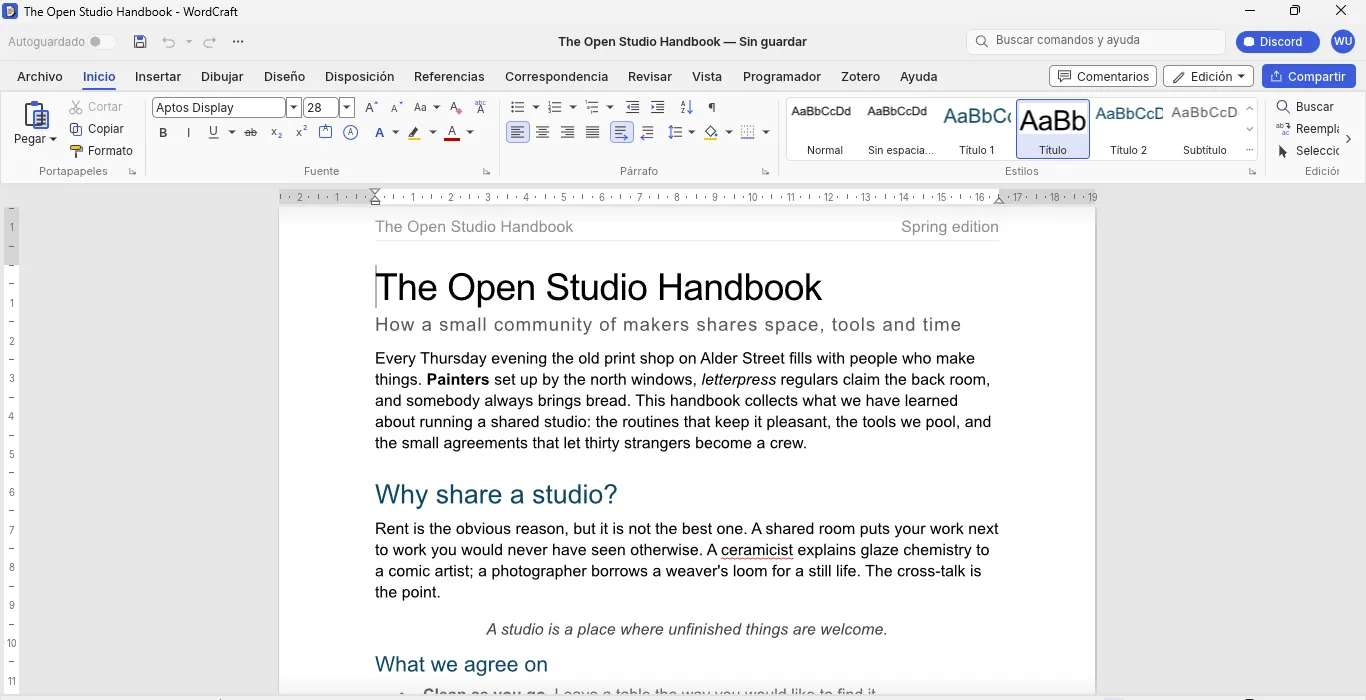
WordCraft reads and writes .docx files and replicates 88% of the features accessible through the traditional ribbon menu. Advanced document management tools such as track changes, footnotes, citations and mail merge are already functional. The developers rate it approximately 60% complete for daily professional tasks. At just 91 megabytes, the alpha-stage application launches quickly and visually mimics the familiar Microsoft layout closely enough to minimize retraining friction for heavy users.
DeckCraft lags slightly behind its counterparts. It covers about 79% of PowerPoint’s overall feature set and 93% of core presentation capabilities, handling .pptx files, transitions, animations and PDF exports. However, it has not yet reached an initial alpha milestone.
Free office suites have existed since Sun Microsystems open-sourced StarOffice as OpenOffice.org in October 2000, followed by the LibreOffice fork in 2010. Those projects required decades of sustained labor from global volunteer communities. Thomas produced three functional equivalents in days by leveraging large language models. He utilized Claude Opus 5.5, which launched September 22 priced at $4 per million input tokens and $20 per million output tokens. On Terminal-Bench 4.0, an evaluation measuring an AI agent’s ability to complete complex professional command-line tasks, Opus 5.5 scored 66.4%.
Beyond manual editing, all three applications expose every interface button as a triggerable command for autonomous AI agents via the Model Context Protocol (MCP). Created by Anthropic, MCP provides a standardized method for language models to execute multi-step actions within external software. A user could instruct an AI model to generate a chart inside GridCraft or reformat a report in WordCraft without manual mouse navigation, integrating productivity tools directly into automated agentic workflows.
Rapid AI-assisted development does carry execution risks. Thomas previously pledged to match Adobe’s entire feature set within a month before walking back the timeline. The current roadmap for WordCraft lists several prerequisites before a beta release: extensive testing against real-world documents containing charts and SmartArt graphics that must survive save cycles, page layout rendering closer to native Word behavior, comprehensive stability sweeps and native printing support.
Developer interest suggests strong market demand for viable alternatives. As of Wednesday, WordCraft had accumulated more than 12,000 stars on GitHub.