Ethernet Cables Carry Power, Video and Audio Beyond Networking
From delivering 90 watts via PoE to extending HDMI signals across buildings, standard category cabling serves critical roles outside traditional networking.
Power over Ethernet has quietly become the backbone of modern building infrastructure, transforming standard category cables from simple data conduits into dual-purpose lines that deliver electricity alongside network traffic. While consumers primarily associate Ethernet with internet connectivity, the underlying copper wiring inside Cat5e, Cat6 and Cat6a cables routinely handles professional audio distribution, long-range video transmission and direct current power delivery.
The most commercially significant departure from traditional networking is PoE. Ratified by the Institute of Electrical and Electronics Engineers under standards like 802.3af, 802.3at and 802.3bt, PoE allows a single twisted-pair cable to supply up to 90 watts of direct current. This capability eliminated the need for dedicated electrical outlets near ceiling-mounted Wi-Fi access points, outdoor security cameras and VoIP desk phones. A compatible network switch or a midspan injector pushes low-voltage electricity through the same copper pairs transmitting data packets. For commercial real estate and enterprise IT deployments, PoE drastically reduces installation costs by allowing low-voltage cabling contractors to run lines without licensed electricians.
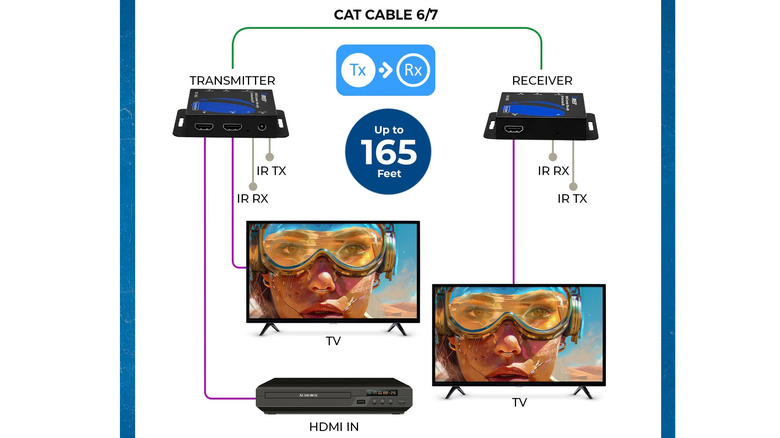
Video distribution presents a different technical reality. Standard HDMI cables suffer severe signal degradation beyond 15 to 25 feet, making them impractical for routing high-definition feeds across large venues or between distant rooms. HDMI extenders solve this by converting the digital video signal so it can travel over existing in-wall category cabling. A transmitter sits at the source device, while a receiver connects to the display, using the Ethernet cable purely as a physical bridge rather than a networked connection. This point-to-point method differs fundamentally from AV over IP, which packetizes audio and video streams and routes them through managed network switches using standard TCP/IP protocols.


Relying on category cables for video comes with strict bandwidth limitations. Many affordable HDMI extenders max out at 1080p or 4K at 30Hz. High-end applications demanding uncompressed 4K resolution at 120Hz or 8K video typically require active optical HDMI cables or fiber-optic AV extenders, as standard copper category cables lack the raw throughput for those formats over distance.
Audio engineers leverage the same physical properties for analog signal routing. A single eight-conductor Cat6 cable contains four twisted pairs. With balun adapters, each pair can carry an independent channel of balanced analog audio. Recording studios and live sound venues use this technique to replace bulky multi-channel snake cables, routing multiple microphone feeds through walls using a single, thin category cable. When microphones require phantom power — the 48-volt DC current used to operate condenser microphones — shielded category cable becomes necessary to prevent electromagnetic interference from degrading the sensitive audio signal.
Despite these capabilities, repurposing network cabling requires verifying the specific wire gauge and twist rate. Older Cat5 cables lack the tighter twists and thicker copper found in Cat6, resulting in higher resistance that limits both PoE wattage delivery and signal clarity over long runs. The Telecommunications Industry Association recommends Cat6 or higher for any new installation intended to support modern PoE devices or high-bandwidth AV extension.
The IEEE finalized the 802.3bt standard in 2018, expanding PoE delivery to 90 watts per port and enabling the technology to power larger hardware such as pan-tilt-zoom security cameras, digital signage displays and smart LED lighting arrays directly through network infrastructure.