
Xi’s India return tests limits of strategic hedging as trade surges past $155 billion
Xi’s first India visit since 2019 coincides with record trade, $100 billion deficit, and unresolved digital bans
Chinese leader Xi Jinping is expected to visit New Delhi this weekend for the Brics summit, his first trip to India since October 2019 when he attended the second informal summit with Prime Minister Narendra Modi in the coastal town of Mamallapuram, Tamil Nadu. That era of “Chennai Connect” optics collapsed months later during the Galwan Valley confrontation.
At least 20 Indian soldiers and an unknown number of Chinese troops were killed in the 2020 clashes along the Line of Actual Control in the Galwan Valley in eastern Ladakh. Dozens more were injured. The four-year military standoff that followed required more than 20 rounds of military-diplomatic talks before disengagement pacts at Depsang and Demchok were finalized.
The two countries in 2024 agreed to resume patrols of their 3,500km border, which had been suspended after the clashes. They also resumed direct flights last year for the first time since 2020, and this year reopened border trade at three Himalayan crossings and jointly organised a Hindu and Buddhist pilgrimage to sacred sites in Tibet.


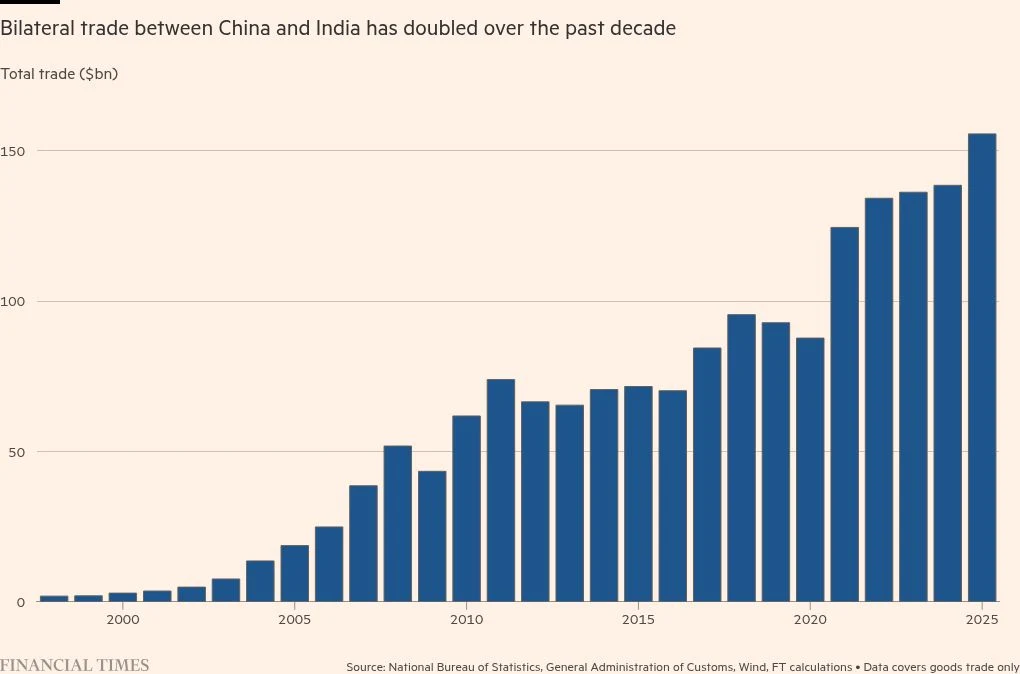
Bilateral trade between China and India last year rose 12.4 per cent to a record $155bn, more than double the $71.6bn reported 10 years earlier, according to Chinese customs data. In the first seven months of this year, bilateral trade jumped a further 23 per cent compared with the same period a year ago. India’s trade deficit with China accounts for nearly two-thirds of that total, exceeding $100 billion.
New Delhi continues to enforce its 2020 bans on over 300 Chinese mobile applications, including TikTok, WeChat, and UC Browser, which remain a major unresolved friction point for Beijing. In India, there is still resistance towards Chinese participation in sensitive sectors, including IT.

Investment flows are also picking up. Over the past 18 months, Chinese companies in the technology and energy sectors have increasingly scoped opportunities in India, including cleantech developer Envision, Geely-backed engine supplier Horse Powertrain and battery maker CosMX. In March, Modi’s administration moved to relax screening of Chinese investments in solar energy and electronics sectors. A tentative change in foreign investment rules means that Chinese companies will gain automatic clearance for non-controlling stakes of up to 10 per cent in Indian entities.
Beijing, meanwhile, remains wary of India becoming an alternative for export manufacturing as the country is not pivoting away from its efforts to strengthen domestic manufacturing to compete with China, for example by wooing Apple to make iPhones and designing and producing semiconductors domestically. Despite Beijing having agreed to address New Delhi’s requests during Chinese foreign minister Wang Yi’s visit a year ago, Indian companies still struggled to secure Chinese licences that allowed shipments of rare earth magnets and industrial machinery, said diplomats familiar with the matter.
The détente has also coincided with the tumultuous foreign policy of US President Donald Trump’s second presidency, which has frayed America’s relations, particularly with India, which was pursuing a closer relationship with Washington. India’s active membership in the Quadrilateral Security Dialogue alongside the US, Japan, and Australia remains New Delhi’s core maritime and security counterweight against Chinese influence in the Indo-Pacific.
Beijing appears hopeful that India can be pulled further from American influence while also offering China’s slowing economy a large potential market for its companies. Yun Sun, director of the China Program at the Stimson Center, a think-tank in Washington, said that China saw India as being in a period of adjustment because of Trump’s policies, so the outreach and measures to improve ties were geared towards pulling New Delhi closer. “China wants to shape India’s strategic choice. It wants an India that does not see China as a threat. It also wants India to not side with the US by default because of China,” she said.
In an op-ed published by Chinese state media after the latest India-China talks in Beijing, Ding Gang, a People’s Daily commentator, said both sides had “recognised that US influence shaped their relationship, a constant, unspoken presence” but argued that this was changing. “The shadow of the US that lingered so palpably in that dialogue years ago is now growing fainter — not because of diplomatic efforts on either side, but because of a deeper adjustment now under way in the international order itself,” he said.
Led by officials including Wang Yi and Modi advisers including top security official Ajit Doval and foreign minister S Jaishankar, both sides have been slowly warming to one other. This year, top trade negotiators held their first bilateral meeting since 2019. Soon after, New Delhi authorised two large state-owned companies to procure critical components from China, lifting restrictions imposed in 2020.
“The structural differences and strategic trust deficit in bilateral relations are significant, so multilateral forums such as Brics provide a platform to manage these challenges,” said Praveen Donthi, senior analyst with Crisis Group. Donthi called this “a cautious re-engagement”, bringing them back to a “regional rivalry dressed up as competition and co-operation” dating back decades.
“A thaw in the relationship has begun, but once you start distrusting a nation . . . it takes a long time to set things right,” said Amitabh Kant, India’s former G20 emissary. “That setting things right is happening now because Prime Minister Modi has spent a lot of political capital on China.” Brian Wong, a fellow at the University of Hong Kong’s Centre on Contemporary China and the World, said there have certainly been “clear and positive signs”.
Sanchari Ghosh, an Indian foreign policy expert writing for the Lowy Institute think-tank, argued that the 2020 clashes fundamentally changed New Delhi’s view of China. “India appears to be embracing a form of competitive coexistence,” Ghosh said, “accepting China as a long-term rival while maintaining enough engagement to prevent competition from hardening into perpetual confrontation.”