

Financial advisers across the world’s largest economies are increasingly out of step with their most affluent clients on digital assets, a widening gap that is leaving wealth management firms exposed to missed revenue and outdated portfolio strategies.
A CoinShares survey of 2,230 investors holding at least $500,000 in investable assets found that a majority now own cryptocurrency across the United States, United Kingdom, France, Germany, Italy, Sweden and Switzerland. Digital asset ownership reached roughly 70% among respondents in the U.S., U.K., Germany and Switzerland, while Sweden recorded the lowest penetration at 54%. On average, these investors dedicate about 10% of their portfolios to crypto.
The data points to a structural shift in how high-net-worth individuals view digital assets. Rather than treating cryptocurrency as a speculative vehicle, respondents cited long-term appreciation and portfolio diversification as their primary motivations. Only 6% identified primarily as short-term traders. Bitcoin remains the dominant holding, owned by 80% of surveyed crypto investors, though 89% of those holders also maintain positions in other tokens. Nearly four in five respondents believe Bitcoin will play a significant role in the future global financial system.


This conviction has proven resilient against market volatility. During the February 2026 crypto sell-off, more investors across all seven countries reported that the downturn made them more likely to buy digital assets rather than less likely. At least 85% of current crypto holders in five of the surveyed nations plan to increase their exposure this year, a figure that climbs to 91% in the U.S., U.K. and Germany.
Younger affluent investors are driving much of this momentum. In all seven countries, younger cohorts allocated more capital to digital assets than older investors, and in four of those markets, they held roughly twice as much.
Yet traditional wealth management infrastructure has not kept pace with client demand. Approximately 40% of respondents working with financial advisers in Switzerland, France, the U.S. and Germany described their advisers as overly cautious regarding digital assets. Ric Edelman, founder of the Digital Assets Council of Financial Professionals and Edelman Financial Engines, attributes this friction to institutional barriers rather than individual reluctance. Many advisory firms still prohibit employees from discussing cryptocurrency or offering related investments, meaning advisers frequently lack visibility into which clients already hold digital assets.
That blind spot carries direct business consequences. Advisers who cannot see a client’s crypto holdings are unable to offer tax-loss harvesting, estate planning integration, or philanthropic structuring around those assets—services that form the core of modern wealth management revenue.
Edelman disputes the survey’s finding that affluent investors allocate an average of 10% to crypto, arguing his own research indicates 2% to 5% is far more typical today. Regardless of the current baseline, he recommends significantly higher exposures based on risk tolerance: 10% for conservative portfolios, 25% for moderate ones, and up to 40% for aggressive allocations.
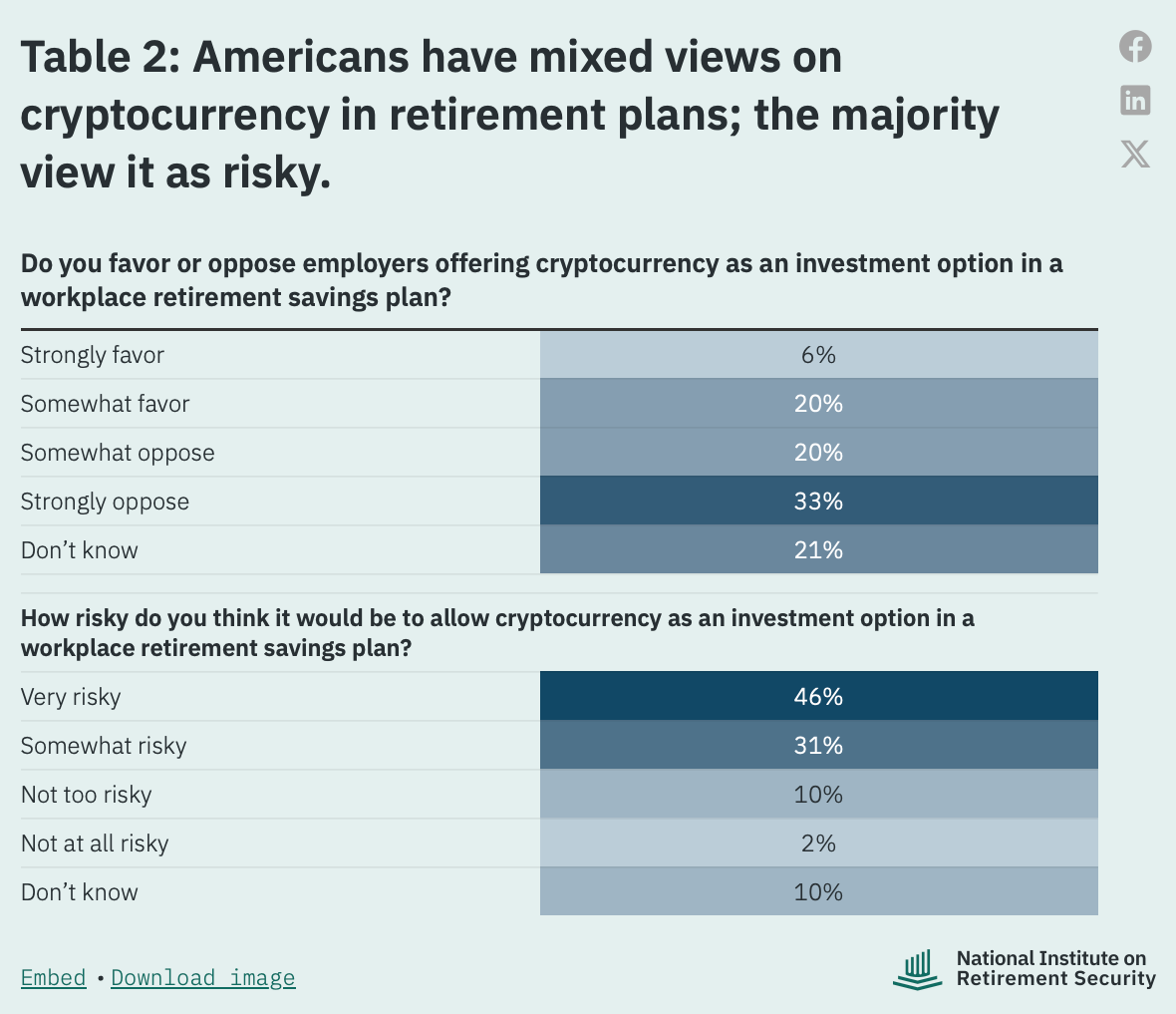
Such recommendations clash sharply with broader public sentiment, particularly regarding retirement accounts. The regulatory environment in the U.S. remains highly restrictive; the Employee Retirement Income Security Act (ERISA) imposes strict fiduciary duties on workplace retirement plans, making plan sponsors deeply hesitant to include volatile assets. An August survey by the National Institute on Retirement Security underscored this caution, finding that 77% of Americans consider cryptocurrency in workplace retirement plans risky, including 46% who view it as very risky.
Despite the divide between retail retirement sentiment and wealthy investor behavior, regulatory frameworks are slowly adapting. Seventy-nine percent of the surveyed affluent investors support increased regulation of digital asset markets, signaling a preference for institutional guardrails over the unregulated environment that characterized early crypto adoption. In the U.S., the Securities and Exchange Commission’s approval of spot Bitcoin exchange-traded funds in early 2024 and subsequent Ether ETFs provided the first major compliant on-ramps for registered investment advisers, though firm-level compliance policies have been slow to follow the SEC’s lead.
Major wirehouses and independent broker-dealers continue to update their approved product lists throughout 2026, gradually allowing advisers to recommend regulated crypto-linked products even as direct token ownership remains largely confined to self-directed accounts.



