

Meta adds AI training opt-out for Ray-Ban smart glasses as contractors may review images
Users must change the setting for each pair, and turning it off disables visual reminders.
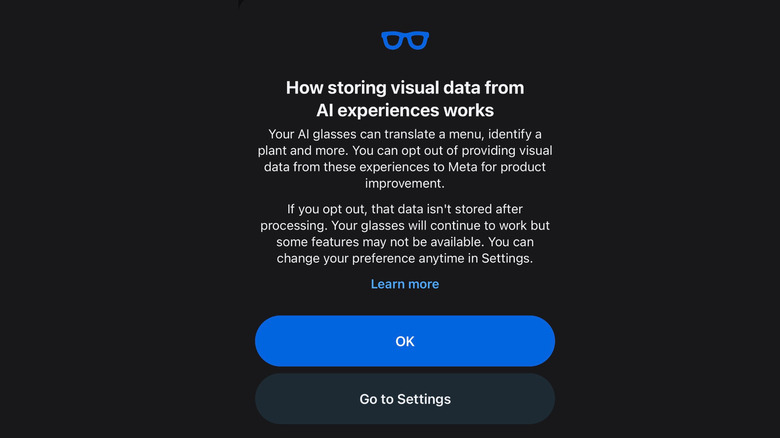
Meta Platforms Inc. has introduced a setting that lets Ray-Ban Meta smart glasses users stop the company from storing and using visual data from interactive AI sessions to train its artificial intelligence models. The change comes with updated documentation stating that human contractors may review photos and video frames captured during those sessions.
The setting is in the Meta AI mobile app, but it must be configured separately for each pair of glasses. Users need to take the glasses out of their charging case, connect them to the phone over Bluetooth and Wi-Fi, then open the hardware settings and switch off “store visual data from AI experiences” in the “Meta AI” section.



Under Meta’s updated Help Center documentation, visual data is transmitted to company servers when users ask Meta AI to interact with their surroundings—for example, by scanning a printed menu, translating a sign or identifying an object. The media can be used to train machine learning models through automated software pipelines and manual human review.
That data is treated differently from ordinary photos and videos. Recordings made when the glasses’ physical LED indicator is illuminated are saved on the device or synchronized with the companion smartphone app. Images generated by real-time AI requests, such as asking Meta AI to analyze an object in view, go to cloud infrastructure and are retained for model training unless the user opts out.
Meta says visual data sent to its servers to fulfil a request is deleted immediately after processing when storage is switched off, rather than kept in persistent training logs. The change also limits features that depend on information being available across sessions. The company warns users that “visual reminders”—which lets them look at an item and ask Meta AI to set a future alert based on what it sees—requires stored image logs and is disabled when retention is off.
The second-generation Ray-Ban Meta glasses, developed with eyewear manufacturer EssilorLuxottica, launched in October 2023 with a Qualcomm Snapdragon AR1 Gen 1 processor and an ultra-wide 12-megapixel camera sensor. In early 2024, Meta added multimodal AI features that let the glasses assess visual context and deliver audio responses through open-ear speakers.
The disclosure of human review echoes scrutiny of voice assistants. In 2019, Google, Apple, Amazon and Microsoft faced regulatory and public scrutiny after reports that third-party contractors systematically evaluated recordings to help calibrate speech-recognition algorithms. The reviews prompted major hardware vendors to add explicit opt-out mechanisms and update disclosures about consumer data handling.
Technology companies’ collection and annotation of real-world data for generative AI training has drawn broader industry scrutiny, while smart glasses raise particular privacy concerns because they are worn at eye level and may capture surrounding scenes during everyday use.
Meta has also faced regulatory oversight of AI data practices in international markets. In mid-2024, after intervention by Ireland’s Data Protection Commission over compliance with the General Data Protection Regulation, the company adjusted plans to train its Llama family of large language models on public European user data. The smart-glasses opt-out controls are designed to meet regulatory demands for clear user consent on biometric and visual data processing.





2 Comments